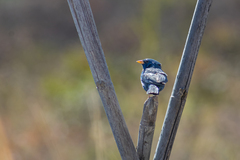
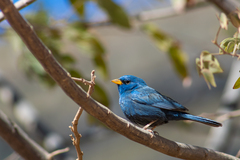
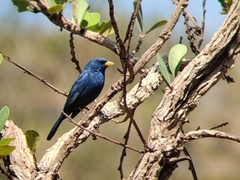
Blue Finch

Blue Finch

Porphyrospiza caerulescens

Silhouette: Manabu Sakamoto · PhyloPic

LCNTNear ThreatenedVUENCR
Daily sighting probability ~10% · With luck
at Chapada Diamantina National Park

In 3 days ~40% in a week ~60%

96 Verified sightings at Chapada Diamantina National Park From 2019 to 2026
212 In all 3 parks
November Best month
☀️ Diurnal When it's spotted

About the Blue Finch

The blue finch or yellow-billed blue finch (Rhopospina caerulescens) is a Near Threatened species of bird in the family Thraupidae, the tanagers and allies. It is found in Bolivia and Brazil. The blue finch was formally described in 1830 with the binomial Tanagra caerulescens. It was later reassigned to the genus Porphyrospiza. That genus was long in family Emberizidae which at the time held many New and Old World species. There it was grouped with the cardinalines which were later separated as the family Cardinalidae. A study published in 2007 showed that the genus belonged in its present tanager family Thraupidae. Beginning in 2019 most taxonomic systems began reassigning the blue finch to the resurrected genus Rhopospina that had been erected in 1851. However, as of late 2025 BirdLife International's Handbook of the Birds of the World retains it as the only species in Porphyrospiza.

The blue finch is monotypic. The blue finch is about 12.5 cm (4.9 in) long and weighs about 13 g (0.46 oz). It is a slim bird with a long tail and a long bill. The species is sexually dimorphic. Adult males are almost entirely bright indigo-blue. They have... Wikipedia →

Sounds

Song0:34

Bolivia · 2020

© Jacob Wijpkema · XC604123 · CC BY-NC-SA 4.0

Canto0:20

Brazil · 2020

© Caio Brito · XC556524 · CC BY-NC-SA 4.0

Call0:25

Brazil · 2009

© Nick Athanas · XC38079 · CC BY-NC-SA 3.0

Global Distribution

Parks Where Found

# Park Country Daily sighting probability
1 Serra da Canastra National Park 🇧🇷 Brazil
~20%
2 Chapada Diamantina National Park 🇧🇷 Brazil
~10%
3 Chapada dos Guimarães National Park 🇧🇷 Brazil
<5%

Before you go

What are the chances of seeing a Blue Finch in Chapada Diamantina National Park?

With luck

About 10% of wildlife watchers report a Blue Finch sighting in Chapada Diamantina National Park on a given day, based on 96 verified sightings from GBIF citizen-science data from 2019 to 2026. It is the 99th most-seen of the 271 birds we can rate there. Over three days the chance rises to about 40%, and over a week to about 60%, if each day is a fresh chance.

When is the best time to see a Blue Finch in Chapada Diamantina National Park?

June–July and November–December

In those months about 20% of wildlife watchers report a Blue Finch in Chapada Diamantina National Park on a given day, against about 10% in January–May and August–October, the lowest months.

What time of day is best to see a Blue Finch?

Between 7 and 10 am

Across all the parks we cover, that three-hour window holds the most Blue Finch sightings with a recorded time, and about 9 in 10 of them come between 6 am and 6 pm: it is a daytime animal.

Is Chapada Diamantina National Park the best place to see a Blue Finch?

2nd of 3

Of the 3 parks where we can rate Blue Finch sightings, Chapada Diamantina National Park ranks 2nd at about 10%. The best odds are in Serra da Canastra National Park (Brazil, about 20%).

Which relatives of the Blue Finch live in Chapada Diamantina National Park?

Same family: Thraupidae

The closest relatives of the Blue Finch that you can see in Chapada Diamantina National Park (family Thraupidae, Tanagers and Allies) are Bananaquit (about 60%), Blue Dacnis (about 50%) and Red-cowled Cardinal (about 50%), with each one's daily chance of a sighting.

Where does the Blue Finch sighting chance come from?

GBIF citizen-science records

It is estimated from how often the Blue Finch is recorded against all the birds logged in Chapada Diamantina National Park (96 verified sightings from 2019 to 2026), calibrated against known sighting rates. Figures are rounded to the nearest 10% because citizen-science data supports honest approximations, not decimals, and months with records from fewer than five people show "—". How it works.

← Back to Chapada Diamantina National Park