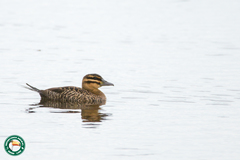
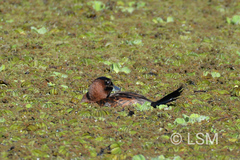
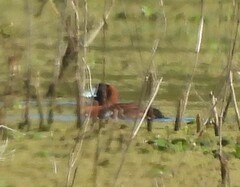
Masked Duck

Masked Duck

Nomonyx dominicus

Silhouette: Sheatherius · PhyloPic

LCLeast ConcernNTVUENCR
Daily sighting probability <5% · Rare
at Chapada Diamantina National Park

In 3 days <5% in a week ~10%

8 Verified sightings at Chapada Diamantina National Park From 2019 to 2026
61 In all 4 parks
November Best month
☀️ Diurnal When it's spotted

About the Masked Duck

The masked duck (Nomonyx dominicus) is a tiny stiff-tailed duck ranging through the tropical Americas. The only member of the genus Nomonyx, it is intermediate between the rather primitive black-headed duck (Heteronetta) and the very apomorphic true stiff-tailed ducks. It is sometimes included with the latter in the genus Oxyura, but the masked ducks are now considered the descendants of a missing link in the Oxyurini evolution, having changed little for millions of years.

They are found from southern Texas and Mexico to South America and also in the Caribbean. Primarily not migratory, masked ducks are reported as very uncommon vagrants in the southernmost United States, along the Mexican border and in Florida. As of 2000, the conservation status for masked ducks in Texas is 3,800 birds. On April 1, 1962, it was recorded from Lowndes County, Georgia, where it was photographed by Alexander Wetmore. Masked ducks breed in any freshwater body with marsh vegetation and surrounded by heavy tree cover. They also occur in mangrove swamps.

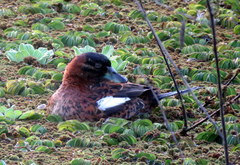
Breeding adult males have a rust-colored body with a black face and mottled wings. Adult... Wikipedia →

Sounds

Song0:18

Brazil · 2022

© Fernando Igor de Godoy · XC770310 · CC BY-NC-SA 4.0

Call0:04

Brazil · 2022

© JAYRSON ARAUJO DE OLIVEIRA · XC737380 · CC BY-NC-SA 4.0

Alarm call0:11

Brazil · 2019

© NUNES D&#039;ACOSTA · XC513795 · CC BY-NC-SA 4.0

Global Distribution

Parks Where Found

# Park Country Daily sighting probability
1 Chapada Diamantina National Park 🇧🇷 Brazil
<5%
2 Soberanía National Park 🇵🇦 Panama
<5%
3 Los Nevados National Natural Park 🇨🇴 Colombia
<5%
4 Iguazú National Park 🇦🇷 Argentina
<5%

Cities Where Found

# City Country Daily sighting probability
1 Buenos Aires 🇦🇷 Argentina
<5%
2 Curitiba 🇧🇷 Brazil
<5%
3 Bogota 🇨🇴 Colombia
<5%

Before you go

What are the chances of seeing a Masked Duck in Chapada Diamantina National Park?

Rare

Under 5% of wildlife watchers report a Masked Duck sighting in Chapada Diamantina National Park on a given day, based on 8 verified sightings from GBIF citizen-science data from 2019 to 2026. It is the 238th most-seen of the 271 birds we can rate there. Over three days the chance rises to under 5%, and over a week to about 10%, if each day is a fresh chance.

When is the best time to see a Masked Duck in Chapada Diamantina National Park?

November

In that month about 10% of wildlife watchers report a Masked Duck in Chapada Diamantina National Park on a given day, against under 5% in December to October, the lowest months. That is one of Chapada Diamantina National Park's wettest months, with about 180 mm of rain against 50 mm in June.

What time of day is best to see a Masked Duck?

Between 8 and 11 am

Across all the parks we cover, that three-hour window holds the most Masked Duck sightings with a recorded time, and about 9 in 10 of them come between 6 am and 6 pm: it is a daytime animal.

Is Chapada Diamantina National Park the best place to see a Masked Duck?

Yes

Of the 4 parks where we can rate Masked Duck sightings, Chapada Diamantina National Park has the highest daily chance: under 5%. Next come Soberanía National Park (Panama, under 5%) and Los Nevados National Natural Park (Colombia, under 5%).

Where does the Masked Duck sighting chance come from?

GBIF citizen-science records

It is estimated from how often the Masked Duck is recorded against all the birds logged in Chapada Diamantina National Park (8 verified sightings from 2019 to 2026), calibrated against known sighting rates. Figures are rounded to the nearest 10% because citizen-science data supports honest approximations, not decimals, and months with records from fewer than five people show "—". How it works.

← Back to Chapada Diamantina National Park