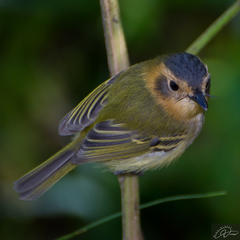

Ochre-faced Tody-Flycatcher

Ochre-faced Tody-Flycatcher

Poecilotriccus plumbeiceps

Silhouette: Emily Willoughby · PhyloPic

LCLeast ConcernNTVUENCR
Daily sighting probability <5% · Rare
at Chapada Diamantina National Park

In 3 days ~10% in a week ~20%

14 Verified sightings at Chapada Diamantina National Park From 2019 to 2026
608 In all 6 parks
May Best month
☀️ Diurnal When it's spotted

About the Ochre-faced Tody-Flycatcher

The ochre-faced tody-flycatcher (Poecilotriccus plumbeiceps) is a species of bird in the family Tyrannidae, the tyrant flycatchers. It is found in Argentina, Bolivia, Brazil, Paraguay, Peru, and Uruguay. The ochre-faced tody-flycatcher was originally described in 1846 as Todirostrum plumbeiceps. For a time in the early twentieth century it was assigned to genus Euscarthmornis and then returned to Todirostrum. Following a 1988 publication, taxonomic systems moved plumbeiceps and several other species from Todirostrum to genus Poecilotriccus. By the early twenty-first century genus Poecilotriccus had species called both "tody-tyrant" and "tody-flycatcher" so taxonomic systems began renaming the "tyrants" to "flycatcher". The ochre-faced and the ruddy tody-flycatcher (P. russatus) form a superspecies.

The ochre-faced tody-flycatcher has these four subspecies: The sexes have the same plumage... Wikipedia →

Sounds

Song0:16

Argentina · 2026

© Marcos E. Sosa · XC1104353 · CC BY-NC-SA 4.0

Call0:11

Brazil · 2025

© Joost van Bruggen · XC1050517 · CC BY-NC-ND 4.0

Uncertain0:13

Argentina · 2002

© david thorns · XC664618 · CC BY-NC-SA 4.0

Global Distribution

Parks Where Found

# Park Country Daily sighting probability
1 El Impenetrable National Park 🇦🇷 Argentina
~30%
2 Itatiaia National Park 🇧🇷 Brazil
~20%
3 Serra dos Órgãos National Park 🇧🇷 Brazil
~10%
4 Iguazú National Park 🇦🇷 Argentina
<5%
5 Chapada Diamantina National Park 🇧🇷 Brazil
<5%
6 Iguaçu National Park 🇧🇷 Brazil
<5%

Cities Where Found

# City Country Daily sighting probability
1 Curitiba 🇧🇷 Brazil
~10%
2 Porto Alegre 🇧🇷 Brazil
<5%
3 São Paulo 🇧🇷 Brazil
<5%
4 Belo Horizonte 🇧🇷 Brazil
<5%

Before you go

What are the chances of seeing an Ochre-faced Tody-Flycatcher in Chapada Diamantina National Park?

Rare

Under 5% of wildlife watchers report an Ochre-faced Tody-Flycatcher sighting in Chapada Diamantina National Park on a given day, based on 14 verified sightings from GBIF citizen-science data from 2019 to 2026. It is the 207th most-seen of the 271 birds we can rate there. Over three days the chance rises to about 10%, and over a week to about 20%, if each day is a fresh chance.

When is the best time to see an Ochre-faced Tody-Flycatcher in Chapada Diamantina National Park?

February and April–June

In those months about 10% of wildlife watchers report an Ochre-faced Tody-Flycatcher in Chapada Diamantina National Park on a given day, against under 5% in March and July–January, the lowest months.

What time of day is best to see an Ochre-faced Tody-Flycatcher?

Between 8 and 11 am

Across all the parks we cover, that three-hour window holds the most Ochre-faced Tody-Flycatcher sightings with a recorded time, and about 9 in 10 of them come between 6 am and 6 pm: it is a daytime animal.

Which relatives of the Ochre-faced Tody-Flycatcher live in Chapada Diamantina National Park?

Same family: Tyrannidae

The closest relatives of the Ochre-faced Tody-Flycatcher that you can see in Chapada Diamantina National Park (family Tyrannidae, Tyrant Flycatchers) are Tropical Kingbird (about 50%), Plain-crested Elaenia (about 50%) and Great Kiskadee (about 50%), with each one's daily chance of a sighting.

Where does the Ochre-faced Tody-Flycatcher sighting chance come from?

GBIF citizen-science records

It is estimated from how often the Ochre-faced Tody-Flycatcher is recorded against all the birds logged in Chapada Diamantina National Park (14 verified sightings from 2019 to 2026), calibrated against known sighting rates. Figures are rounded to the nearest 10% because citizen-science data supports honest approximations, not decimals, and months with records from fewer than five people show "—". How it works.

← Back to Chapada Diamantina National Park