
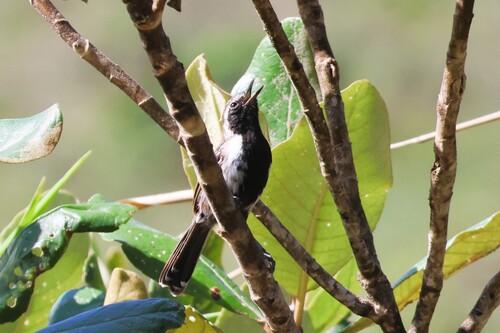
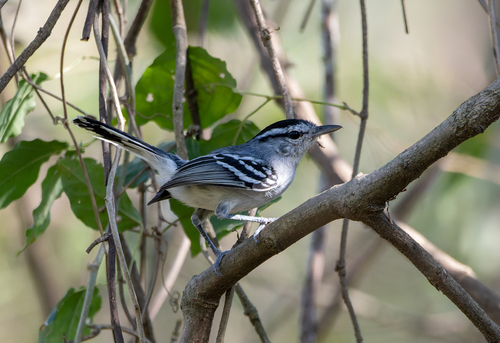
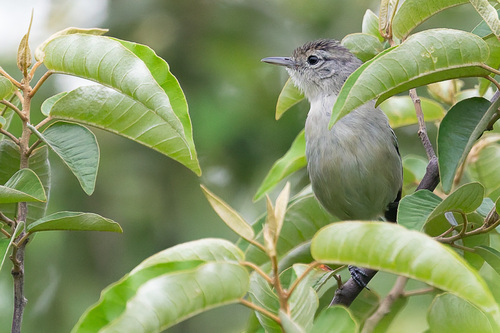
Rufous-winged Antshrike

Rufous-winged Antshrike

Thamnophilus torquatus

Silhouette: Sheatherius · PhyloPic

LCLeast ConcernNTVUENCR
Daily sighting probability ~40% · Likely
at Chapada Diamantina National Park

In 3 days ~80% in a week >90%

299 Verified sightings at Chapada Diamantina National Park From 2019 to 2026
489 In all 4 parks
April Best month
☀️ Diurnal When it's spotted

About the Rufous-winged Antshrike

The rufous-winged antshrike (Thamnophilus torquatus) is a species of bird in subfamily Thamnophilinae of family Thamnophilidae, the "typical antbirds". It is found in Bolivia, Brazil, and Paraguay. The rufous-winged antshrike was described by the English naturalist William Swainson in 1825 and given its current binomial name Thamnophilus torquatus. It and the rufous-capped antshrike (T. ruficapillus) are sister species. The South American Classification Committee of the American Ornithological Society is considering a proposal to lump them as a single species.

The rufous-winged antshrike is monotypic. The rufous-winged antshrike is about 14 cm (5.5 in) long and weighs 18 to 20 g (0.63 to 0.71 oz). Members of genus Thamnophilus are largish members of the antbird family; all have stout bills with a hook like those of true shrikes. This species exhibits significant sexual dimorphism. Adult males have a black crown and a gray face, neck, and upperparts. Their wings and wing coverts are cinnamon-rufous. Their tail is black with white bars on the outer feathers. Their throat and underparts are whitish with black bars on the breast. Adult females... Wikipedia →

Sounds

Call0:40

Brazil · 2020

© Ciro Albano · XC552221 · CC BY-NC-SA 4.0

Song0:16

Brazil · 2020

© JAYRSON ARAUJO DE OLIVEIRA · XC521427 · CC BY-NC-SA 4.0

Canto0:40

Brazil · 2016

© Caio Brito · XC428081 · CC BY-NC-SA 4.0

Global Distribution

Parks Where Found

# Park Country Daily sighting probability
1 Chapada Diamantina National Park 🇧🇷 Brazil
~40%
2 Serra da Canastra National Park 🇧🇷 Brazil
~20%
3 Emas National Park 🇧🇷 Brazil
~20%
4 Chapada dos Guimarães National Park 🇧🇷 Brazil
<5%

Before you go

What are the chances of seeing a Rufous-winged Antshrike in Chapada Diamantina National Park?

Likely

About 40% of wildlife watchers report a Rufous-winged Antshrike sighting in Chapada Diamantina National Park on a given day, based on 299 verified sightings from GBIF citizen-science data from 2019 to 2026. It is the 17th most-seen of the 271 birds we can rate there. Over three days the chance rises to about 80%, and over a week to over 90%, if each day is a fresh chance.

When is the best time to see a Rufous-winged Antshrike in Chapada Diamantina National Park?

April

In that month about 60% of wildlife watchers report a Rufous-winged Antshrike in Chapada Diamantina National Park on a given day, against about 20% in February, the lowest month.

What time of day is best to see a Rufous-winged Antshrike?

Between 6 and 9 am

Across all the parks we cover, that three-hour window holds the most Rufous-winged Antshrike sightings with a recorded time, and about 9 in 10 of them come between 6 am and 6 pm: it is a daytime animal.

Is Chapada Diamantina National Park the best place to see a Rufous-winged Antshrike?

Yes

Of the 4 parks where we can rate Rufous-winged Antshrike sightings, Chapada Diamantina National Park has the highest daily chance: about 40%. Next come Serra da Canastra National Park (Brazil, about 20%) and Emas National Park (Brazil, about 20%).

Which relatives of the Rufous-winged Antshrike live in Chapada Diamantina National Park?

Same genus: Thamnophilus

The closest relatives of the Rufous-winged Antshrike that you can see in Chapada Diamantina National Park (genus Thamnophilus, Typical Antshrikes) are Planalto Slaty-Antshrike (about 30%) and Variable Antshrike (about 20%), with each one's daily chance of a sighting.

Where does the Rufous-winged Antshrike sighting chance come from?

GBIF citizen-science records

It is estimated from how often the Rufous-winged Antshrike is recorded against all the birds logged in Chapada Diamantina National Park (299 verified sightings from 2019 to 2026), calibrated against known sighting rates. Figures are rounded to the nearest 10% because citizen-science data supports honest approximations, not decimals, and months with records from fewer than five people show "—". How it works.

← Back to Chapada Diamantina National Park