
White-banded Tanager

White-banded Tanager

Neothraupis fasciata

Silhouette: Sheatherius · PhyloPic

LCNTNear ThreatenedVUENCR
Daily sighting probability ~10% · With luck
at Chapada Diamantina National Park

In 3 days ~30% in a week ~60%

90 Verified sightings at Chapada Diamantina National Park From 2019 to 2026
444 In all 4 parks
November Best month
☀️ Diurnal When it's spotted

About the White-banded Tanager

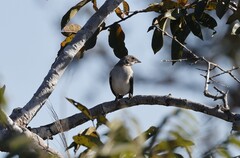
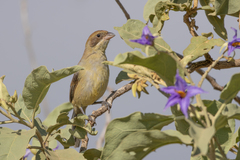
The shrike-like tanager (Neothraupis fasciata), also known as the white-banded tanager, is a South American bird in the tanager family Thraupidae. It is the only member of the genus Neothraupis. The shrike-like tanager was formally described in 1823 by the German naturalist Hinrich Lichtenstein under the binomial name Tanagra fasciata. The species is now the only member of the genus Neothraupis that was introduced in 1936 by the Austrian ornithologist Carl Eduard Hellmayr. The genus name combines the Ancient Greek neos meaning "new" and thraupis, the word for an unknown small bird, perhaps some form of finch. The specific epithet is from the Late Latin fasciatus meaning "banded". The shrike-like tanager is monotypic: no subspecies are recognised.

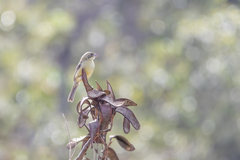
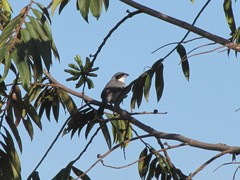
The plumage of the shrike-like tanager is remarkably similar to that of several species of shrikes in the genus Lanius, but these Corvoidea are quite distantly related songbirds. Males and females of this species look alike. It has a total length of about 16 cm (6+1⁄4 in) and weighs 29–32 g.

It is a bird native to the interior of south-central South America at elevations of 550... Wikipedia →

Sounds

Call0:15

Brazil · 2022

© Robson Silva e Silva · XC733948 · CC BY-NC-SA 4.0

Song1:21

Brazil · 2014

© Marco Cruz · XC634320 · CC BY-NC-ND 4.0

Alarm call0:13

Paraguay · 2008

© Paul Smith · XC30365 · CC BY-NC-ND 2.5

Global Distribution

Parks Where Found

# Park Country Daily sighting probability
1 Emas National Park 🇧🇷 Brazil
~50%
2 Serra da Canastra National Park 🇧🇷 Brazil
~10%
3 Chapada Diamantina National Park 🇧🇷 Brazil
~10%
4 Chapada dos Guimarães National Park 🇧🇷 Brazil
~10%

Before you go

What are the chances of seeing a White-banded Tanager in Chapada Diamantina National Park?

With luck

About 10% of wildlife watchers report a White-banded Tanager sighting in Chapada Diamantina National Park on a given day, based on 90 verified sightings from GBIF citizen-science data from 2019 to 2026. It is the 105th most-seen of the 271 birds we can rate there. Over three days the chance rises to about 30%, and over a week to about 60%, if each day is a fresh chance.

When is the best time to see a White-banded Tanager in Chapada Diamantina National Park?

March, July, September and November

In those months about 20% of wildlife watchers report a White-banded Tanager in Chapada Diamantina National Park on a given day, against under 5% in June and August, the lowest months.

What time of day is best to see a White-banded Tanager?

Between 7 and 10 am

Across all the parks we cover, that three-hour window holds the most White-banded Tanager sightings with a recorded time, and about 9 in 10 of them come between 6 am and 6 pm: it is a daytime animal.

Is Chapada Diamantina National Park the best place to see a White-banded Tanager?

3rd of 4

Of the 4 parks where we can rate White-banded Tanager sightings, Chapada Diamantina National Park ranks 3rd at about 10%. The best odds are in Emas National Park (Brazil, about 50%) and Serra da Canastra National Park (Brazil, about 10%).

Which relatives of the White-banded Tanager live in Chapada Diamantina National Park?

Same family: Thraupidae

The closest relatives of the White-banded Tanager that you can see in Chapada Diamantina National Park (family Thraupidae, Tanagers and Allies) are Bananaquit (about 60%), Blue Dacnis (about 50%) and Red-cowled Cardinal (about 50%), with each one's daily chance of a sighting.

Where does the White-banded Tanager sighting chance come from?

GBIF citizen-science records

It is estimated from how often the White-banded Tanager is recorded against all the birds logged in Chapada Diamantina National Park (90 verified sightings from 2019 to 2026), calibrated against known sighting rates. Figures are rounded to the nearest 10% because citizen-science data supports honest approximations, not decimals, and months with records from fewer than five people show "—". How it works.

← Back to Chapada Diamantina National Park