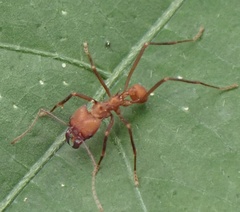
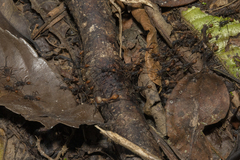
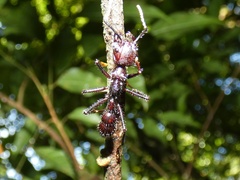
Completed
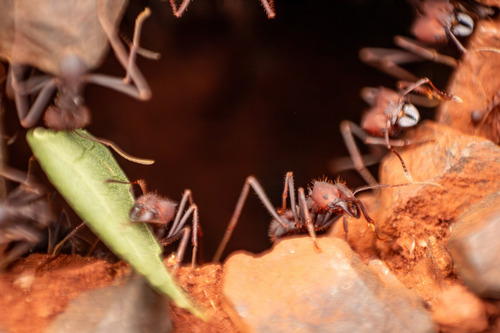
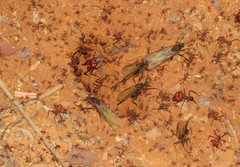
Atta laevigata
Atta laevigata
- KingdomAnimalia (Animals)
- PhylumArthropoda (Arthropods)
- ClassInsecta (Insects)
- OrderHymenoptera (Ants, Bees, Wasps, and Sawflies)
- FamilyFormicidae (Ants)
- GenusAtta
- SpeciesAtta laevigata
In 3 days ~50% in a week ~80%
5 Verified sightings at Chapada dos Guimarães National Park From 2019 to 2026
5 In 1 park
May Best month
☀️ Diurnal When it's spotted
About the Atta laevigata
Atta laevigata (Smith, 1858) is one of about a dozen species of leafcutter ants in the genus Atta, found from Venezuela and south to Paraguay. This species is one of the largest leafcutter species, and can be recognized by the smooth and shining head of the largest workers in a colony. Atta laevigata is known in northern South America as hormiga culona (literally translated as "big-assed ant"), or as sikisapa in Peru, bachaco culón in Venezuela, akango in Paraguay. In Brazil they are known as "saúva-cabeça-de-vidro" (literally "glass-headed saúva"), with saúva being the common name for all Atta ants. Other Atta species are called zompopo de mayo in Central America and chicatana in Mexico.
The colony sizes of these ants are made up of around 3.5 million individuals. The hormiga culona has been eaten for hundreds (if not thousands) of years, as a tradition inherited from pre-colonial cultures such as the Guanes. The ants are harvested for about nine weeks during the rainy season every year, at the time when they make their nuptial flight. A. laevigata are used as traditional gifts in weddings. There are local superstitions and beliefs regarding the ants as aphrodisiacs... Wikipedia →
Recent sightings of Atta laevigata in Chapada dos Guimarães National Park
LIVEiNaturalistGlobal Distribution
Parks Where Found
| # | Park | Country | Daily sighting probability |
|---|---|---|---|
| 1 | Chapada dos Guimarães National Park | 🇧🇷 Brazil |
More parks will be added in future updates.
Cities Where Found
| # | City | Country | Daily sighting probability |
|---|---|---|---|
| 1 | Manaus | 🇧🇷 Brazil | |
| 2 | Brasilia | 🇧🇷 Brazil | |
| 3 | Caracas | 🇻🇪 Venezuela | |
| 4 | Belo Horizonte | 🇧🇷 Brazil |
Closest Relatives at Chapada dos Guimarães National Park
No species of the same family or order lives in Chapada dos Guimarães National Park, so these are its closest relatives here: other insects.

Before you go
What are the chances of seeing an Atta laevigata in Chapada dos Guimarães National Park?
Possible
About 20% of wildlife watchers report an Atta laevigata sighting in Chapada dos Guimarães National Park on a given day, based on 5 verified sightings from GBIF citizen-science data from 2019 to 2026. Over three days the chance rises to about 50%, and over a week to about 80%, if each day is a fresh chance.
When is the best time to see an Atta laevigata in Chapada dos Guimarães National Park?
May and June
In those months about 40% of wildlife watchers report an Atta laevigata in Chapada dos Guimarães National Park on a given day, against under 5% in July to October, the lowest months. Those are among Chapada dos Guimarães National Park's driest months, with about 20 mm of rain a month against 240 mm in March. March and December have too few records to rate.
What time of day is best to see an Atta laevigata?
Between 9 am and noon
Across all the parks we cover, that three-hour window holds the most Atta laevigata sightings with a recorded time, and nearly all of them come between 6 am and 6 pm: it is a daytime animal.
Where else can you see an Atta laevigata?
Only Chapada dos Guimarães National Park, in our data
Chapada dos Guimarães National Park is the only park on Wallace's Line with enough records to rate Atta laevigata sightings: about 20% of wildlife watchers there report one on a given day.
Where does the Atta laevigata sighting chance come from?
GBIF citizen-science records
It is estimated from how often the Atta laevigata is recorded against all the insects logged in Chapada dos Guimarães National Park (5 verified sightings from 2019 to 2026), calibrated against known sighting rates. Figures are rounded to the nearest 10% because citizen-science data supports honest approximations, not decimals, and months with records from fewer than five people show "—". How it works.
