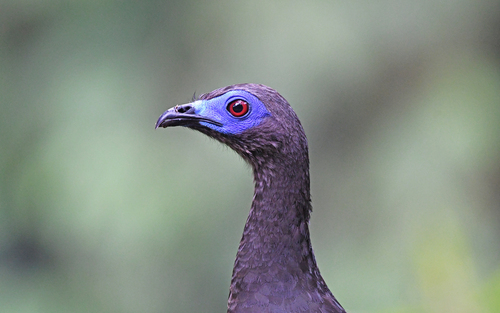
Andean Guan

Andean Guan

Penelope montagnii

Silhouette: Sheatherius · PhyloPic

LCLeast ConcernNTVUENCR
Daily sighting probability ~30% · Possible
at Chingaza National Natural Park

In 3 days ~70% in a week ~90%

400 Verified sightings at Chingaza National Natural Park From 2019 to 2026
1,123 In all 2 parks
May Best month
☀️ Diurnal When it's spotted

About the Andean Guan

The Andean guan (Penelope montagnii) is a gamefowl species of the family Cracidae, in which it belongs to the guan subfamily Penelopinae. This bird occurs in the highlands (5,000 ft/1,500 m ASL and higher) of the Andes, from Venezuela and Colombia through Ecuador and Peru south to Bolivia and perhaps northwesternmost Argentina.

These are medium-sized birds, measuring about 40–58 centimetres (16–23 in) in length and weighing about 500–840 g (1.1–1.9 lb). They are long-bodied with thin necks and small heads, and similar in shape to turkeys but more slender and elegant. The plumage is overall brown with whitish edging to the feathers of the head, neck and chest. It has a red dewlap and reddish legs.

In the Conover Collection of the Field Museum, there is a hypopigmented female specimen of the subspecies atrogularis taken December 20, 1929, at Pucará (west Ecuador). The forehead, chin and upper throat retain the normal color and the hind part of the body is faintly barred pinkish-buff; otherwise the plumage is white. The iris color was not recorded, making it tough to determine whether this is a case of albinism or leucism. Leucism is more frequently seen in birds—particularly... Wikipedia →

Sounds

Alarm call0:11

Ecuador · 2021

© Manuel Sánchez-Nivicela · XC1158364 · CC BY-NC-ND 4.0

Recording0:23

Colombia · 2025

© Emmanuel Laverde · XC985776 · CC BY-NC-SA 4.0

Call0:22

Colombia · 2025

© Sue Riffe · XC979252 · CC BY-NC-SA 4.0

Global Distribution

Parks Where Found

# Park Country Daily sighting probability
1 Chingaza National Natural Park 🇨🇴 Colombia
~30%
2 Los Nevados National Natural Park 🇨🇴 Colombia
~10%

Cities Where Found

# City Country Daily sighting probability
1 Bogota 🇨🇴 Colombia
<5%
2 Quito 🇪🇨 Ecuador
<5%

Zoos & Centres Where Found

# Zoo / Centre Country
1 Bioparque Municipal Vesty Pakos 🇧🇴 Bolivia In captivity
2 Bioparque Los Ocarros 🇨🇴 Colombia In captivity
3 Bioparque Wakatá 🇨🇴 Colombia In captivity
4 Agroflori Parque de las Aves 🇧🇴 Bolivia In captivity

Before you go

What are the chances of seeing an Andean Guan in Chingaza National Natural Park?

Possible

About 30% of wildlife watchers report an Andean Guan sighting in Chingaza National Natural Park on a given day, based on 400 verified sightings from GBIF citizen-science data from 2019 to 2026. It is the 22nd most-seen of the 258 birds we can rate there. Over three days the chance rises to about 70%, and over a week to about 90%, if each day is a fresh chance.

When is the best time to see an Andean Guan in Chingaza National Natural Park?

May

In that month about 60% of wildlife watchers report an Andean Guan in Chingaza National Natural Park on a given day, against about 20% in April, the lowest month.

What time of day is best to see an Andean Guan?

Between 7 and 10 am

Across all the parks we cover, that three-hour window holds the most Andean Guan sightings with a recorded time, and nearly all of them come between 6 am and 6 pm: it is a daytime animal.

Is Chingaza National Natural Park the best place to see an Andean Guan?

Yes

Of the 2 parks where we can rate Andean Guan sightings, Chingaza National Natural Park has the highest daily chance: about 30%. Next come Los Nevados National Natural Park (Colombia, about 10%).

Where does the Andean Guan sighting chance come from?

GBIF citizen-science records

It is estimated from how often the Andean Guan is recorded against all the birds logged in Chingaza National Natural Park (400 verified sightings from 2019 to 2026), calibrated against known sighting rates. Figures are rounded to the nearest 10% because citizen-science data supports honest approximations, not decimals, and months with records from fewer than five people show "—". How it works.

← Back to Chingaza National Natural Park