Plushcap

Plushcap

Catamblyrhynchus diadema

Silhouette: Sheatherius · PhyloPic

LCLeast ConcernNTVUENCR
Daily sighting probability ~10% · With luck
at Chingaza National Natural Park

In 3 days ~30% in a week ~60%

144 Verified sightings at Chingaza National Natural Park From 2019 to 2026
371 In all 3 parks
June Best month
☀️ Diurnal When it's spotted

About the Plushcap

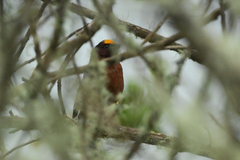
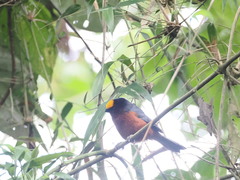
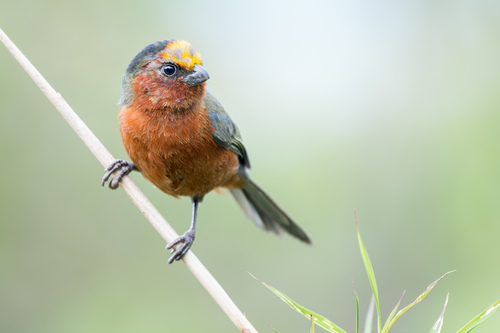
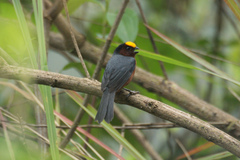
The plushcap (Catamblyrhynchus diadema) is a species of bird in the tanager family Thraupidae and it is the only member of the genus Catamblyrhynchus. The plushcap is one of the most distinctive of all Neotropical passerines in both its appearance and behavior. The plushcap was in its own family until recently when it was grouped with the tanagers. The bill is broad and black. The body is a chestnut color with a bright golden-yellow forecrown. The forecrown is made up of stiff feathers. It has been speculated that these short, dense feathers are less susceptible to feather wear and more resistant to moisture than typical feathers. This may be an adaptation for its specialized feeding mode, in which it probes into dense whorls of bamboo for its prey items. They are found at high elevations from northern Venezuela south to Argentina, including the coastal mountains of Venezuela and the Andes of Colombia, Ecuador, Peru, Bolivia, and extreme northwestern Argentina. They live in montane forests and secondary forests near bamboo. They forage for insects inside the bamboo. They will eat small insects, berries, and small plant matter.

The bird is very distinct and is not confused with many other birds. It stands out from the other tanagers, only possibly being confused with the golden-crowned tanager despite the golden-crowned tanager being blue. Its natural habitat is humid montane forests and it is always found in close association with Chusquea bamboo. It is typically found at elevations between 1,800 and 3,500 m (5,900–11,500 ft). Wikipedia →
Sounds

Call0:29

Ecuador · 2024

© Manuel Sánchez-Nivicela · XC1104822 · CC BY-NC-ND 4.0

Song0:16

Colombia · 2025

© Fabrice Schmitt · XC1005176 · CC BY-NC-SA 4.0

?0:13

Colombia · 2010

© Pablo Florez · XC76985 · CC BY-NC-ND 2.5

Global Distribution

Parks Where Found

# Park Country Daily sighting probability
1 Chingaza National Natural Park 🇨🇴 Colombia
~10%
2 Podocarpus National Park 🇪🇨 Ecuador
~10%
3 Los Nevados National Natural Park 🇨🇴 Colombia
<5%

Before you go

What are the chances of seeing a Plushcap in Chingaza National Natural Park?

With luck

About 10% of wildlife watchers report a Plushcap sighting in Chingaza National Natural Park on a given day, based on 144 verified sightings from GBIF citizen-science data from 2019 to 2026. It is the 53rd most-seen of the 258 birds we can rate there. Over three days the chance rises to about 30%, and over a week to about 60%, if each day is a fresh chance.

When is the best time to see a Plushcap in Chingaza National Natural Park?

April, June, August and October

In those months about 20% of wildlife watchers report a Plushcap in Chingaza National Natural Park on a given day, against under 5% in March, the lowest month.

What time of day is best to see a Plushcap?

Between 8 and 11 am

Across all the parks we cover, that three-hour window holds the most Plushcap sightings with a recorded time, and about 9 in 10 of them come between 6 am and 6 pm: it is a daytime animal.

Is Chingaza National Natural Park the best place to see a Plushcap?

Yes

Of the 3 parks where we can rate Plushcap sightings, Chingaza National Natural Park has the highest daily chance: about 10%. Next come Podocarpus National Park (Ecuador, about 10%) and Los Nevados National Natural Park (Colombia, under 5%).

Where does the Plushcap sighting chance come from?

GBIF citizen-science records

It is estimated from how often the Plushcap is recorded against all the birds logged in Chingaza National Natural Park (144 verified sightings from 2019 to 2026), calibrated against known sighting rates. Figures are rounded to the nearest 10% because citizen-science data supports honest approximations, not decimals, and months with records from fewer than five people show "—". How it works.

← Back to Chingaza National Natural Park