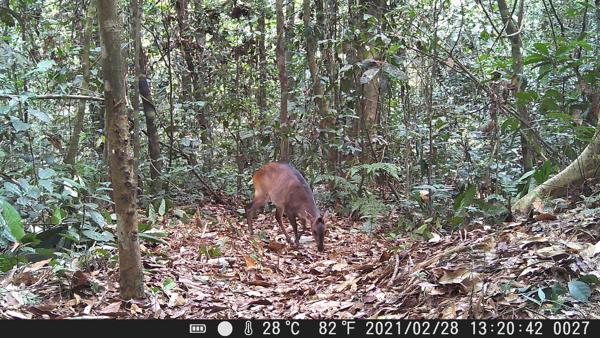
Bay Duiker

Bay Duiker

Cephalophus dorsalis

Silhouette: Kai Caspar · PhyloPic

LCNTNear ThreatenedVUENCR
Daily sighting probability ~40% · Likely
at Chinko Conservation Area

In 3 days ~80% in a week >90%

46 Verified sightings at Chinko Conservation Area From 2019 to 2026
54 In all 2 parks
November Best month
🌙 Nocturnal When it's spotted

About the Bay Duiker

The bay duiker (Cephalophus dorsalis), also known as the black-striped duiker and the black-backed duiker, is a forest-dwelling duiker native to western and southern Africa. It was first described by British zoologist John Edward Gray in 1846. Two subspecies are identified. The bay duiker is reddish-brown and has a moderate size. Both sexes reach 44–49 cm (17–19 in) at the shoulder. The sexes do not vary considerably in their weights, either; the typical weight range for this duiker is 18–23 kg (40–51 lb). Both sexes have a pair of spiky horns, measuring 5–8 cm (2.0–3.1 in). A notable feature of this duiker is the well-pronounced solid stripe of black extending from the back of the head to the tail.

The bay duiker is a nocturnal animal. It tends to remain solitary, but pairs can also be observed. The leopard is the main predator of this duiker. It mainly prefers fruits, but may also feed on animal matter such as bird eggs. Females may conceive by the age of 18 months. Breeding occurs throughout the year. Gestation lasts about 240 days, following which generally a single offspring is born. The lifespan of the bay duiker is typically 17 to 18 years.

The bay duiker prefers old-growth or primary forests. It has been historically overhunted across its range for bushmeat. The survival of the bay duiker is also threatened by human settlement and agricultural expansion due to this duiker's preference for old-growth forests, and habitat degradation. The bay duiker is, however, still a common duiker species, and is classified as near threatened by the International Union for Conservation of Nature and Natural Resources.

Wikipedia →

Global Distribution

Parks Where Found

# Park Country Daily sighting probability
1 Chinko Conservation Area 🇨🇫 Central African Republic
~40%
2 Odzala-Kokoua National Park 🇨🇬 Republic of the Congo
~20%

Zoos & Centres Where Found

# Zoo / Centre Country
1 Abidjan zoo 🇨🇮 Côte d’Ivoire In captivity

Before you go

What are the chances of seeing a Bay Duiker in Chinko Conservation Area?

Likely

About 40% of wildlife watchers report a Bay Duiker sighting in Chinko Conservation Area on a given day, based on 46 verified sightings from GBIF citizen-science data from 2019 to 2026. It is the 23rd most-seen of the 53 mammals we can rate there. Over three days the chance rises to about 80%, and over a week to over 90%, if each day is a fresh chance.

When is the best time to see a Bay Duiker in Chinko Conservation Area?

November

In that month about 60% of wildlife watchers report a Bay Duiker in Chinko Conservation Area on a given day, against under 5% in May–June and August–October, the lowest months. That is one of Chinko Conservation Area's driest months, with about 15 mm of rain against 180 mm in August.

What time of day is best to see a Bay Duiker?

Between 7 and 10 pm

Across all the parks we cover, that three-hour window holds the most Bay Duiker sightings with a recorded time, and about 8 in 10 of them come between 6 pm and 6 am: it is mostly seen at night.

Is Chinko Conservation Area the best place to see a Bay Duiker?

Yes

Of the 2 parks where we can rate Bay Duiker sightings, Chinko Conservation Area has the highest daily chance: about 40%. Next come Odzala-Kokoua National Park (Republic of the Congo, about 20%).

Which relatives of the Bay Duiker live in Chinko Conservation Area?

Same genus: Cephalophus

The closest relatives of the Bay Duiker that you can see in Chinko Conservation Area (genus Cephalophus, Forest Duikers) are Light-backed Duiker (about 60%), Weyns's Duiker (about 50%) and Red-Flanked Duiker (about 40%), with each one's daily chance of a sighting.

Where does the Bay Duiker sighting chance come from?

GBIF citizen-science records

It is estimated from how often the Bay Duiker is recorded against all the mammals logged in Chinko Conservation Area (46 verified sightings from 2019 to 2026), calibrated against known sighting rates. Figures are rounded to the nearest 10% because citizen-science data supports honest approximations, not decimals, and months with records from fewer than five people show "—". How it works.

← Back to Chinko Conservation Area