Black Fronted Duiker

Black Fronted Duiker

Cephalophus nigrifrons

Silhouette: Kai Caspar · PhyloPic

LCLeast ConcernNTVUENCR
Daily sighting probability ~30% · Possible
at Chinko Conservation Area

In 3 days ~60% in a week ~90%

16 Verified sightings at Chinko Conservation Area From 2019 to 2026
32 In all 2 parks
February Best month
☀️ Diurnal When it's spotted

About the Black Fronted Duiker

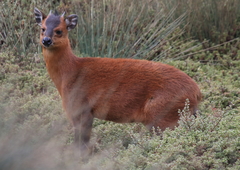
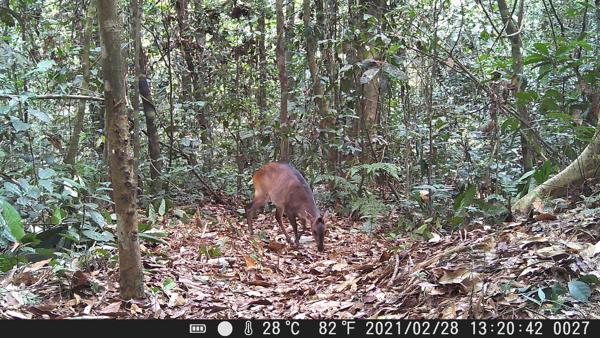
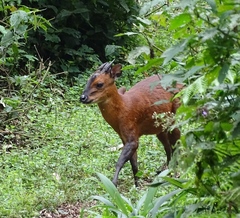
The black-fronted duiker (Cephalophus nigrifrons) is a small antelope found in central and west-central Africa. The black-fronted duiker is a compact, short-necked, and active antelope that gets its name from the broad black streak that runs from the nose to its forehead, a feature distinguishing it from its congeners. It has a glossy coat that is deep reddish-mahogany to a lighter orange-chestnut in colour, the hair becoming sparser and darker on the long legs. It has a short tail that is black with a white tip and short, pointed horns, measuring 4–12 cm (1.6–4.7 in), which are carried by both sexes and are used for defense against other duikers and predators. Their elongated hooves appear to be an adaptation to the wet habitats they seem to prefer. It weighs 14–18 kg (31–40 lb) and has a shoulder height of 43 cm (17 in).

The black-fronted duiker is found in central and west-central Africa, with an isolated population in the Niger Delta in eastern Nigeria and then from southern Cameroon east to western Kenya and south to northern Angola. The black-fronted duiker occurs in montane, lowland, and swamp forests, from near sea level up...

Wikipedia →

Global Distribution

Parks Where Found

# Park Country Daily sighting probability
1 Odzala-Kokoua National Park 🇨🇬 Republic of the Congo
~30%
2 Chinko Conservation Area 🇨🇫 Central African Republic
~30%

Before you go

What are the chances of seeing a Black Fronted Duiker in Chinko Conservation Area?

Possible

About 30% of wildlife watchers report a Black Fronted Duiker sighting in Chinko Conservation Area on a given day, based on 16 verified sightings from GBIF citizen-science data from 2019 to 2026. It is the 37th most-seen of the 53 mammals we can rate there. Over three days the chance rises to about 60%, and over a week to about 90%, if each day is a fresh chance.

When is the best time to see a Black Fronted Duiker in Chinko Conservation Area?

February

In that month about 60% of wildlife watchers report a Black Fronted Duiker in Chinko Conservation Area on a given day, against under 5% in May–August and October–November, the lowest months. That is one of Chinko Conservation Area's driest months, with almost no rain against 180 mm in August.

What time of day is best to see a Black Fronted Duiker?

Between 6 and 9 am

Across all the parks we cover, that three-hour window holds the most Black Fronted Duiker sightings with a recorded time, and about 9 in 10 of them come between 6 am and 6 pm: it is a daytime animal.

Is Chinko Conservation Area the best place to see a Black Fronted Duiker?

Among the best

Of the 2 parks where we can rate Black Fronted Duiker sightings, Chinko Conservation Area ranks 2nd at about 30%, level with the leaders once rounded. The best odds are in Odzala-Kokoua National Park (Republic of the Congo, about 30%).

Which relatives of the Black Fronted Duiker live in Chinko Conservation Area?

Same genus: Cephalophus

The closest relatives of the Black Fronted Duiker that you can see in Chinko Conservation Area (genus Cephalophus, Forest Duikers) are Light-backed Duiker (about 60%), Weyns's Duiker (about 50%) and Red-Flanked Duiker (about 40%), with each one's daily chance of a sighting.

Where does the Black Fronted Duiker sighting chance come from?

GBIF citizen-science records

It is estimated from how often the Black Fronted Duiker is recorded against all the mammals logged in Chinko Conservation Area (16 verified sightings from 2019 to 2026), calibrated against known sighting rates. Figures are rounded to the nearest 10% because citizen-science data supports honest approximations, not decimals, and months with records from fewer than five people show "—". How it works.

← Back to Chinko Conservation Area