
Blotched Palm-pitviper

Blotched Palm-pitviper

Bothriechis supraciliaris

Silhouette: Steven Traver · PhyloPic

LCLeast ConcernNTVUENCR
Daily sighting probability ~10% · With luck
at Chirripó National Park

In 3 days ~40% in a week ~70%

8 Verified sightings at Chirripó National Park From 2019 to 2026
8 In 1 park
August Best month
☀️🌙 Day & Night When it's spotted

About the Blotched Palm-pitviper

Bothriechis supraciliaris, commonly known as the blotched eyelash-pitviper, is a species of venomous snake in the subfamily Crotalinae of the family Viperidae. The species is endemic to southern Pacific parts of Talamanca Mountain Range in Costa Rica and western Panama.

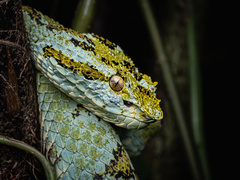
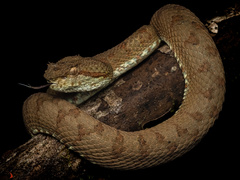
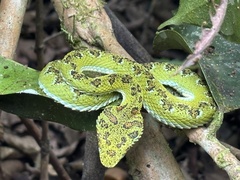
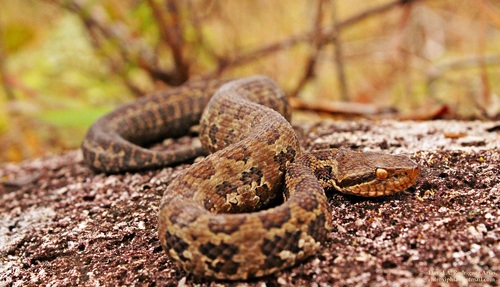
Bothriechis supraciliaris is usually 50–60 cm (20–24 in) in total length (including tail), but can reach 80 cm (31 in). Its body colour varies. It can be either bluish-green, reddish-brown, or reddish-maroon, but usually it is bright-green or moss-green. The body is circular, ovoid and rhomboid in cross-section, with irregular dorsal blotches, that sometimes form crossbands. The belly is light. There are 21–23 dorsal scales rows at midbody. The head carries dark stripes and prominent scales that are located above the eyes.

The only sexual dimorphism noted is that females of the species tend to be longer and thicker than males. The geographic range of B. supraciliaris is limited to southern Costa Rica (between San Isidro and San Vito) and western Panama. All of its range overlaps with that of the closely related species B. nigroadspersus. Bothriechis supraciliaris... Wikipedia →

Global Distribution

Parks Where Found

# Park Country Daily sighting probability
1 Chirripó National Park 🇨🇷 Costa Rica
~10%

More parks will be added in future updates.

Before you go

What are the chances of seeing a Blotched Palm-pitviper in Chirripó National Park?

With luck

About 10% of wildlife watchers report a Blotched Palm-pitviper sighting in Chirripó National Park on a given day, based on 8 verified sightings from GBIF citizen-science data from 2019 to 2026. It is the 8th most-seen of the 17 reptiles we can rate there. Over three days the chance rises to about 40%, and over a week to about 70%, if each day is a fresh chance.

When is the best time to see a Blotched Palm-pitviper in Chirripó National Park?

April and August–September

In those months about 30% of wildlife watchers report a Blotched Palm-pitviper in Chirripó National Park on a given day, against under 5% in February–March, May, July and October–December, the lowest months.

What time of day is best to see a Blotched Palm-pitviper?

Between 9 am and noon

Across all the parks we cover, that three-hour window holds the most Blotched Palm-pitviper sightings with a recorded time, and about half of them come between 6 am and 6 pm: it is seen both by day and at night.

Where else can you see a Blotched Palm-pitviper?

Only Chirripó National Park, in our data

Chirripó National Park is the only park on Wallace's Line with enough records to rate Blotched Palm-pitviper sightings: about 10% of wildlife watchers there report one on a given day.

Which relatives of the Blotched Palm-pitviper live in Chirripó National Park?

Same genus: Bothriechis

The closest relatives of the Blotched Palm-pitviper that you can see in Chirripó National Park (genus Bothriechis, Palm Vipers) are Side-striped palm pit viper (about 20%) and Black-speckled Palm Pit Viper (about 10%), with each one's daily chance of a sighting.

Where does the Blotched Palm-pitviper sighting chance come from?

GBIF citizen-science records

It is estimated from how often the Blotched Palm-pitviper is recorded against all the reptiles logged in Chirripó National Park (8 verified sightings from 2019 to 2026), calibrated against known sighting rates. Figures are rounded to the nearest 10% because citizen-science data supports honest approximations, not decimals, and months with records from fewer than five people show "—". How it works.

← Back to Chirripó National Park