Sulphur-winged Parakeet

Sulphur-winged Parakeet

Pyrrhura hoffmanni

Silhouette: Sheatherius · PhyloPic

LCLeast ConcernNTVUENCR
Daily sighting probability ~40% · Likely
at Chirripó National Park

In 3 days ~70% in a week >90%

553 Verified sightings at Chirripó National Park From 2019 to 2026
7,266 In all 5 parks
November Best month
☀️ Diurnal When it's spotted

About the Sulphur-winged Parakeet

The sulphur-winged parakeet (Pyrrhura hoffmanni), also known as Hoffmann's conure in aviculture, is a species of bird in subfamily Arinae of the family Psittacidae, the African and New World parrots. It is found in Costa Rica and Panama.

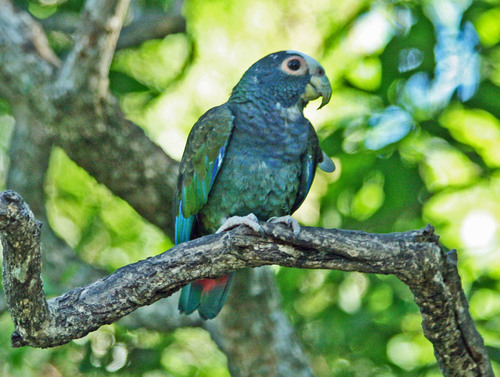
It is named for the German naturalist Karl Hoffmann. The sulphur-winged parakeet is about 23 to 24 cm (9.1 to 9.4 in) long and weighs an average of 82 g (2.9 oz). The sexes are the same. Adults of the nominate subspecies are mostly green. Their head, nape, and throat have some yellow inclusions; bare white skin surrounds their eye and their ear coverts are bright terracotta. Their breast has a dull orange wash. Their wing is mostly green with yellow primary coverts, inner primaries, and outer secondaries; the outer primaries are blue. Their tail's upperside is rufous olive with green fringes on the feathers; its underside is reddish brown. Immature birds have duller scaling, less orange on their breast, and much less yellow on their wings. Wikipedia →

Sounds

Call0:20

Costa Rica · 2024

© Paul Driver · XC956108 · CC BY-NC-SA 4.0

Flight call0:09

Panama · 2015

© Peter Boesman · XC271554 · CC BY-NC-ND 4.0

Call0:11

Panama · 2020

© Yoann Blanchon · XC540594 · CC BY-NC-SA 4.0

Global Distribution

Parks Where Found

# Park Country Daily sighting probability
1 Los Quetzales National Park 🇨🇷 Costa Rica
~40%
2 Chirripó National Park 🇨🇷 Costa Rica
~40%
3 Volcán Barú National Park 🇵🇦 Panama
~30%
4 La Amistad International Park (Panama) 🇵🇦 Panama
~20%
5 Tapantí-Macizo de la Muerte National Park 🇨🇷 Costa Rica
<5%

Cities Where Found

# City Country Daily sighting probability
1 San José 🇨🇷 Costa Rica
<5%

Zoos & Centres Where Found

# Zoo / Centre Country
1 Loro Parque 🇪🇸 Spain In captivity

Before you go

What are the chances of seeing a Sulphur-winged Parakeet in Chirripó National Park?

Likely

About 40% of wildlife watchers report a Sulphur-winged Parakeet sighting in Chirripó National Park on a given day, based on 553 verified sightings from GBIF citizen-science data from 2019 to 2026. It is the 21st most-seen of the 332 birds we can rate there. Over three days the chance rises to about 70%, and over a week to over 90%, if each day is a fresh chance.

When is the best time to see a Sulphur-winged Parakeet in Chirripó National Park?

November

In that month about 50% of wildlife watchers report a Sulphur-winged Parakeet in Chirripó National Park on a given day, against about 20% in September, the lowest month. That is one of Chirripó National Park's wettest months, with about 450 mm of rain against 75 mm in February.

What time of day is best to see a Sulphur-winged Parakeet?

Between 9 am and noon

Across all the parks we cover, that three-hour window holds the most Sulphur-winged Parakeet sightings with a recorded time, and about 9 in 10 of them come between 6 am and 6 pm: it is a daytime animal.

Is Chirripó National Park the best place to see a Sulphur-winged Parakeet?

Among the best

Of the 5 parks where we can rate Sulphur-winged Parakeet sightings, Chirripó National Park ranks 2nd at about 40%, level with the leaders once rounded. The best odds are in Los Quetzales National Park (Costa Rica, about 40%).

Where does the Sulphur-winged Parakeet sighting chance come from?

GBIF citizen-science records

It is estimated from how often the Sulphur-winged Parakeet is recorded against all the birds logged in Chirripó National Park (553 verified sightings from 2019 to 2026), calibrated against known sighting rates. Figures are rounded to the nearest 10% because citizen-science data supports honest approximations, not decimals, and months with records from fewer than five people show "—". How it works.

← Back to Chirripó National Park