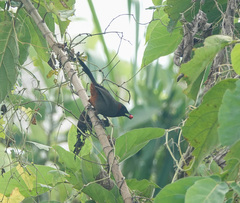
Rufous-necked Laughingthrush

Rufous-necked Laughingthrush

Garrulax ruficollis

Silhouette: Jiekun He · PhyloPic

Daily sighting probability ~10% · With luck
at Chitwan National Park

In 3 days ~10% in a week ~30%

71 Verified sightings at Chitwan National Park From 2019 to 2026
866 In all 4 parks
July Best month
☀️ Diurnal When it's spotted

About the Rufous-necked Laughingthrush

The rufous-necked laughingthrush (Pterorhinus ruficollis) is a bird species in the laughingthrush family, Leiothrichidae. It is found in Bangladesh, Bhutan, China, India, Myanmar and Nepal, where its natural habitats are subtropical or tropical moist lowland forest and subtropical or tropical moist montane forest. Little study was done on this species due to its abundance and lack of interest in its conservation.

The rufous-necked laughingthrush was placed in the genus Dryonastes before being moved to Garrulax. Following the publication of a comprehensive molecular phylogenetic study in 2018, it was moved again to the resurrected genus Pterorhinus.

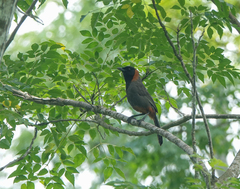
The rufous-necked laughingthrush is actually not a thrush but a species of babbler, it is roughly 22–27 centimetres (8.7–10.6 in) in length and weighs anywhere between 51–73 grams (1.8–2.6 oz). The rufous-necked laughingthrush as its name implies has a rustic color around its neck. overall the bird is grey with a black face and its rufous neck. Due to the fact that they are non migratory birds this means that they molt very slowly which means that they look the same as young birds than as older birds. The... Wikipedia →

Sounds

Recording0:12

India · 2023

© dbeadle · iNaturalist · CC BY-NC 4.0

Recording0:08

China · 2025

© Lin, Zhanyi · iNaturalist · CC BY-NC 4.0

Recording0:14

Bangladesh · 2024

© Abdul Karim · iNaturalist · CC BY-NC 4.0

Global Distribution

Parks Where Found

# Park Country Daily sighting probability
1 Royal Manas National Park 🇧🇹 Bhutan
~30%
2 Manas National Park 🇮🇳 India
~30%
3 Chitwan National Park 🇳🇵 Nepal
~10%
4 Namdapha National Park 🇮🇳 India
<5%

Cities Where Found

# City Country Daily sighting probability
1 Dhaka 🇧🇩 Bangladesh
<5%

Before you go

What are the chances of seeing a Rufous-necked Laughingthrush in Chitwan National Park?

With luck

About 10% of wildlife watchers report a Rufous-necked Laughingthrush sighting in Chitwan National Park on a given day, based on 71 verified sightings from GBIF citizen-science data from 2019 to 2026. It is the 182nd most-seen of the 367 birds we can rate there. Over three days the chance rises to about 10%, and over a week to about 30%, if each day is a fresh chance.

When is the best time to see a Rufous-necked Laughingthrush in Chitwan National Park?

February–March and July–August

In those months about 10% of wildlife watchers report a Rufous-necked Laughingthrush in Chitwan National Park on a given day, against under 5% in April–June and September–January, the lowest months. Those are among Chitwan National Park's wettest months, with about 320 mm of rain a month against almost none in November.

What time of day is best to see a Rufous-necked Laughingthrush?

Between 6 and 9 am

Across all the parks we cover, that three-hour window holds the most Rufous-necked Laughingthrush sightings with a recorded time, and about 8 in 10 of them come between 6 am and 6 pm: it is a daytime animal.

Is Chitwan National Park the best place to see a Rufous-necked Laughingthrush?

3rd of 4

Of the 4 parks where we can rate Rufous-necked Laughingthrush sightings, Chitwan National Park ranks 3rd at about 10%. The best odds are in Royal Manas National Park (Bhutan, about 30%) and Manas National Park (India, about 30%).

Where does the Rufous-necked Laughingthrush sighting chance come from?

GBIF citizen-science records

It is estimated from how often the Rufous-necked Laughingthrush is recorded against all the birds logged in Chitwan National Park (71 verified sightings from 2019 to 2026), calibrated against known sighting rates. Figures are rounded to the nearest 10% because citizen-science data supports honest approximations, not decimals, and months with records from fewer than five people show "—". How it works.

← Back to Chitwan National Park