Southern Bell Frog

Southern Bell Frog

Ranoidea raniformis

Silhouette: Vijay Karthick · PhyloPic

Endemic
Daily sighting probability ~10% · With luck
at Auckland

In 3 days ~10% in a week ~30%

7 Verified sightings at Auckland
38 In all 2 parks From 2019 to 2026
November Best month
☀️🌙 Day & Night When it's spotted

About the Southern Bell Frog

The growling grass frog (Ranoidea raniformis), also commonly known as the southern bell frog, warty swamp frog and erroneously as the green frog, is a species of ground-dwelling tree frog native to southeastern Australia, ranging from southern South Australia along the Murray River though Victoria to New South Wales, with populations through Tasmania. This species' common names vary between states; the name southern bell frog applies in New South Wales and South Australia, growling grass frog in Victoria, and green and gold frog in Tasmania. This species has been introduced to New Zealand.

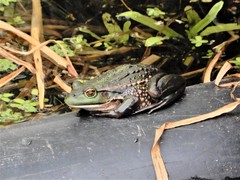
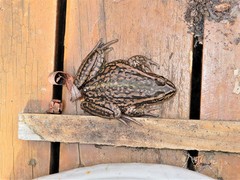
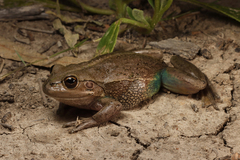
The growling grass frog is a very large, ground-dwelling tree frog up to 10 cm (almost 4 in) from snout to vent. It is a mottled bright green and bronze colour above, often with dark brown enameled bumps. It has a pale cream underside, with a faint cobbling pattern. A pale stripe runs from the side of the head down the flanks as a skin fold. The thighs are blue-green in colour.

There are a series of shallow bumps over its back. This frog closely resembles the green and golden bell frog (Ranoidea aurea), but is distinguished by the shallow bumps on its back, a shorter call, and a... Wikipedia →

Sounds

Recording1:00

Australia · 2022

© Nick Talbot · XC904611 · CC BY-NC-SA 4.0

Recording0:09

New Zealand · 2025

© lucinda2730 · iNaturalist · CC BY-NC 4.0

Recording0:31

Australia · 2021

© Anna Lanigan · iNaturalist · CC BY-NC 4.0

Global Distribution

Parks Where Found

# Park Country Daily sighting probability
1 Wilsons Promontory National Park 🇦🇺 Australia
~10%
2 Grampians National Park 🇦🇺 Australia
~10%

Cities Where Found

# City Country Daily sighting probability
1 Melbourne 🇦🇺 Australia
~10%
2 Auckland 🇳🇿 New Zealand
~10%

Zoos & Centres Where Found

# Zoo / Centre Country
1 Taronga Zoo 🇦🇺 Australia In captivity
2 Cleland Wildlife Park 🇦🇺 Australia In captivity
3 Melbourne Zoo 🇦🇺 Australia In captivity
4 Moonlit Sanctuary Wildlife Conservation Park 🇦🇺 Australia In captivity
5 Sydney Zoo 🇦🇺 Australia In captivity
6 Willowbank Wildlife Reserve 🇳🇿 New Zealand In captivity
7 Melbourne Aquarium 🇦🇺 Australia In captivity
8 National Aquarium of New Zealand 🇳🇿 New Zealand In captivity

Before you go

What are the chances of seeing a Southern Bell Frog in Auckland?

With luck

About 10% of wildlife watchers report a Southern Bell Frog sighting in Auckland on a given day, based on 7 verified sightings from GBIF citizen-science data. Over three days the chance rises to about 10%, and over a week to about 30%, if each day is a fresh chance.

When is the best time to see a Southern Bell Frog in Auckland?

March–April, June, August and November

In those months about 10% of wildlife watchers report a Southern Bell Frog in Auckland on a given day, against under 5% in May, July, September–October and December–February, the lowest months.

What time of day is best to see a Southern Bell Frog?

Between 8 and 11 pm

Across all the parks we cover, that three-hour window holds the most Southern Bell Frog sightings with a recorded time, and about 6 in 10 of them come between 6 am and 6 pm: it is seen both by day and at night.

Is Auckland the best place to see a Southern Bell Frog?

Among the best

Of the 2 cities where we can rate Southern Bell Frog sightings, Auckland ranks 2nd at about 10%, level with the leaders once rounded. The best odds are in Melbourne (Australia, about 10%).

Where does the Southern Bell Frog sighting chance come from?

GBIF citizen-science records

It is estimated from how often the Southern Bell Frog is recorded against all the amphibians logged in Auckland (7 verified sightings), calibrated against known sighting rates. Figures are rounded to the nearest 10% because citizen-science data supports honest approximations, not decimals, and months with records from fewer than five people show "—". How it works.

← Back to Auckland