VOC

VOC

Haematopus unicolor

Silhouette: terngirl · PhyloPic

LCLeast ConcernNTVUENCR Endemic
Daily sighting probability ~30% · Possible
at Auckland

In 3 days ~60% in a week ~90%

1,848 Verified sightings at Auckland
3,270 In all 4 parks From 2019 to 2026
December Best month
☀️ Diurnal When it's spotted

About the VOC

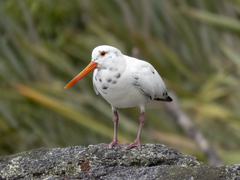
The variable oystercatcher (Haematopus unicolor) is a species of wader in the family Haematopodidae. It is endemic to New Zealand. The Māori name is tōrea-pango. They are also known as 'red bills'. "Variable" refers to the frontal plumage, which ranges from pied through mottled to all black. They are polymorphic meaning they have different genetic variants. These color differences are attributed to the latitude of the habitat, where the northernmost oystercatchers have significantly more white on their bodies than those of southern origin. All Stewart Island variable oystercatchers are black. They have pink legs, an orange eye ring and orange-red beaks. Similar to a needle in shape, the bill is thin and long, and darkens to a deep red color during the breeding season. Males are around 678 grams and females slightly larger at around 724 grams. Length of individuals range from 42 to 47 cm from beak to tail and have a short, sturdy body with a thick neck.

Variables can be identified as they are slightly larger than the South Island pied oystercatcher (SIPO are around 550 grams). Occasionally completely black, but if they are pied (black and white) they can be easily confused... Wikipedia →

Sounds

Nocturnal flight call0:28

New Zealand · 2021

© craig wilson · XC665865 · CC BY 4.0

Flight call0:17

New Zealand · 2018

© Romuald Mikusek · XC405678 · CC BY-NC-SA 4.0

Call0:16

New Zealand · 2011

© nick talbot · XC188410 · CC BY-NC-SA 4.0

Global Distribution

Parks Where Found

# Park Country Daily sighting probability
1 Rakiura National Park 🇳🇿 New Zealand
~80%
2 Abel Tasman National Park 🇳🇿 New Zealand
~60%
3 Fiordland National Park 🇳🇿 New Zealand
~20%
4 Egmont National Park 🇳🇿 New Zealand
<5%

Cities Where Found

# City Country Daily sighting probability
1 Auckland 🇳🇿 New Zealand
~30%

Zoos & Centres Where Found

# Zoo / Centre Country
1 Ōtorohanga Kiwi House 🇳🇿 New Zealand In captivity

Before you go

What are the chances of seeing a VOC in Auckland?

Possible

About 30% of wildlife watchers report a VOC sighting in Auckland on a given day, based on 1,848 verified sightings from GBIF citizen-science data. It is the 26th most-seen of the 93 birds we can rate there. Over three days the chance rises to about 60%, and over a week to about 90%, if each day is a fresh chance.

When is the best time to see a VOC in Auckland?

March and December

In those months about 40% of wildlife watchers report a VOC in Auckland on a given day, against about 20% in April–May and August–September, the lowest months.

What time of day is best to see a VOC?

Between 1 and 4 pm

Across all the parks we cover, that three-hour window holds the most VOC sightings with a recorded time, and about 9 in 10 of them come between 6 am and 6 pm: it is a daytime animal.

Where else can you see a VOC?

Only Auckland, in our data

Auckland is the only city on Wallace's Line with enough records to rate VOC sightings: about 30% of wildlife watchers there report one on a given day.

Where does the VOC sighting chance come from?

GBIF citizen-science records

It is estimated from how often the VOC is recorded against all the birds logged in Auckland (1,848 verified sightings), calibrated against known sighting rates. Figures are rounded to the nearest 10% because citizen-science data supports honest approximations, not decimals, and months with records from fewer than five people show "—". How it works.

← Back to Auckland