Eastern Narrow-mouthed Toad

Eastern Narrow-mouthed Toad

Gastrophryne carolinensis

Silhouette: Dmitry Bogdanov (vectorized by T. Michael Keesey) · PhyloPic

LCLeast ConcernNTVUENCR Endemic
Daily sighting probability <5% · Rare
at Austin

In 3 days ~10% in a week ~20%

9 Verified sightings at Austin
130 In all 4 parks From 2019 to 2026
May Best month
☀️🌙 Day & Night When it's spotted

About the Eastern Narrow-mouthed Toad

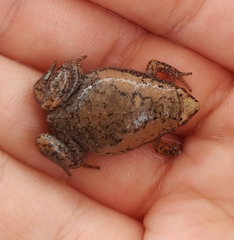
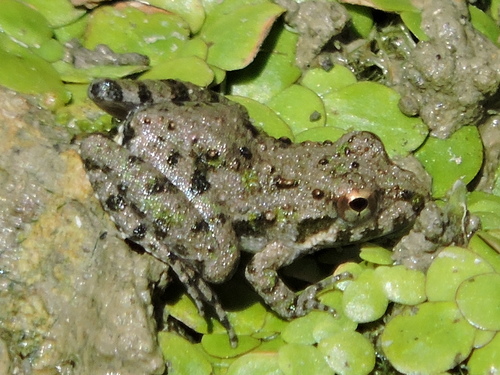
Gastrophryne carolinensis, the eastern narrow-mouthed toad, is a species of microhylid frog. It is a relatively small, toad-like amphibian found in damp, shady habitats. The species is highly fossorial, and feeds primarily on ants. These North American microhylids (Family: Microhylidae) are distinguished from true toads (genus Bufo), and other anurans by their moist, smooth skin, their lack of eardrums or tympana, their distinguishable squat body shape, and the unique fold of skin superior to their eyes. It is found in the United States, from southern Maryland to the Florida Keys, west to Missouri, Arkansas and Texas. While not a true toad, it is so called because it is terrestrial.

Gastrophryne carolinensis belongs to one of the largest anuran families, the microhylids. No subspecies are currently recognized. The eastern narrowmouth toad is one of only three microhylids that currently live in the United States.

The eastern narrow-mouthed toad is relatively small, growing to a maximum length of 53 mm (2.1 in). It has an oval-shaped body and a narrow head with a pointed snout. On the back of their head, they have a fold of skin that is capable of covering... Wikipedia →

Sounds

Advertisement call0:09

United States · 2015

© Chris Harrison · XC890982 · CC BY-NC-SA 4.0

Recording0:22

United States · 2025

© Mike Duran · iNaturalist · CC BY 4.0

Recording0:05

United States · 2025

© Raúl MT · iNaturalist · CC BY-NC 4.0

Global Distribution

Parks Where Found

# Park Country Daily sighting probability
1 Big Cypress National Preserve 🇺🇸 United States
~30%
2 Everglades National Park 🇺🇸 United States
~10%
3 Congaree National Park 🇺🇸 United States
~10%
4 Padre Island National Seashore 🇺🇸 United States
~10%

Cities Where Found

# City Country Daily sighting probability
1 Houston 🇺🇸 United States
~10%
2 Orlando 🇺🇸 United States
~10%
3 Miami 🇺🇸 United States
<5%
4 Austin 🇺🇸 United States
<5%

Zoos & Centres Where Found

# Zoo / Centre Country
1 Wonders of Wildlife Museum & Aquarium 🇺🇸 United States In captivity

Closest Relatives at Austin

Before you go

What are the chances of seeing an Eastern Narrow-mouthed Toad in Austin?

Rare

Under 5% of wildlife watchers report an Eastern Narrow-mouthed Toad sighting in Austin on a given day, based on 9 verified sightings from GBIF citizen-science data. It is the 10th most-seen of the 13 amphibians we can rate there. Over three days the chance rises to about 10%, and over a week to about 20%, if each day is a fresh chance.

When is the best time to see an Eastern Narrow-mouthed Toad in Austin?

Any time of year

In every month with enough records, under 5% of wildlife watchers report an Eastern Narrow-mouthed Toad in Austin on a given day, so our monthly data shows no clear season.

What time of day is best to see an Eastern Narrow-mouthed Toad?

Between 8 and 11 pm

Across all the parks we cover, that three-hour window holds the most Eastern Narrow-mouthed Toad sightings with a recorded time, and about 6 in 10 of them come between 6 pm and 6 am: it is seen both by day and at night.

Is Austin the best place to see an Eastern Narrow-mouthed Toad?

4th of 4

Of the 4 cities where we can rate Eastern Narrow-mouthed Toad sightings, Austin ranks 4th at under 5%. The best odds are in Houston (United States, about 10%), Orlando (United States, about 10%) and Miami (United States, under 5%).

Where does the Eastern Narrow-mouthed Toad sighting chance come from?

GBIF citizen-science records

It is estimated from how often the Eastern Narrow-mouthed Toad is recorded against all the amphibians logged in Austin (9 verified sightings), calibrated against known sighting rates. Figures are rounded to the nearest 10% because citizen-science data supports honest approximations, not decimals, and months with records from fewer than five people show "—". How it works.

← Back to Austin