
Southern Leopard Frog

Southern Leopard Frog

Lithobates sphenocephalus

Silhouette: Jose Carlos Arenas-Monroy · PhyloPic

LCLeast ConcernNTVUENCR Endemic
Daily sighting probability <5% · Rare
at Austin

In 3 days ~10% in a week ~20%

11 Verified sightings at Austin
320 In all 4 parks From 2019 to 2026
November Best month
☀️🌙 Day & Night When it's spotted

About the Southern Leopard Frog

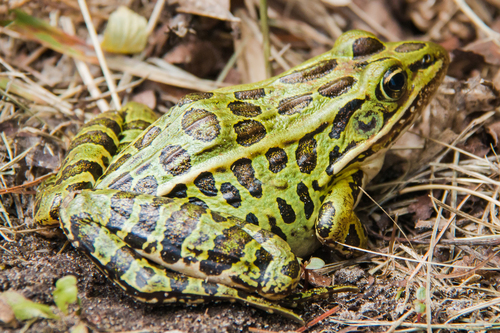
Lithobates sphenocephalus or Rana sphenocephala, commonly known as the southern leopard frog, is a medium-sized anuran in the family Ranidae (the true frogs). The southern leopard frog is one of the 36 species currently or formerly classified in the Rana genus found in North America. It is native to eastern North America from Kansas to New Jersey to Florida. It is also an introduced species in some areas.

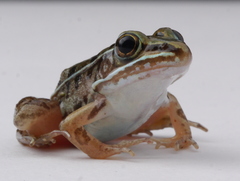
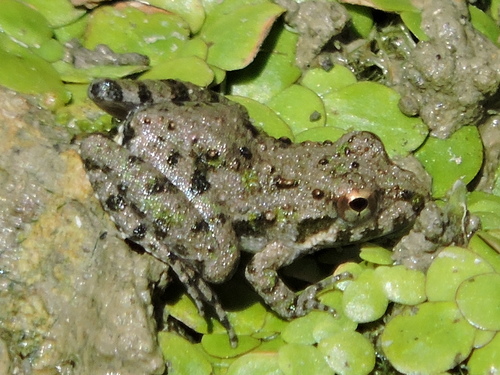
This frog is up to 13 cm (5.1 in) long. Males at sexual maturity average 52.9 mm (2.08 in) snout to vent length and females average 63.8 mm (2.51 in) SVL. It is green or brown in color with a yellowish ridge along each side of the back. Rounded dark spots occur on the back and sides; a light spot is seen on each tympanum. The male has larger fore limbs than the female. The breeding male's vocal sacs are spherical when inflated. The call is described as a "ratchet-like trill", "chuckling croak", or a "squeaky balloon-like sound".

The larva is mottled, and the eyes are positioned on the top of the head. It grows to 7.6 cm (3.0 in) in length before maturing. The female lays an egg mass that is "baseball-sized" when close to hatching time, and contains up to 1,500 eggs... Wikipedia →

Sounds

Advertisement call0:19

United States · 2012

© Chris Harrison · XC894002 · CC BY-NC-SA 4.0

Recording0:22

United States · 2026

© Daniel Collins · iNaturalist · CC BY-NC 4.0

Recording0:17

United States · 2026

© soulflower_ecological · iNaturalist · CC BY-NC 4.0

Global Distribution

Parks Where Found

# Park Country Daily sighting probability
1 Big Cypress National Preserve 🇺🇸 United States
~50%
2 Congaree National Park 🇺🇸 United States
~30%
3 Merritt Island National Wildlife Refuge 🇺🇸 United States
~10%
4 Everglades National Park 🇺🇸 United States
~10%

Cities Where Found

# City Country Daily sighting probability
1 Washington 🇺🇸 United States
~10%
2 Houston 🇺🇸 United States
~10%
3 Orlando 🇺🇸 United States
~10%
4 Dallas 🇺🇸 United States
~10%
5 Miami 🇺🇸 United States
<5%
6 Austin 🇺🇸 United States
<5%

Zoos & Centres Where Found

# Zoo / Centre Country
1 Shedd Aquarium 🇺🇸 United States In captivity
2 Cape May County Park & Zoo 🇺🇸 United States In captivity
3 North Carolina Aquarium at Fort Fisher 🇺🇸 United States In captivity
4 Oklahoma Aquarium 🇺🇸 United States In captivity

Closest Relatives at Austin

Before you go

What are the chances of seeing a Southern Leopard Frog in Austin?

Rare

Under 5% of wildlife watchers report a Southern Leopard Frog sighting in Austin on a given day, based on 11 verified sightings from GBIF citizen-science data. It is the 12th most-seen of the 13 amphibians we can rate there. Over three days the chance rises to about 10%, and over a week to about 20%, if each day is a fresh chance.

When is the best time to see a Southern Leopard Frog in Austin?

November

In that month about 10% of wildlife watchers report a Southern Leopard Frog in Austin on a given day, against under 5% in December to October, the lowest months.

What time of day is best to see a Southern Leopard Frog?

Between 8 and 11 pm

Across all the parks we cover, that three-hour window holds the most Southern Leopard Frog sightings with a recorded time, and about half of them come between 6 am and 6 pm: it is seen both by day and at night.

Is Austin the best place to see a Southern Leopard Frog?

6th of 6

Of the 6 cities where we can rate Southern Leopard Frog sightings, Austin ranks 6th at under 5%. The best odds are in Washington (United States, about 10%), Houston (United States, about 10%) and Orlando (United States, about 10%).

Which relatives of the Southern Leopard Frog live in Austin?

Same genus: Lithobates

The closest relatives of the Southern Leopard Frog that you can see in Austin (genus Lithobates, American Water Frogs) are American Bullfrog (about 10%) and Rio Grande Leopard Frog (about 10%), with each one's daily chance of a sighting.

Where does the Southern Leopard Frog sighting chance come from?

GBIF citizen-science records

It is estimated from how often the Southern Leopard Frog is recorded against all the amphibians logged in Austin (11 verified sightings), calibrated against known sighting rates. Figures are rounded to the nearest 10% because citizen-science data supports honest approximations, not decimals, and months with records from fewer than five people show "—". How it works.

← Back to Austin