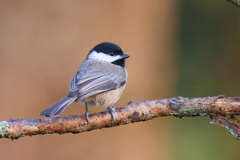
Carolina Chickadee

Carolina Chickadee

Poecile carolinensis

Silhouette: Andy Wilson · PhyloPic

LCLeast ConcernNTVUENCR Endemic
Daily sighting probability ~40% · Likely
at Baltimore

In 3 days ~80% in a week >90%

5,311 Verified sightings at Baltimore
9,223 In all 4 parks From 2019 to 2026
December Best month
☀️ Diurnal When it's spotted

About the Carolina Chickadee

The Carolina chickadee (Poecile carolinensis) is a small passerine bird in the tit family Paridae. It is largely found in the Southern United States. The Carolina chickadee was often placed in the genus Parus with most other tits, but mtDNA cytochrome b sequence data and morphology suggest that separating Poecile more adequately expresses these birds' relationships. The American Ornithologists' Union has been treating Poecile as distinct genus since 1998. Although it and the black-capped chickadee most likely diverged about 2.5 million years ago, the birds still hybridize in the areas where their ranges overlap. The offspring of mated pairs of hybrid chickadees suffer from lower hatching success, and a male bias sex ratio, consistent with Haldane's rule.

Adults are 11.5–13 cm (4.5–5.1 in) long with a weight of 9–12 g (0.32–0.42 oz), and have a black cap and bib with white sides to the face. Their underparts are white with rusty brown on the flanks; their back is gray. They have a short dark bill, short wings and a moderately long tail. Very similar to the black-capped chickadee, the Carolina chickadee is distinguished by the slightly browner wing with... Wikipedia →

Sounds

Duet0:27

United States · 2024

© Sue Riffe · XC938770 · CC BY-NC-SA 4.0

Call0:43

United States · 2024

© Valerie Heemstra · XC871064 · CC BY-NC-SA 4.0

Alarm call1:09

United States · 2022

© Patrick J. Blake · XC734763 · CC BY-NC-SA 4.0

Global Distribution

Parks Where Found

# Park Country Daily sighting probability
1 Congaree National Park 🇺🇸 United States
~80%
2 Great Smoky Mountains National Park 🇺🇸 United States
~70%
3 Shenandoah National Park 🇺🇸 United States
~60%
4 Merritt Island National Wildlife Refuge 🇺🇸 United States
<5%

Cities Where Found

# City Country Daily sighting probability
1 Dallas 🇺🇸 United States
~70%
2 Austin 🇺🇸 United States
~70%
3 Houston 🇺🇸 United States
~60%
4 Washington 🇺🇸 United States
~60%
5 San Antonio 🇺🇸 United States
~60%
6 Baltimore 🇺🇸 United States
~40%
7 Philadelphia 🇺🇸 United States
~30%
8 Orlando 🇺🇸 United States
~20%
9 New York City 🇺🇸 United States
<5%

Zoos & Centres Where Found

# Zoo / Centre Country
1 National Zoological Park 🇺🇸 United States In captivity

Before you go

What are the chances of seeing a Carolina Chickadee in Baltimore?

Likely

About 40% of wildlife watchers report a Carolina Chickadee sighting in Baltimore on a given day, based on 5,311 verified sightings from GBIF citizen-science data. It is the 18th most-seen of the 246 birds we can rate there. Over three days the chance rises to about 80%, and over a week to over 90%, if each day is a fresh chance.

When is the best time to see a Carolina Chickadee in Baltimore?

December

In that month about 60% of wildlife watchers report a Carolina Chickadee in Baltimore on a given day, against about 40% in January to October, the lowest months.

What time of day is best to see a Carolina Chickadee?

Between 7 and 10 am

Across all the parks we cover, that three-hour window holds the most Carolina Chickadee sightings with a recorded time, and about 9 in 10 of them come between 6 am and 6 pm: it is a daytime animal.

Is Baltimore the best place to see a Carolina Chickadee?

6th of 9

Of the 9 cities where we can rate Carolina Chickadee sightings, Baltimore ranks 6th at about 40%. The best odds are in Dallas (United States, about 70%), Austin (United States, about 70%) and Houston (United States, about 60%).

Where does the Carolina Chickadee sighting chance come from?

GBIF citizen-science records

It is estimated from how often the Carolina Chickadee is recorded against all the birds logged in Baltimore (5,311 verified sightings), calibrated against known sighting rates. Figures are rounded to the nearest 10% because citizen-science data supports honest approximations, not decimals, and months with records from fewer than five people show "—". How it works.

← Back to Baltimore