Javan Myna

Javan Myna

Acridotheres javanicus

Silhouette: Andy Wilson · PhyloPic

LCNTVUVulnerableENCR
Daily sighting probability ~30% · Possible
at Bandung

In 3 days ~70% in a week ~90%

59 Verified sightings at Bandung
3,182 In all 7 parks From 2019 to 2026
January Best month
🌅 Crepuscular When it's spotted

About the Javan Myna

The Javan myna (Acridotheres javanicus), also known as the white-vented myna, is a species of myna. It is a member of the starling family. It is native to Bali and Java. It has been introduced to other Asian countries, and as far away as Puerto Rico.

The Javan myna is sometimes included in the great myna (Acridotheres grandis) or the jungle myna (A. fuscus). The International Ornithologists' Union recommends not using the name "white-vented myna" to avoid confusion with the pale-bellied myna A. cinereus.

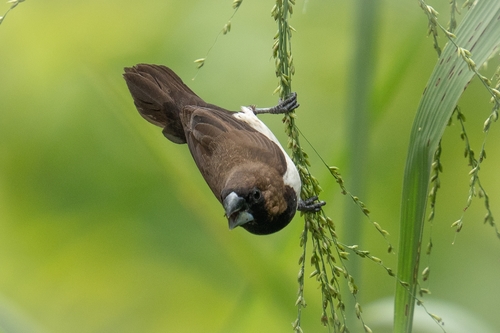
The Javan myna is mainly black. The wings are brownish-black, and the primary feathers have white bases, displayed in flight as a striking white wing bar, along with a white tail bar. The undertail-coverts are white. There is a short crest on the forehead. Its beak, legs and feet are yellow. The eyes are lemon-yellow. The immature is browner. Its length is 21–23 cm (8.3–9.1 in). Its weight is about 100 g (3.5 oz).

The Javan myna is native to Bali and Java, and has been introduced to southeastern Thailand, southern Malaysia, Singapore, Sumatra, the Lesser Sundas, Taiwan, Puerto Rico, Japan and Nepal. It is found in cities and cultivated... Wikipedia →

Sounds

Recording0:15

Taiwan · 2022

© Hong · iNaturalist · CC BY-NC 4.0

Recording0:26

Malaysia · 2021

© Joshua Chow Keng Fatt · iNaturalist · CC BY-NC 4.0

Recording0:05

Singapore · 2020

© e0325215anlydia20 · iNaturalist · CC BY-NC 4.0

Global Distribution

Parks Where Found

# Park Country Daily sighting probability
1 Sepilok 🇲🇾 Malaysia
~50%
2 Kinabatangan Wildlife Sanctuary 🇲🇾 Malaysia
~50%
3 Bali Barat National Park 🇮🇩 Indonesia
~40%
4 Taman Negara National Park 🇲🇾 Malaysia
~30%
5 Gunung Leuser National Park 🇮🇩 Indonesia
~10%
6 Taroko National Park 🇹🇼 Taiwan
<5%
7 Danum Valley Conservation Area 🇲🇾 Malaysia
<5%

Cities Where Found

# City Country Daily sighting probability
1 Taichung 🇹🇼 Taiwan
~90%
2 Tainan 🇹🇼 Taiwan
~80%
3 Kuala Lumpur 🇲🇾 Malaysia
~80%
4 Kaohsiung 🇹🇼 Taiwan
~80%
5 Singapore 🇸🇬 Singapore
~80%
6 Johor Bahru 🇲🇾 Malaysia
~70%
7 Taipei 🇹🇼 Taiwan
~70%
8 Kuching 🇲🇾 Malaysia
~70%
9 Yogyakarta 🇮🇩 Indonesia
~40%
10 Jakarta 🇮🇩 Indonesia
~40%

Zoos & Centres Where Found

# Zoo / Centre Country
1 Bandung Zoo 🇮🇩 Indonesia In captivity

Before you go

What are the chances of seeing a Javan Myna in Bandung?

Possible

About 30% of wildlife watchers report a Javan Myna sighting in Bandung on a given day, based on 59 verified sightings from GBIF citizen-science data. It is the 4th most-seen of the 28 birds we can rate there. Over three days the chance rises to about 70%, and over a week to about 90%, if each day is a fresh chance.

When is the best time to see a Javan Myna in Bandung?

March and December–January

In those months about 40% of wildlife watchers report a Javan Myna in Bandung on a given day, against about 10% in February, the lowest month. Those are among Bandung's wettest months, with about 330 mm of rain a month against 45 mm in August.

What time of day is best to see a Javan Myna?

Between 1 and 4 am

Across all the parks we cover, that three-hour window holds the most Javan Myna sightings with a recorded time, and about half of them come between 6 pm and 6 am: it is most active around dawn and dusk.

Is Bandung the best place to see a Javan Myna?

11th of 12

Of the 12 cities where we can rate Javan Myna sightings, Bandung ranks 11th at about 30%. The best odds are in Taichung (Taiwan, about 90%), Tainan (Taiwan, about 80%) and Kuala Lumpur (Malaysia, about 80%).

Where does the Javan Myna sighting chance come from?

GBIF citizen-science records

It is estimated from how often the Javan Myna is recorded against all the birds logged in Bandung (59 verified sightings), calibrated against known sighting rates. Figures are rounded to the nearest 10% because citizen-science data supports honest approximations, not decimals, and months with records from fewer than five people show "—". How it works.

← Back to Bandung