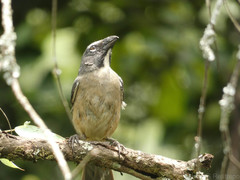
Olivaceous Saltator

Olivaceous Saltator

Saltator olivascens

Silhouette: Sheatherius · PhyloPic

LCLeast ConcernNTVUENCR
Daily sighting probability ~40% · Likely
at Barranquilla

In 3 days ~80% in a week >90%

305 Verified sightings at Barranquilla
613 In all 4 parks From 2019 to 2026
August Best month
☀️ Diurnal When it's spotted

About the Olivaceous Saltator

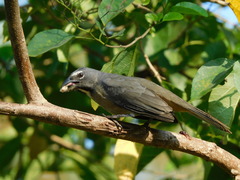
The olive-grey saltator (Saltator olivascens), also known as the Caribbean grey saltator, is a quiet, grey-colored passerine bird in the tanager family Thraupidae, native to Colombia, Venezuela, the Guianas, far northern Brazil, and Trinidad. It was formerly considered conspecific with the greyish saltator (Saltator coerulescens), but was split as a distinct species by the IOC in 2021. The olive-grey saltator includes the subspecies brewsteri and plumbeus.

Previously grouped with the bluish-grey Saltator (Saltator coerulescens) and cinnamon-bellied saltator (Saltator grandis) into one species, the greyish saltator, the olive-grey saltator (Saltator olivascens) was split in 2021 by the IOC on the basis of vocal and genetic differences, as well as the fact that the three occupy different ranges.

This species includes three subspecies, ssp. olivascens, plumbeus, and brewsteri. The olive-grey saltator has a thick, black bill that is slightly hooked at the end, with white supercilliaries (giving it a distinct white "eyebrow"), and a thin white crescent under its eye. Distinct black malar stripes frame either side of a white throat. Its underside is a light... Wikipedia →

Sounds

Call0:30

Colombia · 2020

© Hernán Arias · XC721914 · CC BY-NC-SA 4.0

Song0:08

Colombia · 2020

© A Edwar H Guarín · XC579290 · CC BY-NC-SA 4.0

Song0:09

Colombia · 2019

© Arcadio Marin · XC573311 · CC BY-NC-SA 4.0

Global Distribution

Parks Where Found

# Park Country Daily sighting probability
1 Tayrona National Natural Park 🇨🇴 Colombia
~30%
2 Henri Pittier National Park 🇻🇪 Venezuela
~20%
3 Caroni Swamp 🇹🇹 Trinidad and Tobago
~10%
4 Sierra de la Macarena National Park 🇨🇴 Colombia
<5%

Cities Where Found

# City Country Daily sighting probability
1 Valencia 🇻🇪 Venezuela
~40%
2 Barranquilla 🇨🇴 Colombia
~40%
3 Caracas 🇻🇪 Venezuela
~30%
4 Maracaibo 🇻🇪 Venezuela
~30%
5 Medellín 🇨🇴 Colombia
~20%
6 Bogota 🇨🇴 Colombia
<5%

Before you go

What are the chances of seeing an Olivaceous Saltator in Barranquilla?

Likely

About 40% of wildlife watchers report an Olivaceous Saltator sighting in Barranquilla on a given day, based on 305 verified sightings from GBIF citizen-science data. It is the 17th most-seen of the 153 birds we can rate there. Over three days the chance rises to about 80%, and over a week to over 90%, if each day is a fresh chance.

When is the best time to see an Olivaceous Saltator in Barranquilla?

August

In that month about 70% of wildlife watchers report an Olivaceous Saltator in Barranquilla on a given day, against about 20% in December and January, the lowest months.

What time of day is best to see an Olivaceous Saltator?

Between 8 and 11 am

Across all the parks we cover, that three-hour window holds the most Olivaceous Saltator sightings with a recorded time, and about 9 in 10 of them come between 6 am and 6 pm: it is a daytime animal.

Is Barranquilla the best place to see an Olivaceous Saltator?

Among the best

Of the 6 cities where we can rate Olivaceous Saltator sightings, Barranquilla ranks 2nd at about 40%, level with the leaders once rounded. The best odds are in Valencia (Venezuela, about 40%).

Which relatives of the Olivaceous Saltator live in Barranquilla?

Same family: Thraupidae

The closest relatives of the Olivaceous Saltator that you can see in Barranquilla (family Thraupidae, Tanagers and Allies) are Saffron Finch (about 30%), Bananaquit (about 20%) and Blue-gray Tanager (about 20%), with each one's daily chance of a sighting.

Where does the Olivaceous Saltator sighting chance come from?

GBIF citizen-science records

It is estimated from how often the Olivaceous Saltator is recorded against all the birds logged in Barranquilla (305 verified sightings), calibrated against known sighting rates. Figures are rounded to the nearest 10% because citizen-science data supports honest approximations, not decimals, and months with records from fewer than five people show "—". How it works.

← Back to Barranquilla