





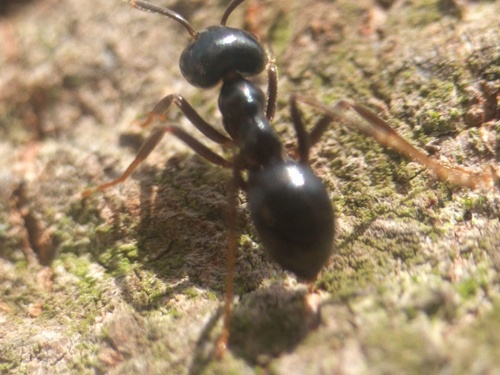






European Fire Ant

European Fire Ant

Myrmica rubra

Daily sighting probability <5% · Rare
at Berlin

In 3 days ~10% in a week ~20%

11 Verified sightings at Berlin
46 In all 2 parks From 2019 to 2026
February Best month
☀️ Diurnal When it's spotted

About the European Fire Ant

Myrmica rubra, also known in the UK as the common red ant or in the USA as the European fire ant, is a species of ant of the genus Myrmica. It is found across Europe and is now invasive in some parts of North America and Asia. It is mainly red in colour, with slightly darker pigmentation on the head. These ants live under stones and fallen trees, and in soil. They are aggressive, often attacking rather than running away, and are equipped with a stinger, though they lack the ability to spray formic acid like the genus Formica.

This species is very similar to M. ruginodis, M. rubra is common in Southern England and becomes rarer further north whereas M. ruginodis is common all over the UK including Northern Scotland. The larvae of the butterflies Phengaris alcon (Alcon blue) and P. teleius (scarce large blue) use M. rubra as their primary host.

Research from the University of Maine suggests that a certain type of nematode might be a catalyst for colony collapse, which suggests a possible management method for Myrmica rubra. This is one of the most common and widespread Myrmica species of the Palaearctic. It occurs in the region stretching from Portugal to... Wikipedia →

Global Distribution

Parks Where Found

# Park Country Daily sighting probability
1 Acadia National Park 🇺🇸 United States
~10%
2 Wadden Sea National Park 🇩🇪 Germany
<5%

Cities Where Found

# City Country Daily sighting probability
1 Nizhny Novgorod 🇷🇺 Russia
~10%
2 Toronto 🇨🇦 Canada
~10%
3 Brussels 🇧🇪 Belgium
<5%
4 Kyiv 🇺🇦 Ukraine
<5%
5 Warsaw 🇵🇱 Poland
<5%
6 Boston 🇺🇸 United States
<5%
7 London 🇬🇧 United Kingdom
<5%
8 Helsinki 🇫🇮 Finland
<5%
9 Berlin 🇩🇪 Germany
<5%
10 Essen 🇩🇪 Germany
<5%

Before you go

What are the chances of seeing a European Fire Ant in Berlin?

Rare

Under 5% of wildlife watchers report a European Fire Ant sighting in Berlin on a given day, based on 11 verified sightings from GBIF citizen-science data. It is the 593rd most-seen of the 1065 insects we can rate there. Over three days the chance rises to about 10%, and over a week to about 20%, if each day is a fresh chance.

When is the best time to see a European Fire Ant in Berlin?

February and May

In those months about 10% of wildlife watchers report a European Fire Ant in Berlin on a given day, against under 5% in March–April and June–January, the lowest months.

What time of day is best to see a European Fire Ant?

Between 10 am and 1 pm

Across all the parks we cover, that three-hour window holds the most European Fire Ant sightings with a recorded time, and about 9 in 10 of them come between 6 am and 6 pm: it is a daytime animal.

Is Berlin the best place to see a European Fire Ant?

9th of 16

Of the 16 cities where we can rate European Fire Ant sightings, Berlin ranks 9th at under 5%. The best odds are in Nizhny Novgorod (Russia, about 10%), Toronto (Canada, about 10%) and Brussels (Belgium, under 5%).

Which relatives of the European Fire Ant live in Berlin?

Same family: Formicidae

The closest relatives of the European Fire Ant that you can see in Berlin (family Formicidae, Ants) are Dolichoderus quadripunctatus (about 10%), Camponotus fallax (about 10%) and Jet Ant (about 10%), with each one's daily chance of a sighting.

Where does the European Fire Ant sighting chance come from?

GBIF citizen-science records

It is estimated from how often the European Fire Ant is recorded against all the insects logged in Berlin (11 verified sightings), calibrated against known sighting rates. Figures are rounded to the nearest 10% because citizen-science data supports honest approximations, not decimals, and months with records from fewer than five people show "—". How it works.

← Back to Berlin