Yellow-necked Field Mouse

Yellow-necked Field Mouse

Apodemus flavicollis

Silhouette: Anthony Caravaggi · PhyloPic

LCLeast ConcernNTVUENCR
Daily sighting probability ~10% · With luck
at Berlin

In 3 days ~20% in a week ~40%

16 Verified sightings at Berlin
April Best month
☀️ Diurnal When it's spotted

About the Yellow-necked Field Mouse

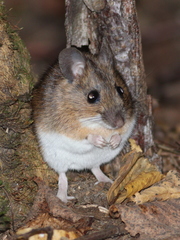
The yellow-necked mouse (Apodemus flavicollis), also called yellow-necked field mouse or yellow-necked wood mouse, is closely related to the wood mouse, with which it was long confused. It was only recognised as a separate species in 1894. It differs in its band of yellow fur around the neck and in having slightly larger ears and usually being slightly larger overall. Around 100 mm in length, it can climb trees and sometimes overwinters in houses. It is found mostly in mountainous areas of southern Europe, but extends north into parts of Scandinavia and Britain. It facilitates the spread of tick-borne encephalitis to humans and is a reservoir species for the Dobrava virus, a hantavirus that is responsible for causing haemorrhagic fever with renal syndrome.

Apodemus ponticus is probably a synonym of Apodemus flavicollis. The former is found in the former Soviet Union with the boundary between the two being the political boundary between Russia and Western Europe. For many years direct comparison of the two species was not possible because of political tensions but it is now accepted that they are in reality the same species.

The yellow-necked mouse is... Wikipedia →

Global Distribution

Parks Where Found

# Park Country Daily sighting probability

More parks will be added in future updates.

Cities Where Found

# City Country Daily sighting probability
1 Helsinki 🇫🇮 Finland
~10%
2 Berlin 🇩🇪 Germany
~10%
3 Hamburg 🇩🇪 Germany
~10%
4 Munich 🇩🇪 Germany
<5%
5 Saint Petersburg 🇷🇺 Russia
<5%

Zoos & Centres Where Found

# Zoo / Centre Country
1 Hellabrunn Zoo 🇩🇪 Germany In captivity
2 Wildkatzengehege 🇩🇪 Germany In captivity
3 Tierpark Schlichtweg 15 in München 🇩🇪 Germany In captivity
4 Zoo Schlichtweg 11 in München 🇩🇪 Germany In captivity
5 Zoo Siebenbrunner Straße 6 in München 🇩🇪 Germany In captivity

Before you go

What are the chances of seeing a Yellow-necked Field Mouse in Berlin?

With luck

About 10% of wildlife watchers report a Yellow-necked Field Mouse sighting in Berlin on a given day, based on 16 verified sightings from GBIF citizen-science data. It is the 16th most-seen of the 19 mammals we can rate there. Over three days the chance rises to about 20%, and over a week to about 40%, if each day is a fresh chance.

When is the best time to see a Yellow-necked Field Mouse in Berlin?

March–May, July–September and December

In those months about 10% of wildlife watchers report a Yellow-necked Field Mouse in Berlin on a given day, against under 5% in January–February, June and October–November, the lowest months.

What time of day is best to see a Yellow-necked Field Mouse?

Between 11 am and 2 pm

Across all the parks we cover, that three-hour window holds the most Yellow-necked Field Mouse sightings with a recorded time, and about 7 in 10 of them come between 6 am and 6 pm: it is a daytime animal.

Is Berlin the best place to see a Yellow-necked Field Mouse?

Among the best

Of the 5 cities where we can rate Yellow-necked Field Mouse sightings, Berlin ranks 2nd at about 10%, level with the leaders once rounded. The best odds are in Helsinki (Finland, about 10%).

Where does the Yellow-necked Field Mouse sighting chance come from?

GBIF citizen-science records

It is estimated from how often the Yellow-necked Field Mouse is recorded against all the mammals logged in Berlin (16 verified sightings), calibrated against known sighting rates. Figures are rounded to the nearest 10% because citizen-science data supports honest approximations, not decimals, and months with records from fewer than five people show "—". How it works.

← Back to Berlin