Dubious Dtella

Dubious Dtella

Gehyra dubia

Silhouette: Gopal Murali · PhyloPic

LCLeast ConcernNTVUENCR
Daily sighting probability <5% · Rare
at Brisbane

In 3 days ~10% in a week ~20%

10 Verified sightings at Brisbane
6 In 1 park From 2019 to 2026
December Best month
🌙 Nocturnal When it's spotted

About the Dubious Dtella

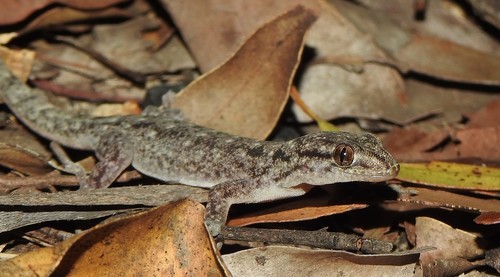
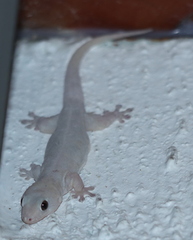
The dubious dtella, native Australian house gecko, or dubious four-clawed gecko (Gehyra dubia) is a species of gecko in the genus Gehyra, native to Northeastern Australia (Queensland and northern New South Wales as well as islands of the Great Barrier Reef and the Torres Strait). The lizard is found in a variety of habitats, including acacia and eucalyptus woodlands, and in human-developed habitats, such as house walls in urban areas. Its urban presence makes it known as a common house gecko in Queensland. These geckos are often confused with the Asian common house gecko, which was introduced to Australia from Indonesia, but G. dubia has distinct rounded feet and quieter calls.

Gehyra dubia is a small gecko; its snout-to-vent length ranges up to 6 cm, and its tail length ranging up to 14 cm. Body size does not vary significantly between the sexes. While resting, they are typically a dull gray-brown color and carry dark spots all over the dorsal side. It has a slight camouflage ability, and often changes to a lighter brown. When foraging, they lose the spots on their back. These geckos have four limbs, each complete with five digits. On each digit is situated... Wikipedia →
Global Distribution

Parks Where Found

# Park Country Daily sighting probability
1 Daintree National Park 🇦🇺 Australia
~10%

More parks will be added in future updates.

Cities Where Found

# City Country Daily sighting probability
1 Brisbane 🇦🇺 Australia
<5%

Before you go

What are the chances of seeing a Dubious Dtella in Brisbane?

Rare

Under 5% of wildlife watchers report a Dubious Dtella sighting in Brisbane on a given day, based on 10 verified sightings from GBIF citizen-science data. It is the 37th most-seen of the 43 reptiles we can rate there. Over three days the chance rises to about 10%, and over a week to about 20%, if each day is a fresh chance.

When is the best time to see a Dubious Dtella in Brisbane?

December and January

In those months about 10% of wildlife watchers report a Dubious Dtella in Brisbane on a given day, against under 5% in February to November, the lowest months. Those are among Brisbane's wettest months, with about 140 mm of rain a month against 40 mm in July.

What time of day is best to see a Dubious Dtella?

Between 7 and 10 pm

Across all the parks we cover, that three-hour window holds the most Dubious Dtella sightings with a recorded time, and about 8 in 10 of them come between 6 pm and 6 am: it is mostly seen at night.

Where else can you see a Dubious Dtella?

Only Brisbane, in our data

Brisbane is the only city on Wallace's Line with enough records to rate Dubious Dtella sightings: under 5% of wildlife watchers there report one on a given day.

Where does the Dubious Dtella sighting chance come from?

GBIF citizen-science records

It is estimated from how often the Dubious Dtella is recorded against all the reptiles logged in Brisbane (10 verified sightings), calibrated against known sighting rates. Figures are rounded to the nearest 10% because citizen-science data supports honest approximations, not decimals, and months with records from fewer than five people show "—". How it works.

← Back to Brisbane