Mangrove Gerygone

Mangrove Gerygone

Gerygone levigaster

Silhouette: Sheatherius · PhyloPic

LCLeast ConcernNTVUENCR
Daily sighting probability ~10% · With luck
at Brisbane

In 3 days ~10% in a week ~30%

833 Verified sightings at Brisbane
53 In all 2 parks From 2019 to 2026
June Best month
☀️ Diurnal When it's spotted

About the Mangrove Gerygone

The mangrove gerygone (Gerygone levigaster) is a species of bird in the Australian warbler family Acanthizidae. The species is also known as the mangrove warbler. The species is thought to form a superspecies with the closely related fan-tailed gerygone of Melanesia and the Australian western gerygone. The species is uncommon in New Guinea and has suffered some declines due to mangrove clearances but is not considered threatened by the IUCN.

The species is principally distributed in mangrove forests and in forests and woodland adjacent to mangroves. The species will move into nearby forests from mangroves to feed, particularly in the breeding season. Where its range overlaps with that of the large-billed gerygone in the Kimberley it is actually displaced from the mangroves and is instead found in scrubland dominated by paperbarks and acacia.

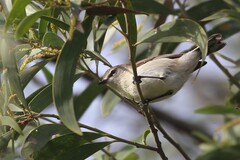
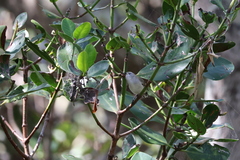
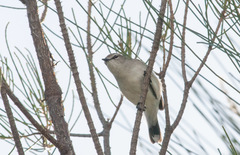
The mangrove gerygone is a typical member of the genus Gerygone, they are small birds with rounded wings, 9–11 cm long and weighing 6 g. The plumage is grey above with a white throat, belly, flanks and rump. There is a distinct white eye stripe. The bill and legs are black and the iris is red. The song, which is similar to that of the western gerygone, has been described as "sweet, rich, tuneful".

The species feeds in the foliage of trees on insects, including beetles, grasshoppers, wasps, ants and moths. It is less likely to catch prey in the air than other gerygones, but will join mixed-species feeding flocks with white-eyes, honey-eaters and fantails. The species mostly feeds in the canopy but will forage amongst the roots of mangroves.

The mangrove gerygone breeds throughout the year, although principally in spring-summer in the east of Australia and during the dry season in the north. The female builds the oval domed nest. It is constructed out of roots, grass, spider webs, moss, seaweed and bark, and hangs from mangroves. Two to three eggs, are laid in the nest and are incubated for 14–17 days. Both parents feed the chick for another 14–17 days. A number of cuckoo species are brood parasites of this species. Wikipedia →

Sounds

Song0:14

Australia · 2022

© Marc Anderson · XC705138 · CC BY-NC-ND 4.0

Call1:05

Australia · 2017

© Greg McLachlan · XC388284 · CC BY-NC-SA 4.0

Song0:16

Australia · 2021

© James Lambert · XC644958 · CC BY-NC-ND 4.0

Global Distribution

Parks Where Found

# Park Country Daily sighting probability
1 Noosa National Park 🇦🇺 Australia
~10%
2 Kakadu National Park 🇦🇺 Australia
<5%

Cities Where Found

# City Country Daily sighting probability
1 Brisbane 🇦🇺 Australia
~10%
2 Sydney 🇦🇺 Australia
<5%

Before you go

What are the chances of seeing a Mangrove Gerygone in Brisbane?

With luck

About 10% of wildlife watchers report a Mangrove Gerygone sighting in Brisbane on a given day, based on 833 verified sightings from GBIF citizen-science data. It is the 106th most-seen of the 237 birds we can rate there. Over three days the chance rises to about 10%, and over a week to about 30%, if each day is a fresh chance.

When is the best time to see a Mangrove Gerygone in Brisbane?

January, May–September and November

In those months about 10% of wildlife watchers report a Mangrove Gerygone in Brisbane on a given day, against under 5% in February–April, October and December, the lowest months.

What time of day is best to see a Mangrove Gerygone?

Between 9 am and noon

Across all the parks we cover, that three-hour window holds the most Mangrove Gerygone sightings with a recorded time, and about 9 in 10 of them come between 6 am and 6 pm: it is a daytime animal.

Is Brisbane the best place to see a Mangrove Gerygone?

Yes

Of the 2 cities where we can rate Mangrove Gerygone sightings, Brisbane has the highest daily chance: about 10%. Next come Sydney (Australia, under 5%).

Where does the Mangrove Gerygone sighting chance come from?

GBIF citizen-science records

It is estimated from how often the Mangrove Gerygone is recorded against all the birds logged in Brisbane (833 verified sightings), calibrated against known sighting rates. Figures are rounded to the nearest 10% because citizen-science data supports honest approximations, not decimals, and months with records from fewer than five people show "—". How it works.

← Back to Brisbane