Brown Gerygone

Brown Gerygone

Gerygone mouki

Silhouette: Sheatherius · PhyloPic

LCLeast ConcernNTVUENCR Endemic
Daily sighting probability <5% · Rare
at Brisbane

In 3 days <5%

10 Verified sightings at Brisbane
4,445 In all 7 parks From 2019 to 2026
June Best month
☀️ Diurnal When it's spotted

About the Brown Gerygone

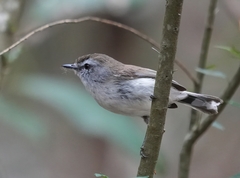
The brown gerygone (Gerygone mouki), previously known as the brown warbler, is a small passerine bird native to eastern coastal Australia. The upper parts are olive-brown (or olive-grey for the nominate subspecies native to far-north Queensland), while its face and underparts are a much paler grey, cream, or washed-out brown. The tail feathers are dark and may be white-tipped. It is approximately 10 cm in length.

The brown gerygone has a relatively large range. Although total population trends have not been quantified, it is considered of "least concern" by the IUCN. It may be sighted in coastal rainforest, singly or in small groups of two to four. It feeds on insects. The brown gerygone call is a soft what-is-it.

It is not closely related to either true Old World Warblers or the New World Warblers, but belongs rather to the Corvida parvorder comprising many tropical and Australian passerines, as well as crows. The brown gerygone is similar to both the large-billed (G. magnirostris) and mangrove (G. levigaster) gerygones. It differs from the former by having a distinctive white eyebrow and a grey-tinged face. The mangrove gerygone, while having a white eyebrow, lacks the grey face, has more white on the flanks and has a redder eye. Wikipedia →

Sounds

Song0:16

Australia · 2023

© Romuald Mikusek · XC1170145 · CC BY-NC-SA 4.0

Call1:00

Australia · 2025

© Peter Boesman · XC1066581 · CC BY-NC-ND 4.0

Flight call0:33

Australia · 2022

© Eddy Smith · XC747043 · CC BY-NC-SA 4.0

Global Distribution

Parks Where Found

# Park Country Daily sighting probability
1 Lamington National Park 🇦🇺 Australia
~60%
2 Royal National Park 🇦🇺 Australia
~30%
3 Springbrook National Park 🇦🇺 Australia
~20%
4 Blue Mountains National Park 🇦🇺 Australia
~20%
5 Booderee National Park 🇦🇺 Australia
~20%
6 Wilsons Promontory National Park 🇦🇺 Australia
<5%
7 Daintree National Park 🇦🇺 Australia
<5%

Cities Where Found

# City Country Daily sighting probability
1 Sydney 🇦🇺 Australia
~10%
2 Melbourne 🇦🇺 Australia
<5%
3 Brisbane 🇦🇺 Australia
<5%

Before you go

What are the chances of seeing a Brown Gerygone in Brisbane?

Rare

Under 5% of wildlife watchers report a Brown Gerygone sighting in Brisbane on a given day, based on 10 verified sightings from GBIF citizen-science data. It is the 224th most-seen of the 237 birds we can rate there. Over three days the chance rises to under 5%, if each day is a fresh chance.

When is the best time to see a Brown Gerygone in Brisbane?

Any time of year

In every month with enough records, under 5% of wildlife watchers report a Brown Gerygone in Brisbane on a given day, so our monthly data shows no clear season.

What time of day is best to see a Brown Gerygone?

Between 11 am and 2 pm

Across all the parks we cover, that three-hour window holds the most Brown Gerygone sightings with a recorded time, and nearly all of them come between 6 am and 6 pm: it is a daytime animal.

Is Brisbane the best place to see a Brown Gerygone?

3rd of 3

Of the 3 cities where we can rate Brown Gerygone sightings, Brisbane ranks 3rd at under 5%. The best odds are in Sydney (Australia, about 10%) and Melbourne (Australia, under 5%).

Where does the Brown Gerygone sighting chance come from?

GBIF citizen-science records

It is estimated from how often the Brown Gerygone is recorded against all the birds logged in Brisbane (10 verified sightings), calibrated against known sighting rates. Figures are rounded to the nearest 10% because citizen-science data supports honest approximations, not decimals, and months with records from fewer than five people show "—". How it works.

← Back to Brisbane