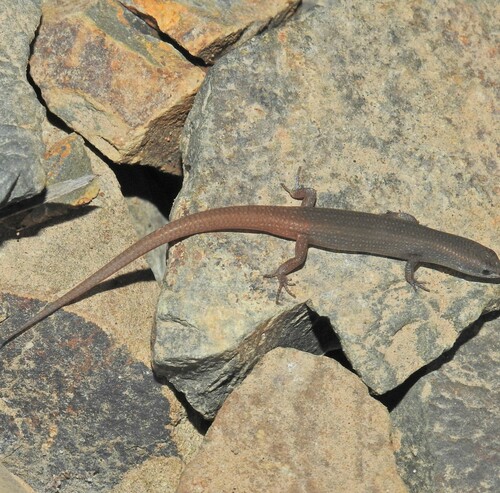
Pink-Tongued Lizard

Pink-Tongued Lizard

Cyclodomorphus gerrardii

Silhouette: Kailah Thorn & Mark Hutchinson · PhyloPic

LCLeast ConcernNTVUENCR Endemic
Daily sighting probability ~10% · With luck
at Brisbane

In 3 days ~20% in a week ~40%

54 Verified sightings at Brisbane
95 In all 3 parks From 2019 to 2026
March Best month
☀️🌙 Day & Night When it's spotted

About the Pink-Tongued Lizard

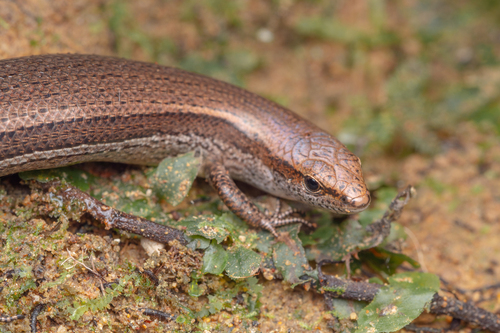
The pink-tongued skink (Cyclodomorphus gerrardii) is a species of lizard in the family Scincidae. It is endemic to Australia, where it is also called commonly the pink-tongued lizard. As suggested by these common names, its distinguishing characteristic is a pink tongue as opposed to the blue tongue of lizards of the closely related genus Tiliqua.

The specific name, gerrardii, is in honor of British zoologist Edward Gerrard (1810–1910), who was Gray's "right-hand man" at the British Museum. C. gerrardii is endemic to Australia. It can be found from Springwood, New South Wales, along the eastern coastal country and eastern ranges to the Cairns Region, Queensland.

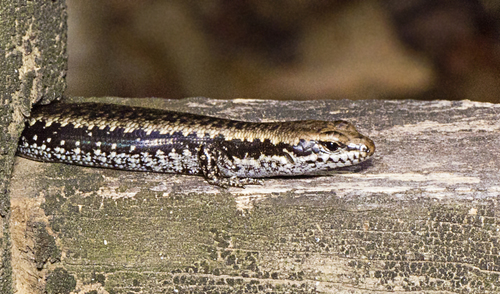
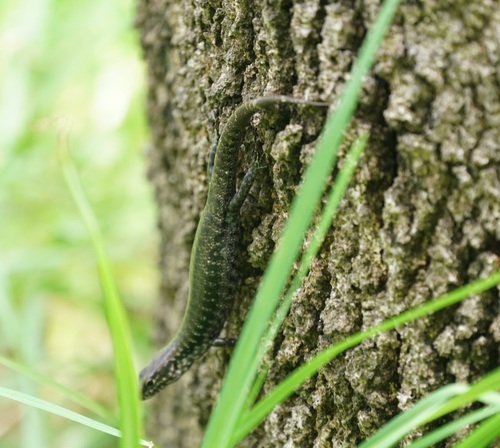
C. gerrardii is a relatively large lizard of up to 45 cm (18 in) total length (including tail). It has a slender body with a long, slender and slightly prehensile tail about the same length as the body. The limbs are well developed with long digits and sharp claws. The neck is well pronounced, and the head is relatively large, wider in males than in females. In adults the tongue is pink. C. gerrardii has a slate-grey to fawn dorsal ground colour with dark grey to brown... Wikipedia →

Global Distribution

Parks Where Found

# Park Country Daily sighting probability
1 Lamington National Park 🇦🇺 Australia
~20%
2 Blue Mountains National Park 🇦🇺 Australia
~20%
3 Springbrook National Park 🇦🇺 Australia
~10%

Cities Where Found

# City Country Daily sighting probability
1 Brisbane 🇦🇺 Australia
~10%

Zoos & Centres Where Found

# Zoo / Centre Country
1 Copenhagen Zoo 🇩🇰 Denmark In captivity
2 Elizabeth's Wildlife Center 🇨🇦 Canada In captivity

Before you go

What are the chances of seeing a Pink-Tongued Lizard in Brisbane?

With luck

About 10% of wildlife watchers report a Pink-Tongued Lizard sighting in Brisbane on a given day, based on 54 verified sightings from GBIF citizen-science data. It is the 23rd most-seen of the 43 reptiles we can rate there. Over three days the chance rises to about 20%, and over a week to about 40%, if each day is a fresh chance.

When is the best time to see a Pink-Tongued Lizard in Brisbane?

June, August–September and November–April

In those months about 10% of wildlife watchers report a Pink-Tongued Lizard in Brisbane on a given day, against under 5% in May, July and October, the lowest months.

What time of day is best to see a Pink-Tongued Lizard?

Between 7 and 10 pm

Across all the parks we cover, that three-hour window holds the most Pink-Tongued Lizard sightings with a recorded time, and about 6 in 10 of them come between 6 pm and 6 am: it is seen both by day and at night.

Where else can you see a Pink-Tongued Lizard?

Only Brisbane, in our data

Brisbane is the only city on Wallace's Line with enough records to rate Pink-Tongued Lizard sightings: about 10% of wildlife watchers there report one on a given day.

Where does the Pink-Tongued Lizard sighting chance come from?

GBIF citizen-science records

It is estimated from how often the Pink-Tongued Lizard is recorded against all the reptiles logged in Brisbane (54 verified sightings), calibrated against known sighting rates. Figures are rounded to the nearest 10% because citizen-science data supports honest approximations, not decimals, and months with records from fewer than five people show "—". How it works.

← Back to Brisbane