Blue-billed Black-Tyrant

Blue-billed Black-Tyrant

Knipolegus cyanirostris

Silhouette: Emily Willoughby · PhyloPic

LCLeast ConcernNTVUENCR
Daily sighting probability <5% · Rare
at Buenos Aires

In 3 days ~10% in a week ~20%

421 Verified sightings at Buenos Aires
837 In all 4 parks From 2019 to 2026
July Best month
☀️ Diurnal When it's spotted

About the Blue-billed Black-Tyrant

The blue-billed black tyrant (Knipolegus cyanirostris) is a species of bird in the family Tyrannidae, the tyrant flycatchers. It is found in Argentina, Brazil, Paraguay, and Uruguay. The blue-billed black tyrant was formally described in 1818 as Muscicapa cyanirostris, placing it in the Old World flycatcher family. It was later transferred to genus Knipolegus, which was erected in 1826 with it as the type species.

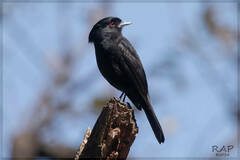
The blue-billed black tyrant is monotypic. The blue-billed black tyrant is 14.5 to 15 cm (5.7 to 5.9 in) long. Adult males are almost entirely glossy black but for faint white edges on the underside of their remiges. Adult females have mostly rufous-brown upperparts. Their crown is a brighter rufous, their rump rufous, and their tail coverts bright cinnamon. Their wings are blackish with buff to cinnamon edges on the coverts that show as two wing bars. Their tail is dusky with rufous edges to the feathers. Their underparts are mostly whitish to yellowish white with heavy blackish brown streaks and their crissum is cinnamon-rufous. Males have a bright red iris, a pale blue bill with a black tip, and black legs and feet. Females... Wikipedia →

Sounds

Call0:29

Argentina · 2008

© Bernabe Lopez-Lanus · XC45194 · CC BY-NC-SA 3.0

Song0:23

Brazil · 2021

© Lia Nahomi Kajiki · XC646468 · CC BY-NC-SA 4.0

Call0:11

Brazil · 2020

© Dante Buzzetti · XC544447 · CC BY-NC-SA 4.0

Global Distribution

Parks Where Found

# Park Country Daily sighting probability
1 Itatiaia National Park 🇧🇷 Brazil
~30%
2 El Palmar National Park 🇦🇷 Argentina
~20%
3 Iberá National Park 🇦🇷 Argentina
<5%
4 Serra dos Órgãos National Park 🇧🇷 Brazil
<5%

Cities Where Found

# City Country Daily sighting probability
1 Buenos Aires 🇦🇷 Argentina
<5%

Before you go

What are the chances of seeing a Blue-billed Black-Tyrant in Buenos Aires?

Rare

Under 5% of wildlife watchers report a Blue-billed Black-Tyrant sighting in Buenos Aires on a given day, based on 421 verified sightings from GBIF citizen-science data. It is the 147th most-seen of the 274 birds we can rate there. Over three days the chance rises to about 10%, and over a week to about 20%, if each day is a fresh chance.

When is the best time to see a Blue-billed Black-Tyrant in Buenos Aires?

July to September

In those months about 10% of wildlife watchers report a Blue-billed Black-Tyrant in Buenos Aires on a given day, against under 5% in October to June, the lowest months.

What time of day is best to see a Blue-billed Black-Tyrant?

Between 9 am and noon

Across all the parks we cover, that three-hour window holds the most Blue-billed Black-Tyrant sightings with a recorded time, and about 9 in 10 of them come between 6 am and 6 pm: it is a daytime animal.

Where else can you see a Blue-billed Black-Tyrant?

Only Buenos Aires, in our data

Buenos Aires is the only city on Wallace's Line with enough records to rate Blue-billed Black-Tyrant sightings: under 5% of wildlife watchers there report one on a given day.

Which relatives of the Blue-billed Black-Tyrant live in Buenos Aires?

Same family: Tyrannidae

The closest relatives of the Blue-billed Black-Tyrant that you can see in Buenos Aires (family Tyrannidae, Tyrant Flycatchers) are Great Kiskadee (about 90%), Cattle Tyrant (about 50%) and White-crested Tyrannulet (about 30%), with each one's daily chance of a sighting.

Where does the Blue-billed Black-Tyrant sighting chance come from?

GBIF citizen-science records

It is estimated from how often the Blue-billed Black-Tyrant is recorded against all the birds logged in Buenos Aires (421 verified sightings), calibrated against known sighting rates. Figures are rounded to the nearest 10% because citizen-science data supports honest approximations, not decimals, and months with records from fewer than five people show "—". How it works.

← Back to Buenos Aires