Polka-dot Tree Frog

Polka-dot Tree Frog

Boana punctata

Silhouette: Andy Wilson · PhyloPic

LCLeast ConcernNTVUENCR
Daily sighting probability ~20% · Possible
at Campo Grande

In 3 days ~40% in a week ~70%

5 Verified sightings at Campo Grande
44 In all 2 parks From 2019 to 2026
January Best month
🌙 Nocturnal When it's spotted

About the Polka-dot Tree Frog

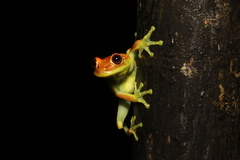
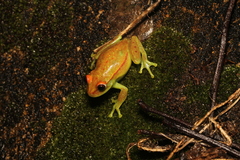
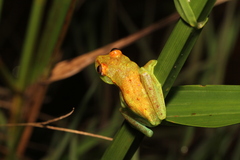
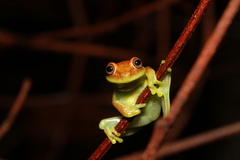
The polka-dot tree frog (Boana punctata), also known as the dotted tree frog, is a frog species in the family Hylidae found in much of South America and also in Trinidad and Tobago. It is fairly small with a snout–to–vent length of c. 3–4 cm (1.2–1.6 in).

Its natural habitats are subtropical or tropical dry forest, subtropical or tropical moist lowland forest, subtropical or tropical swamps, subtropical or tropical moist montane forest, swamps, freshwater marshes, intermittent freshwater marshes, rural gardens, urban areas, and heavily degraded former forests. It is not considered threatened by the IUCN.

In 2017, several polka-dot tree frogs collected in the Santa Fe Province in Argentina were the first amphibian, amongst more than 6,000 species of frog, identified as naturally fluorescent. Among land-living vertebrates, it had only been confirmed earlier in certain parrots (as opposed to fish and invertebrates where fluorescence is relatively widespread). A few months later, fluorescence was discovered in the closely related Boana atlantica, and in 2019 it was discovered in the distantly related pumpkin toadlet (Brachycephalus ephippium) and... Wikipedia →

Sounds

Recording1:08

Brazil · 1985

© M.S. Hoogmoed · XC882725 · CC BY 4.0

Recording0:21

Brazil · 2020

© Marllus Rafael Almeida · iNaturalist · CC BY-NC 4.0

Recording0:09

French Guiana · 2025

© augustinbussac · iNaturalist · CC BY-NC 4.0

Global Distribution

Parks Where Found

# Park Country Daily sighting probability
1 Manu National Park 🇵🇪 Peru
~20%
2 Yasuní National Park 🇪🇨 Ecuador
~20%

Cities Where Found

# City Country Daily sighting probability
1 Campo Grande 🇧🇷 Brazil
~20%

Before you go

What are the chances of seeing a Polka-dot Tree Frog in Campo Grande?

Possible

About 20% of wildlife watchers report a Polka-dot Tree Frog sighting in Campo Grande on a given day, based on 5 verified sightings from GBIF citizen-science data. Over three days the chance rises to about 40%, and over a week to about 70%, if each day is a fresh chance.

When is the best time to see a Polka-dot Tree Frog in Campo Grande?

January and November

In those months about 40% of wildlife watchers report a Polka-dot Tree Frog in Campo Grande on a given day, against under 5% in February, April–October and December, the lowest months. Those are among Campo Grande's wettest months, with about 170 mm of rain a month against 30 mm in July.

What time of day is best to see a Polka-dot Tree Frog?

Between 7 and 10 pm

Across all the parks we cover, that three-hour window holds the most Polka-dot Tree Frog sightings with a recorded time, and about 8 in 10 of them come between 6 pm and 6 am: it is mostly seen at night.

Where else can you see a Polka-dot Tree Frog?

Only Campo Grande, in our data

Campo Grande is the only city on Wallace's Line with enough records to rate Polka-dot Tree Frog sightings: about 20% of wildlife watchers there report one on a given day.

Where does the Polka-dot Tree Frog sighting chance come from?

GBIF citizen-science records

It is estimated from how often the Polka-dot Tree Frog is recorded against all the amphibians logged in Campo Grande (5 verified sightings), calibrated against known sighting rates. Figures are rounded to the nearest 10% because citizen-science data supports honest approximations, not decimals, and months with records from fewer than five people show "—". How it works.

← Back to Campo Grande