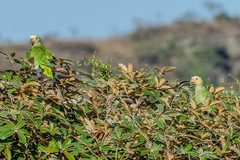
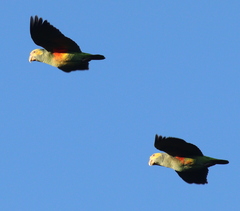
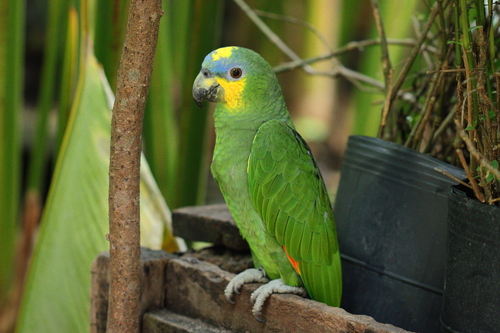
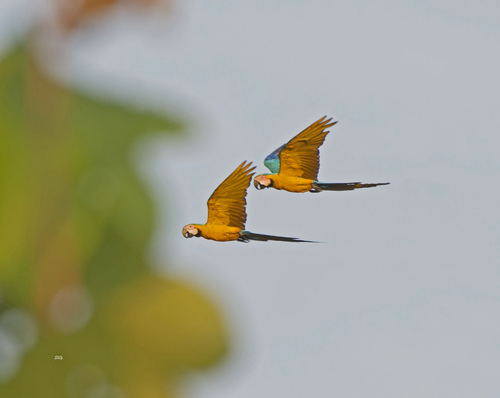
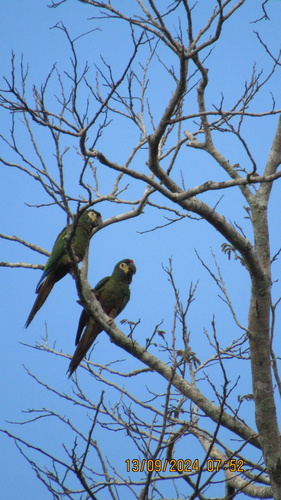
Yellow-faced Parrot

Yellow-faced Parrot

Amazona xanthops

Silhouette: Ferran Sayol · PhyloPic

Daily sighting probability ~10% · With luck
at Campo Grande

In 3 days ~10% in a week ~30%

48 Verified sightings at Campo Grande
279 In all 3 parks From 2019 to 2026
August Best month
☀️ Diurnal When it's spotted

About the Yellow-faced Parrot

The yellow-fronted parrot (Poicephalus flavifrons) from Africa is occasionally called "yellow-faced parrot". The yellow-faced parrot (Alipiopsitta xanthops), formerly also known as the yellow-faced amazon, is the only species of the genus Alipiopsitta. It is a Neotropical parrot (tribe Arini), and was classified in the genus Amazona for many years. It is a predominantly green and yellow-plumaged bird with a yellow head. It is a semi-nomadic species found in the cerrado region of Brazil and adjacent Bolivia. As the yellow-faced parrot has disappeared from parts of its former range due to habitat destruction and generally occurs in low densities, it was considered vulnerable by the IUCN, but it remains locally fairly common, occurs in several protected areas and can survive in fragmented habitats, leading to its downlisting to near-threatened.

The German naturalist Johann Baptist von Spix first described the species in 1824 as Psittacus xanthops. Its species name is derived from the Ancient Greek xanthos "yellow", and ops "face". For many years, it was placed within the genus Amazona, although Alípio de Miranda Ribeiro proposed the new genus Salvatoria in 1920 due to differences... Wikipedia →

Sounds

Recording0:24

Brazil · 2021

© Laurent Quéno · iNaturalist · CC BY-NC 4.0

Recording0:06

Brazil · 2021

© Jonathan Lorencetti Ehlert · iNaturalist · CC BY-NC 4.0

Global Distribution

Parks Where Found

# Park Country Daily sighting probability
1 Emas National Park 🇧🇷 Brazil
~50%
2 Serra da Canastra National Park 🇧🇷 Brazil
~20%
3 Chapada dos Guimarães National Park 🇧🇷 Brazil
<5%

Cities Where Found

# City Country Daily sighting probability
1 Campo Grande 🇧🇷 Brazil
~10%

Zoos & Centres Where Found

# Zoo / Centre Country
1 Curitiba Zoo 🇧🇷 Brazil In captivity
2 Zoobotânico de São José do Rio Preto 🇧🇷 Brazil In captivity
3 Parque Ecológico de São Carlos 🇧🇷 Brazil In captivity
4 Loro Parque 🇪🇸 Spain In captivity
5 Zoo Park da Montanha 🇧🇷 Brazil In captivity
6 Johor Zoo 🇲🇾 Malaysia In captivity

Before you go

What are the chances of seeing a Yellow-faced Parrot in Campo Grande?

With luck

About 10% of wildlife watchers report a Yellow-faced Parrot sighting in Campo Grande on a given day, based on 48 verified sightings from GBIF citizen-science data. It is the 116th most-seen of the 221 birds we can rate there. Over three days the chance rises to about 10%, and over a week to about 30%, if each day is a fresh chance.

When is the best time to see a Yellow-faced Parrot in Campo Grande?

August

In that month about 30% of wildlife watchers report a Yellow-faced Parrot in Campo Grande on a given day, against under 5% in May–July and November–March, the lowest months. That is one of Campo Grande's driest months, with about 40 mm of rain against 200 mm in January.

What time of day is best to see a Yellow-faced Parrot?

Between 6 and 9 am

Across all the parks we cover, that three-hour window holds the most Yellow-faced Parrot sightings with a recorded time, and about 8 in 10 of them come between 6 am and 6 pm: it is a daytime animal.

Where else can you see a Yellow-faced Parrot?

Only Campo Grande, in our data

Campo Grande is the only city on Wallace's Line with enough records to rate Yellow-faced Parrot sightings: about 10% of wildlife watchers there report one on a given day.

Where does the Yellow-faced Parrot sighting chance come from?

GBIF citizen-science records

It is estimated from how often the Yellow-faced Parrot is recorded against all the birds logged in Campo Grande (48 verified sightings), calibrated against known sighting rates. Figures are rounded to the nearest 10% because citizen-science data supports honest approximations, not decimals, and months with records from fewer than five people show "—". How it works.

← Back to Campo Grande