Cape Hare

Cape Hare

Lepus capensis

Silhouette: Jan A. Venter, Herbert H. T. Prins, David A. Balfour & Rob Slotow (vectorized by T. Michael Keesey) · PhyloPic

LCLeast ConcernNTVUENCR
Daily sighting probability <5% · Rare
at Cape Town

In 3 days ~10% in a week ~20%

6 Verified sightings at Cape Town
20 In all 2 parks From 2019 to 2026
June Best month
🌅 Crepuscular When it's spotted

About the Cape Hare

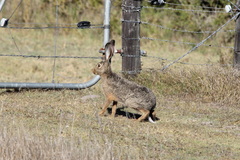
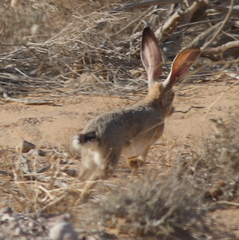
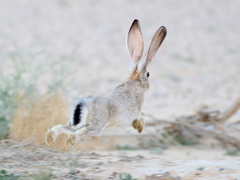
The Cape hare (Lepus capensis), also called the brown hare and the desert hare, is a hare native to Africa and Arabia extending into India. The Cape hare was described by Carl Linnaeus in 1758 with the binomial name Lepus capensis, published in the 10th edition of Systema Naturae.

The Cape hare is part of a species complex. Lepus tolai and Lepus tibetanus were moved out based on geographic distribution and molecular characteristics. The current remaining grouping of Lepus capensis sensu lato remains paraphyletic.

As of 2005, 12 subspecies were recognised: Lepus capensis capensis Lepus capensis aquilo Lepus capensis carpi Lepus capensis granti Lepus capensis aegyptius Lepus capensis hawkeri Lepus capensis isabellinus Lepus capensis sinaiticus

Lepus capensis arabicus Lepus capensis atlanticus Lepus capensis whitakeri Lepus capensis schlumbergi The Cape hare is a typical hare, with well-developed legs for leaping and running, and large eyes and ears to look for threats from its environment. Usually, a white ring surrounds the eye. It has a fine, soft coat which varies in colour from light brown to reddish to sandy grey. Unusually among mammals, the female... Wikipedia →

Global Distribution

Parks Where Found

# Park Country Daily sighting probability
1 West Coast National Park 🇿🇦 South Africa
~10%
2 Namib-Naukluft National Park 🇳🇦 Namibia
~10%

Cities Where Found

# City Country Daily sighting probability
1 Cape Town 🇿🇦 South Africa
<5%

Before you go

What are the chances of seeing a Cape Hare in Cape Town?

Rare

Under 5% of wildlife watchers report a Cape Hare sighting in Cape Town on a given day, based on 6 verified sightings from GBIF citizen-science data. It is the 26th most-seen of the 29 mammals we can rate there. Over three days the chance rises to about 10%, and over a week to about 20%, if each day is a fresh chance.

When is the best time to see a Cape Hare in Cape Town?

Any time of year

In every month with enough records, under 5% of wildlife watchers report a Cape Hare in Cape Town on a given day, so our monthly data shows no clear season.

What time of day is best to see a Cape Hare?

Between 6 and 9 pm

Across all the parks we cover, that three-hour window holds the most Cape Hare sightings with a recorded time, and about 7 in 10 of them come between 6 am and 6 pm: it is most active around dawn and dusk.

Where else can you see a Cape Hare?

Only Cape Town, in our data

Cape Town is the only city on Wallace's Line with enough records to rate Cape Hare sightings: under 5% of wildlife watchers there report one on a given day.

Where does the Cape Hare sighting chance come from?

GBIF citizen-science records

It is estimated from how often the Cape Hare is recorded against all the mammals logged in Cape Town (6 verified sightings), calibrated against known sighting rates. Figures are rounded to the nearest 10% because citizen-science data supports honest approximations, not decimals, and months with records from fewer than five people show "—". How it works.

← Back to Cape Town