Caracal

Caracal

Caracal caracal

Silhouette: Margot Michaud · PhyloPic

LCLeast ConcernNTVUENCR
Daily sighting probability ~10% · With luck
at Cape Town

In 3 days ~30% in a week ~50%

77 Verified sightings at Cape Town
352 In all 9 parks From 2019 to 2026
February Best month
☀️🌙 Day & Night When it's spotted

About the Caracal

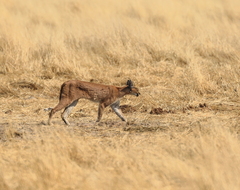
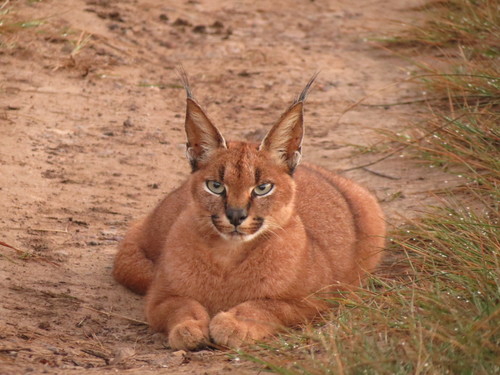
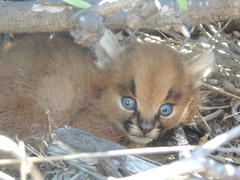
The caracal (Caracal caracal) is a wild cat native to Africa, the Middle East, Central Asia, and arid areas of Pakistan and northwestern India. It is characterised by a robust build, long legs, a short face, long tufted ears, relatively short tail, and long canine teeth. Its coat is uniformly reddish tan or sandy, while the ventral parts are lighter with small reddish markings. It reaches 40–50 cm (16–20 in) at the shoulder and weighs 8–19 kg (18–42 lb). It was first scientifically described by German naturalist Johann Christian Daniel von Schreber in 1776. Three subspecies are recognised.

Typically nocturnal, the caracal is highly secretive and difficult to observe. It is territorial, and lives mainly alone or in pairs. The caracal is a carnivore that typically preys upon birds, rodents, and other small mammals. It can leap higher than 3.0 m (9.8 ft) and catch birds in midair. It stalks its prey until it is within 5 m (16 ft) of it, after which it runs it down and kills it with a bite to the throat or to the back of the neck. Both sexes become sexually mature by the time they are one year old and breed throughout the year. Gestation lasts between two and three months, resulting in a litter of one to six kittens. Juveniles leave their mothers at the age of nine to ten months, though a few females stay back with their mothers. The average lifespan of captive caracals is nearly 16 years. Wikipedia →
Sounds

Recording0:28

South Africa · 2026

© Fayruz Prins · iNaturalist · CC BY-NC 4.0

Global Distribution

Parks Where Found

# Park Country Daily sighting probability
1 West Coast National Park 🇿🇦 South Africa
~30%
2 De Hoop Nature Reserve 🇿🇦 South Africa
~20%
3 Kgalagadi Transfrontier Park 🇿🇦 South Africa
~20%
4 Ngorongoro Conservation Area 🇹🇿 Tanzania
~20%
5 Table Mountain National Park 🇿🇦 South Africa
~20%
6 Serengeti National Park 🇹🇿 Tanzania
~10%
7 Garden Route National Park 🇿🇦 South Africa
~10%
8 Addo Elephant National Park 🇿🇦 South Africa
~10%
9 Kruger National Park 🇿🇦 South Africa
<5%

Cities Where Found

# City Country Daily sighting probability
1 Cape Town 🇿🇦 South Africa
~10%

Zoos & Centres Where Found

# Zoo / Centre Country
1 San Diego Zoo 🇺🇸 United States In captivity
2 Prague Zoo 🇨🇿 Czechia In captivity
3 National Zoological Park 🇺🇸 United States In captivity
4 Copenhagen Zoo 🇩🇰 Denmark In captivity
5 Dresden Zoo 🇩🇪 Germany In captivity
6 Ostrava Zoo 🇨🇿 Czechia In captivity
7 Bali Zoo 🇮🇩 Indonesia In captivity
8 Jihlava Zoo 🇨🇿 Czechia In captivity
9 Karagandy Zoo 🇰🇿 Kazakhstan In captivity
10 Al Hefaiyah Reserve 🇦🇪 United Arab Emirates In captivity
11 Garden Route Safari Camp 🇿🇦 South Africa In captivity
12 Mohamed bin Zayed Nature Reserve 🇧🇭 Bahrain In captivity
13 Beijing Wildlife Park 🇨🇳 China In captivity
14 Toronto Zoo 🇨🇦 Canada In captivity
15 Safari West 🇺🇸 United States In captivity
16 Living Desert Zoo and Gardens 🇺🇸 United States In captivity
17 Poznań Nowe Zoo 🇵🇱 Poland In captivity
18 Khao Kheow Open Zoo 🇹🇭 Thailand In captivity
19 Kansas City Zoo 🇺🇸 United States In captivity
20 Bratislava Zoo 🇸🇰 Slovakia In captivity
21 Chiang Mai Night Safari 🇹🇭 Thailand In captivity
22 Brookfield Zoo 🇺🇸 United States In captivity
23 Parc zoologique de Montpellier 🇫🇷 France In captivity
24 Parc des Félins 🇫🇷 France In captivity
25 Shanghai Zoo 🇨🇳 China In captivity
26 Nanjing Hongshan Forest Zoo 🇨🇳 China In captivity
27 Johannesburg Zoo 🇿🇦 South Africa In captivity
28 National Zoological Garden of South Africa 🇿🇦 South Africa In captivity
29 São Paulo Zoo 🇧🇷 Brazil In captivity
30 Карельский зоопарк 🇷🇺 Russia In captivity
31 Novosibirsk Zoo 🇷🇺 Russia In captivity
32 Oklahoma City Zoo and Botanical Garden 🇺🇸 United States In captivity
33 Kyiv Zoo 🇺🇦 Ukraine In captivity
34 Darling Downs Zoo 🇦🇺 Australia In captivity
35 Boulder Ridge Wild Animal Park 🇺🇸 United States In captivity
36 Uganda Wildlife Conservation Education Center 🇺🇬 Uganda In captivity
37 Memphis Zoo 🇺🇸 United States In captivity
38 Chișinău Zoo 🇲🇩 Moldova In captivity
39 Miskolc Zoo 🇭🇺 Hungary In captivity
40 Melbourne Zoo 🇦🇺 Australia In captivity
41 Warangal Zoo 🇮🇳 India In captivity
42 San Antonio Zoo 🇺🇸 United States In captivity
43 Gembira Loka Zoo 🇮🇩 Indonesia In captivity
44 Chapultepec Zoo 🇲🇽 Mexico In captivity
45 Safari North Wildlife Park 🇺🇸 United States In captivity
46 Zoo d'Amnéville 🇫🇷 France In captivity
47 Зоопарк ХІІ Місяців 🇺🇦 Ukraine In captivity
48 Al Hefaiyah Mountain Conservation Centre 🇦🇪 United Arab Emirates In captivity
49 Little Rock Zoo 🇺🇸 United States In captivity
50 Rivne Zoo 🇺🇦 Ukraine In captivity

Before you go

What are the chances of seeing a Caracal in Cape Town?

With luck

About 10% of wildlife watchers report a Caracal sighting in Cape Town on a given day, based on 77 verified sightings from GBIF citizen-science data. It is the 10th most-seen of the 29 mammals we can rate there. Over three days the chance rises to about 30%, and over a week to about 50%, if each day is a fresh chance.

When is the best time to see a Caracal in Cape Town?

Any time of year

In every month with enough records, about 10% of wildlife watchers report a Caracal in Cape Town on a given day, so our monthly data shows no clear season.

What time of day is best to see a Caracal?

Between 8 and 11 am

Across all the parks we cover, that three-hour window holds the most Caracal sightings with a recorded time, and about 7 in 10 of them come between 6 am and 6 pm: it is seen both by day and at night.

Where else can you see a Caracal?

Only Cape Town, in our data

Cape Town is the only city on Wallace's Line with enough records to rate Caracal sightings: about 10% of wildlife watchers there report one on a given day.

Where does the Caracal sighting chance come from?

GBIF citizen-science records

It is estimated from how often the Caracal is recorded against all the mammals logged in Cape Town (77 verified sightings), calibrated against known sighting rates. Figures are rounded to the nearest 10% because citizen-science data supports honest approximations, not decimals, and months with records from fewer than five people show "—". How it works.

← Back to Cape Town