Cape Gray Mongoose

Cape Gray Mongoose

Galerella pulverulenta

Silhouette: Margot Michaud · PhyloPic

Daily sighting probability ~10% · With luck
at Cape Town

In 3 days ~30% in a week ~50%

84 Verified sightings at Cape Town
240 In all 5 parks From 2019 to 2026
July Best month
☀️ Diurnal When it's spotted

About the Cape Gray Mongoose

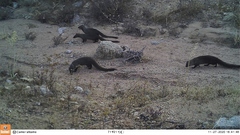
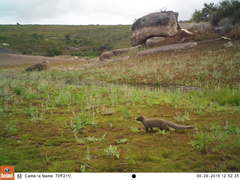
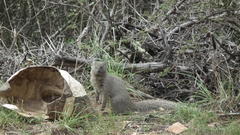
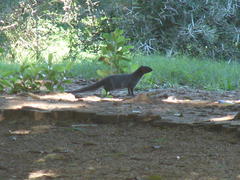
The Cape grey mongoose (Herpestes pulverulentus), also called the small grey mongoose, is a small mammal native to South Africa, Lesotho and southern Namibia. It is a small species (55–69 cm long, weight range 0.5 – 1.0 kg). It is a dark grey colour with a darker tip of the tail. The legs are a darker grey than the rest of the body. It has a typical elongated mongoose body-shape. The ears are small and rounded and are situated on the sides of the head. The tail is long and bushy. The teeth show adaptations for both cutting and crushing.

The Cape grey mongoose feeds mostly on insects and small rodents, but will also eat birds, small reptiles, amphibians, other invertebrates, and fruit. They have been known to eat carrion and garbage as well. It is predominantly insectivorous but also carnivorous. Insects and other arthropoda such as spiders are caught on the ground and then held down with the forefeet and eaten. Larger prey such as rodents are stalked and killed with a bite to the head. Large prey items are held down with the forefeet and then torn into bite size pieces with the teeth.

Small rodents, in particular Otomys and Rhabdomys, are their... Wikipedia →

Sounds

Recording0:35

South Africa · 2018

© Marion Maclean · iNaturalist · CC BY-NC 4.0

Global Distribution

Parks Where Found

# Park Country Daily sighting probability
1 West Coast National Park 🇿🇦 South Africa
~30%
2 De Hoop Nature Reserve 🇿🇦 South Africa
~20%
3 Addo Elephant National Park 🇿🇦 South Africa
~20%
4 Table Mountain National Park 🇿🇦 South Africa
~10%
5 Garden Route National Park 🇿🇦 South Africa
~10%

Cities Where Found

# City Country Daily sighting probability
1 Cape Town 🇿🇦 South Africa
~10%

Before you go

What are the chances of seeing a Cape Gray Mongoose in Cape Town?

With luck

About 10% of wildlife watchers report a Cape Gray Mongoose sighting in Cape Town on a given day, based on 84 verified sightings from GBIF citizen-science data. It is the 7th most-seen of the 29 mammals we can rate there. Over three days the chance rises to about 30%, and over a week to about 50%, if each day is a fresh chance.

When is the best time to see a Cape Gray Mongoose in Cape Town?

July

In that month about 20% of wildlife watchers report a Cape Gray Mongoose in Cape Town on a given day, against under 5% in March, the lowest month. That is one of Cape Town's wettest months, with about 120 mm of rain against 15 mm in February.

What time of day is best to see a Cape Gray Mongoose?

Between 9 am and noon

Across all the parks we cover, that three-hour window holds the most Cape Gray Mongoose sightings with a recorded time, and about 9 in 10 of them come between 6 am and 6 pm: it is a daytime animal.

Where else can you see a Cape Gray Mongoose?

Only Cape Town, in our data

Cape Town is the only city on Wallace's Line with enough records to rate Cape Gray Mongoose sightings: about 10% of wildlife watchers there report one on a given day.

Where does the Cape Gray Mongoose sighting chance come from?

GBIF citizen-science records

It is estimated from how often the Cape Gray Mongoose is recorded against all the mammals logged in Cape Town (84 verified sightings), calibrated against known sighting rates. Figures are rounded to the nearest 10% because citizen-science data supports honest approximations, not decimals, and months with records from fewer than five people show "—". How it works.

← Back to Cape Town