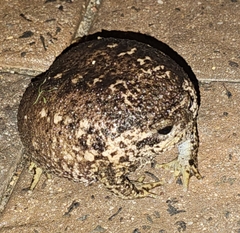
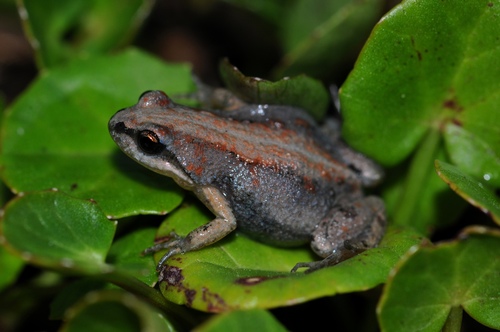
Giant Rain Frog

Giant Rain Frog

Breviceps gibbosus

Silhouette: Jose Carlos Arenas-Monroy · PhyloPic

LCNTVUVulnerableENCR Endemic
Daily sighting probability ~10% · With luck
at Cape Town

In 3 days ~30% in a week ~50%

96 Verified sightings at Cape Town
147 In 1 park From 2019 to 2026
September Best month
☀️ Diurnal When it's spotted

About the Giant Rain Frog

The cape rain frog or giant rain frog (Breviceps gibbosus) is a species of frog in the family Brevicipitidae. Adults grow up to 45 mm in length. It was the first African frog species to be scientifically described by Carl Linnaeus in 1758, under the name Rana gibbosa. It is the most common and largest of rain frogs. The name "rain frog" that is applied to the genus refers to a belief that these frogs bring rain.

The species is endemic to South Africa, where it occurs in the far southwestern Cape, in Cape Town and northwards as far as Citrusdal. In this area it inhabits Mediterranean-type shrubby vegetation, known as fynbos, renosterveld, pastureland on farms, rural gardens, and even urban areas. It seems to adapt well to suburban gardens, but like most frog species it is vulnerable to herbicide poisons and domestic pets.

Breviceps gibbosus is part of the family Brevicipitidae. All species in this family of frog are considered terrestrial breeders by laying and burrowing eggs. The cape rain frog exhibits a rounded shape, with short arms. There are sexual dimorphisms between sexes, the females are larger in size compared to the males. Cape... Wikipedia →

Sounds

Recording0:12

South Africa · 2020

© Nick Helme · iNaturalist · CC BY-NC 4.0

Recording0:10

South Africa · 2022

© Oliver Angus · iNaturalist · CC BY-NC 4.0

Recording0:18

South Africa · 2020

© Alex Rebelo · iNaturalist · CC BY-NC 4.0

Global Distribution

Parks Where Found

# Park Country Daily sighting probability
1 Table Mountain National Park 🇿🇦 South Africa
~10%

More parks will be added in future updates.

Cities Where Found

# City Country Daily sighting probability
1 Cape Town 🇿🇦 South Africa
~10%

Before you go

What are the chances of seeing a Giant Rain Frog in Cape Town?

With luck

About 10% of wildlife watchers report a Giant Rain Frog sighting in Cape Town on a given day, based on 96 verified sightings from GBIF citizen-science data. It is the 7th most-seen of the 13 amphibians we can rate there. Over three days the chance rises to about 30%, and over a week to about 50%, if each day is a fresh chance.

When is the best time to see a Giant Rain Frog in Cape Town?

June and August–September

In those months about 20% of wildlife watchers report a Giant Rain Frog in Cape Town on a given day, against under 5% in December to February, the lowest months. Those are among Cape Town's wettest months, with about 110 mm of rain a month against 15 mm in February.

What time of day is best to see a Giant Rain Frog?

Between 9 am and noon

Across all the parks we cover, that three-hour window holds the most Giant Rain Frog sightings with a recorded time, and about 8 in 10 of them come between 6 am and 6 pm: it is a daytime animal.

Where else can you see a Giant Rain Frog?

Only Cape Town, in our data

Cape Town is the only city on Wallace's Line with enough records to rate Giant Rain Frog sightings: about 10% of wildlife watchers there report one on a given day.

Where does the Giant Rain Frog sighting chance come from?

GBIF citizen-science records

It is estimated from how often the Giant Rain Frog is recorded against all the amphibians logged in Cape Town (96 verified sightings), calibrated against known sighting rates. Figures are rounded to the nearest 10% because citizen-science data supports honest approximations, not decimals, and months with records from fewer than five people show "—". How it works.

← Back to Cape Town