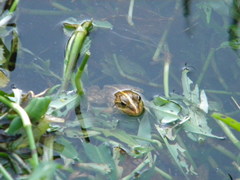
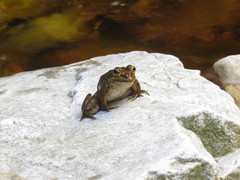
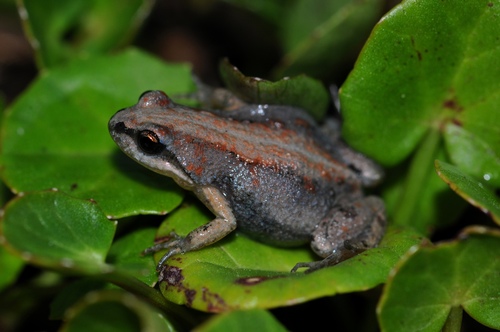
Cape River Frog

Cape River Frog

Amietia fuscigula

Silhouette: Dmitry Bogdanov (vectorized by T. Michael Keesey) · PhyloPic

LCLeast ConcernNTVUENCR
Daily sighting probability ~20% · Possible
at Cape Town

In 3 days ~40% in a week ~70%

238 Verified sightings at Cape Town
1,370 In all 3 parks From 2019 to 2026
January Best month
☀️ Diurnal When it's spotted

About the Cape River Frog

The Cape river frog (Amietia fuscigula) is a species of frog in the family Pyxicephalidae named for the Cape of Good Hope. Formerly, it was placed in the family Ranidae. It occurs widely in the Eastern Cape and Western Cape provinces of South Africa. A newly described species, A. poyntoni, was split from this species in 2013.

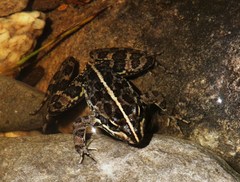
The Cape river frog is a fairly large, typical frog with a snout-to-vent measurement of up to about 125 mm. The snout is slightly rounded. It has a powerful, athletic build with long hind legs and feet, well adapted for leaping, but also well webbed; the species is a powerful swimmer. The fore feet are not webbed. When the animal sits at rest on a level surface, the tip of the longest rear toe reaches to directly below the tympanum.

The ventral skin is smooth and white, except for dark mottling on the throat. The mottling inspired the specific epithet fuscigula: Latin for "dusky throated". In some specimens, the mottling extends to the belly. The dorsal skin bears a modest sprinkling of small, rounded protuberances and segments of longitudinal ridges. The colour scheme is variable, ranging from dark- through light-brown, also commonly green... Wikipedia →

Sounds

Recording0:38

South Africa · 2022

© flamelily · iNaturalist · CC BY-NC 4.0

Recording0:38

South Africa · 2021

© Cameron Scott · iNaturalist · CC BY-NC 4.0

Recording0:21

South Africa · 2021

© Alex Rebelo · iNaturalist · CC BY-NC 4.0

Global Distribution

Parks Where Found

# Park Country Daily sighting probability
1 Table Mountain National Park 🇿🇦 South Africa
~40%
2 Garden Route National Park 🇿🇦 South Africa
~30%
3 De Hoop Nature Reserve 🇿🇦 South Africa
~20%

Cities Where Found

# City Country Daily sighting probability
1 Cape Town 🇿🇦 South Africa
~20%

Zoos & Centres Where Found

# Zoo / Centre Country
1 Exotic Animal World 🇿🇦 South Africa In captivity

Before you go

What are the chances of seeing a Cape River Frog in Cape Town?

Possible

About 20% of wildlife watchers report a Cape River Frog sighting in Cape Town on a given day, based on 238 verified sightings from GBIF citizen-science data. It is the 4th most-seen of the 13 amphibians we can rate there. Over three days the chance rises to about 40%, and over a week to about 70%, if each day is a fresh chance.

When is the best time to see a Cape River Frog in Cape Town?

July and November–April

In those months about 20% of wildlife watchers report a Cape River Frog in Cape Town on a given day, against about 10% in May–June and August–October, the lowest months.

What time of day is best to see a Cape River Frog?

Between 11 am and 2 pm

Across all the parks we cover, that three-hour window holds the most Cape River Frog sightings with a recorded time, and about 7 in 10 of them come between 6 am and 6 pm: it is a daytime animal.

Where else can you see a Cape River Frog?

Only Cape Town, in our data

Cape Town is the only city on Wallace's Line with enough records to rate Cape River Frog sightings: about 20% of wildlife watchers there report one on a given day.

Which relatives of the Cape River Frog live in Cape Town?

Same family: Pyxicephalidae

The closest relatives of the Cape River Frog that you can see in Cape Town (family Pyxicephalidae, African Box-headed Frogs) are Clicking Stream Frog (about 30%), Cape sand frog (about 10%) and Micro Frog (about 10%), with each one's daily chance of a sighting.

Where does the Cape River Frog sighting chance come from?

GBIF citizen-science records

It is estimated from how often the Cape River Frog is recorded against all the amphibians logged in Cape Town (238 verified sightings), calibrated against known sighting rates. Figures are rounded to the nearest 10% because citizen-science data supports honest approximations, not decimals, and months with records from fewer than five people show "—". How it works.

← Back to Cape Town