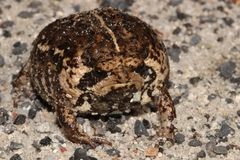
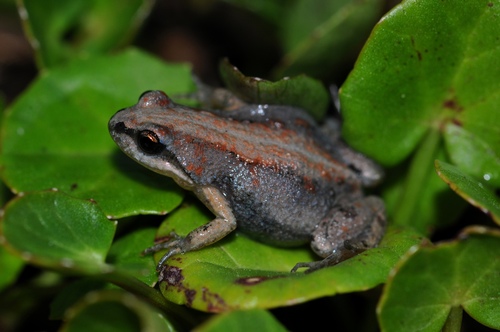
Rose's Rain Frog

Rose's Rain Frog

Breviceps rosei

Silhouette: Jose Carlos Arenas-Monroy · PhyloPic

LCLeast ConcernNTVUENCR Endemic
Daily sighting probability <5% · Rare
at Cape Town

In 3 days ~10% in a week ~20%

8 Verified sightings at Cape Town
23 In all 2 parks From 2019 to 2026
July Best month
☀️ Diurnal When it's spotted

About the Rose's Rain Frog

Rose's rain frog or Rose's rainfrog (Breviceps rosei) is a species of frog in the family Brevicipitidae. It is endemic to the sandveld of south-western coastal South Africa. It is less-frequently known as Rose's short-headed frog, Rose's Blaasop, or the sand rain frog. Some treat Breviceps fasciatus as a synonym of this species, although other authorities have expressed doubt.

Frogs in this species spend most of their lives in subterranean nests under sandy ground, where they lay their eggs. They surface during heavy rain. They cannot swim, and are not found in water. Tadpoles develop inside the eggs and hatch as fully formed baby frogs.

Its natural habitats are temperate shrubland, Fynbos Mediterranean shrubland vegetation, sandy shores, arable land, pastureland, rural gardens, and urban areas. It is threatened by habitat loss, and its range is restricted to less than 20,000 square kilometers. Despite this, its future seems secure, as it is very adaptable and remains locally abundant.

There are two subspecies found on separate coasts. The sand rain frog (Breviceps rosei rosei) occurs on the west coast of the Western Cape, and on Robben Island. The eastern... Wikipedia →

Sounds

Recording0:11

South Africa · 2025

© Luke Goddard · iNaturalist · CC BY-NC 4.0

Recording0:10

South Africa · 2020

© Leighan Mossop · iNaturalist · CC BY-NC 4.0

Recording0:27

South Africa · 2026

© Charleen Brunke · iNaturalist · CC BY-NC 4.0

Global Distribution

Parks Where Found

# Park Country Daily sighting probability
1 Garden Route National Park 🇿🇦 South Africa
<5%
2 Table Mountain National Park 🇿🇦 South Africa
<5%

Cities Where Found

# City Country Daily sighting probability
1 Cape Town 🇿🇦 South Africa
<5%

Before you go

What are the chances of seeing a Rose's Rain Frog in Cape Town?

Rare

Under 5% of wildlife watchers report a Rose's Rain Frog sighting in Cape Town on a given day, based on 8 verified sightings from GBIF citizen-science data. It is the 12th most-seen of the 13 amphibians we can rate there. Over three days the chance rises to about 10%, and over a week to about 20%, if each day is a fresh chance.

When is the best time to see a Rose's Rain Frog in Cape Town?

July and August

In those months about 10% of wildlife watchers report a Rose's Rain Frog in Cape Town on a given day, against under 5% in September to June, the lowest months. Those are among Cape Town's wettest months, with about 120 mm of rain a month against 15 mm in February.

What time of day is best to see a Rose's Rain Frog?

Between 9 am and noon

Across all the parks we cover, that three-hour window holds the most Rose's Rain Frog sightings with a recorded time, and about 9 in 10 of them come between 6 am and 6 pm: it is a daytime animal.

Where else can you see a Rose's Rain Frog?

Only Cape Town, in our data

Cape Town is the only city on Wallace's Line with enough records to rate Rose's Rain Frog sightings: under 5% of wildlife watchers there report one on a given day.

Where does the Rose's Rain Frog sighting chance come from?

GBIF citizen-science records

It is estimated from how often the Rose's Rain Frog is recorded against all the amphibians logged in Cape Town (8 verified sightings), calibrated against known sighting rates. Figures are rounded to the nearest 10% because citizen-science data supports honest approximations, not decimals, and months with records from fewer than five people show "—". How it works.

← Back to Cape Town