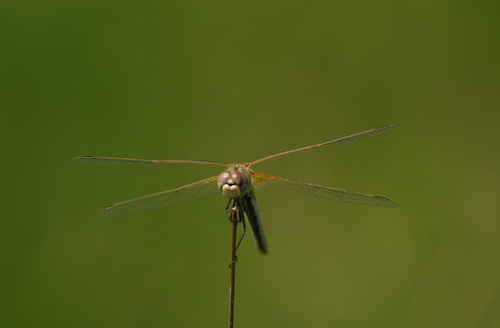
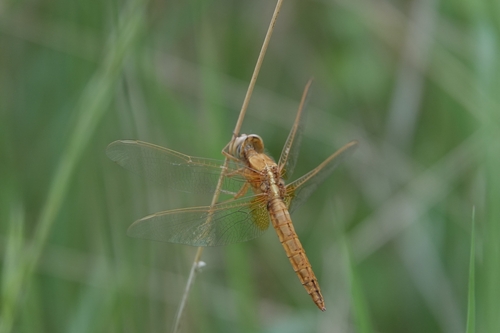
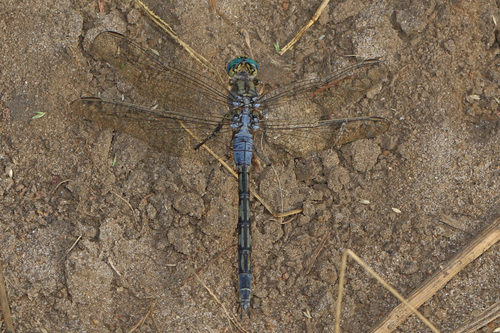
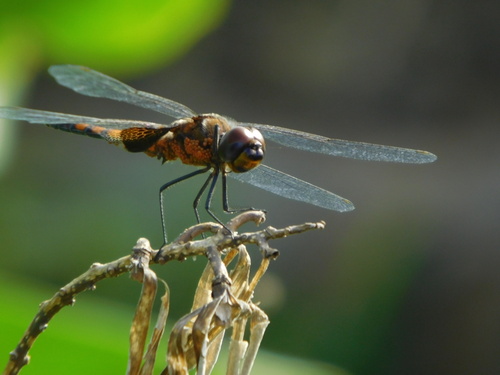
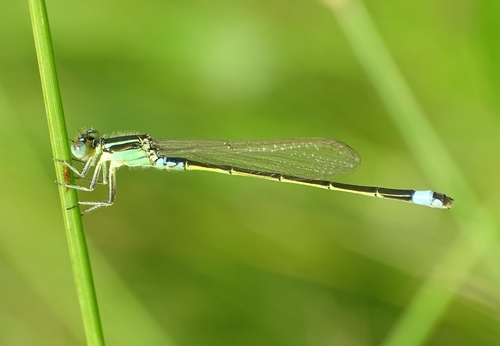
Red-Veined Dropwing

Red-Veined Dropwing

Trithemis arteriosa

Daily sighting probability ~10% · With luck
at Cape Town

In 3 days ~30% in a week ~60%

183 Verified sightings at Cape Town
714 In all 11 parks From 2019 to 2026
February Best month
☀️ Diurnal When it's spotted

About the Red-Veined Dropwing

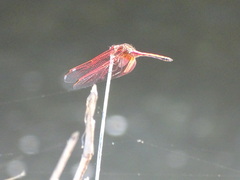
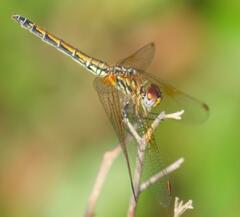
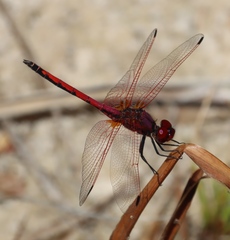
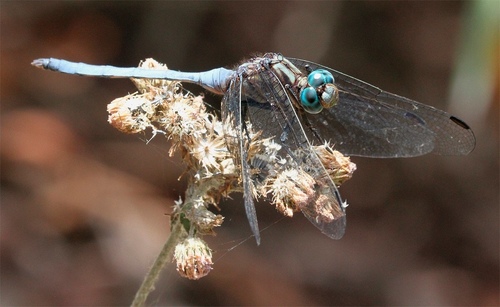
Trithemis arteriosa, the red-veined dropwing, is a species of dragonfly in the family Libellulidae. Trithemis arteriosa is widespread and common in most of its range which includes most of Africa and extends to western Asia and southern Europe. In Africa, it is found in Algeria, Angola, Benin, Botswana, Burkina Faso, Burundi, Cameroon, Canary Islands, Cape Verde, Central African Republic, Chad, Comoros, Congo, Democratic Republic of the Congo, Egypt, Equatorial Guinea, Eritrea, Eswatini, Ethiopia, Gabon, Gambia, Ghana, Guinea, Guinea-Bissau, Ivory Coast, Kenya, Lesotho, Liberia, Libya, Madagascar, Malawi, Mali, Mauritania, Mayotte, Morocco, Mozambique, Namibia, Niger, Nigeria, Rwanda, São Tomé and Príncipe, Senegal, Seychelles, Sierra Leone, Somalia, South Africa, South Sudan, Sudan, Tanzania, Togo, Tunisia, Uganda, Zambia, and Zimbabwe. In western Asia and southern Europe, it is found in Crete, Cyprus, Iran, Israel, Jordan, Kuwait, Lebanon, Oman, Palestinian Territory, Saudi Arabia, Syria, Turkey, United Arab Emirates, and Yemen.

This dragonfly is found in and near a wide variety of slow-flowing and still-water habitats. These include streams... Wikipedia →
Global Distribution

Parks Where Found

# Park Country Daily sighting probability
1 Kafue National Park 🇿🇲 Zambia
~30%
2 uMkhuze Game Reserve 🇿🇦 South Africa
~30%
3 Gonarezhou National Park 🇿🇼 Zimbabwe
~30%
4 Pilanesberg National Park 🇿🇦 South Africa
~20%
5 Garden Route National Park 🇿🇦 South Africa
~20%
6 Nairobi National Park 🇰🇪 Kenya
~20%
7 Kruger National Park 🇿🇦 South Africa
~20%
8 Hluhluwe-Imfolozi Park 🇿🇦 South Africa
~20%
9 Table Mountain National Park 🇿🇦 South Africa
~10%
10 iSimangaliso Wetland Park 🇿🇦 South Africa
~10%
11 Addo Elephant National Park 🇿🇦 South Africa
~10%

Cities Where Found

# City Country Daily sighting probability
1 Riyadh 🇸🇦 Saudi Arabia
~40%
2 Lusaka 🇿🇲 Zambia
~30%
3 Marrakesh 🇲🇦 Morocco
~20%
4 Kigali 🇷🇼 Rwanda
~20%
5 Durban 🇿🇦 South Africa
~10%
6 Cape Town 🇿🇦 South Africa
~10%
7 Pretoria 🇿🇦 South Africa
~10%
8 Tel Aviv 🇮🇱 Israel
~10%
9 Nairobi 🇰🇪 Kenya
~10%
10 Johannesburg 🇿🇦 South Africa
~10%

Before you go

What are the chances of seeing a Red-Veined Dropwing in Cape Town?

With luck

About 10% of wildlife watchers report a Red-Veined Dropwing sighting in Cape Town on a given day, based on 183 verified sightings from GBIF citizen-science data. It is the 28th most-seen of the 311 insects we can rate there. Over three days the chance rises to about 30%, and over a week to about 60%, if each day is a fresh chance.

When is the best time to see a Red-Veined Dropwing in Cape Town?

February and December

In those months about 30% of wildlife watchers report a Red-Veined Dropwing in Cape Town on a given day, against under 5% in May to August, the lowest months. Those are among Cape Town's driest months, with about 20 mm of rain a month against 140 mm in June.

What time of day is best to see a Red-Veined Dropwing?

Between 10 am and 1 pm

Across all the parks we cover, that three-hour window holds the most Red-Veined Dropwing sightings with a recorded time, and nearly all of them come between 6 am and 6 pm: it is a daytime animal.

Is Cape Town the best place to see a Red-Veined Dropwing?

6th of 10

Of the 10 cities where we can rate Red-Veined Dropwing sightings, Cape Town ranks 6th at about 10%. The best odds are in Riyadh (Saudi Arabia, about 40%), Lusaka (Zambia, about 30%) and Marrakesh (Morocco, about 20%).

Where does the Red-Veined Dropwing sighting chance come from?

GBIF citizen-science records

It is estimated from how often the Red-Veined Dropwing is recorded against all the insects logged in Cape Town (183 verified sightings), calibrated against known sighting rates. Figures are rounded to the nearest 10% because citizen-science data supports honest approximations, not decimals, and months with records from fewer than five people show "—". How it works.

← Back to Cape Town