Rufous-chested Sparrowhawk

Rufous-chested Sparrowhawk

Accipiter rufiventris

Silhouette: Shyamal · PhyloPic

LCLeast ConcernNTVUENCR
Daily sighting probability <5% · Rare
at Cape Town

In 3 days ~10% in a week ~20%

175 Verified sightings at Cape Town
666 In all 7 parks From 2019 to 2026
October Best month
☀️ Diurnal When it's spotted

About the Rufous-chested Sparrowhawk

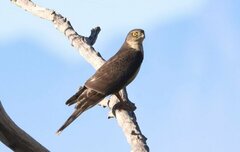
The rufous-breasted sparrowhawk (Accipiter rufiventris), also known as the rufous-chested sparrowhawk and as the red-breasted sparrowhawk, is a species of bird of prey in the family Accipitridae. It is found in Angola, Democratic Republic of the Congo, Eritrea, Eswatini, Ethiopia, Kenya, Lesotho, Malawi, Mozambique, Rwanda, South Africa, South Sudan, Tanzania, Uganda, Zambia, and Zimbabwe.

A small raptor, with a height of about 30 cm and wingspan of 72 cm, the rufous-breasted sparrowhawk is named for its distinctive rufous-coloured underparts, which can be seen both perching and in flight. It is dark grey slate-brown above, including the head, with a black bill and eyes that are yellow at all ages.

In flight, the bold bars on both its wings and tail are clearly visible. Juvenile plumage ranges from the rufous-color of adults to more white, but all have feathers with dark shaft streaks on their underside. It can be differentiated from the similar Ovambo sparrowhawk (Accipiter ovampensis) by its lack of a dark patch behind the eyes or white eyebrow.

The rufous-breasted sparrowhawk is in the family Accipitridae, and is a part of the genus Accipiter, which... Wikipedia →

Sounds

Call0:07

South Africa · 2014

© Peter Boesman · XC279756 · CC BY-NC-ND 4.0

Global Distribution

Parks Where Found

# Park Country Daily sighting probability
1 Bale Mountains National Park 🇪🇹 Ethiopia
~20%
2 Table Mountain National Park 🇿🇦 South Africa
~10%
3 Aberdare National Park 🇰🇪 Kenya
<5%
4 Volcanoes National Park 🇷🇼 Rwanda
<5%
5 Bwindi Impenetrable National Park 🇺🇬 Uganda
<5%
6 West Coast National Park 🇿🇦 South Africa
<5%
7 Nyungwe National Park 🇷🇼 Rwanda
<5%

Cities Where Found

# City Country Daily sighting probability
1 Cape Town 🇿🇦 South Africa
<5%

Before you go

What are the chances of seeing a Rufous-chested Sparrowhawk in Cape Town?

Rare

Under 5% of wildlife watchers report a Rufous-chested Sparrowhawk sighting in Cape Town on a given day, based on 175 verified sightings from GBIF citizen-science data. It is the 108th most-seen of the 196 birds we can rate there. Over three days the chance rises to about 10%, and over a week to about 20%, if each day is a fresh chance.

When is the best time to see a Rufous-chested Sparrowhawk in Cape Town?

October and December

In those months about 10% of wildlife watchers report a Rufous-chested Sparrowhawk in Cape Town on a given day, against under 5% in January–September and November, the lowest months. Those are among Cape Town's driest months, with about 35 mm of rain a month against 140 mm in June.

What time of day is best to see a Rufous-chested Sparrowhawk?

Between 7 and 10 am

Across all the parks we cover, that three-hour window holds the most Rufous-chested Sparrowhawk sightings with a recorded time, and about 9 in 10 of them come between 6 am and 6 pm: it is a daytime animal.

Where else can you see a Rufous-chested Sparrowhawk?

Only Cape Town, in our data

Cape Town is the only city on Wallace's Line with enough records to rate Rufous-chested Sparrowhawk sightings: under 5% of wildlife watchers there report one on a given day.

Which relatives of the Rufous-chested Sparrowhawk live in Cape Town?

Same family: Accipitridae

The closest relatives of the Rufous-chested Sparrowhawk that you can see in Cape Town (family Accipitridae, Hawks, Eagles, and Kites) are Jackal Buzzard (about 10%), Black-winged Kite (about 10%) and Black Kite (about 10%), with each one's daily chance of a sighting.

Where does the Rufous-chested Sparrowhawk sighting chance come from?

GBIF citizen-science records

It is estimated from how often the Rufous-chested Sparrowhawk is recorded against all the birds logged in Cape Town (175 verified sightings), calibrated against known sighting rates. Figures are rounded to the nearest 10% because citizen-science data supports honest approximations, not decimals, and months with records from fewer than five people show "—". How it works.

← Back to Cape Town