Himalayan Bluetail

Himalayan Bluetail

Tarsiger rufilatus

Silhouette: Martin Bulla, based on François Desbordes' illustration · PhyloPic

LCLeast ConcernNTVUENCR
Daily sighting probability <5% · Rare
at Chengdu

In 3 days <5% in a week ~10%

6 Verified sightings at Chengdu
290 In all 5 parks From 2019 to 2026
March Best month
🌅 Crepuscular When it's spotted

About the Himalayan Bluetail

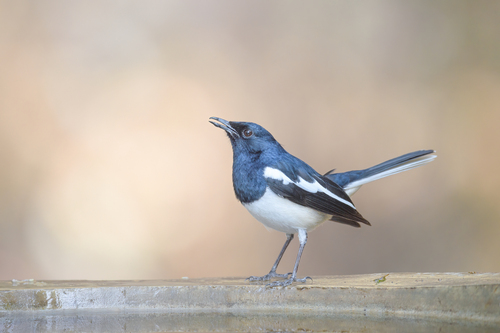
The Himalayan bluetail (Tarsiger rufilatus), also called the Himalayan red-flanked bush-robin or orange-flanked bush-robin, is a small passerine bird that was formerly classed as a member of the thrush family Turdidae, but is now more generally considered to be an Old World flycatcher of Muscicapidae. While currently under review, this taxon is not current recognized as a species by BirdLife international.

It is closely related to the red-flanked bluetail and was generally treated as a subspecies of it in the past, but as well as differing in its migratory behaviour (the red-flanked bluetail is a long-distance migrant), it also differs in the more intense blue colour of the adult males and the greyer colour of the females and juveniles.

The Himalayan bluetail is a short-distance altitudinal migrant species, breeding in the Himalaya in bush layer (dwarf rhododendron in wetter areas, deciduous bushes in drier) of conifer and mixed conifer-oak forest, main species fir (Abies) but sometimes in areas with Picea smithiana or Pinus wallichiana/Cupressus torulosa forest; at 3000–4400 m, not penetrating beyond tree-line and in winters found at 1,500–2,500... Wikipedia →

Sounds

Song0:41

China · 2026

© Yang Li · XC1146871 · CC BY-NC-SA 4.0

Call0:23

Nepal · 2023

© Marc Anderson · XC812246 · CC BY-NC-ND 4.0

Alarm call0:10

Nepal · 2011

© Timo Janhonen · XC118689 · CC BY-NC-SA 3.0

Global Distribution

Parks Where Found

# Park Country Daily sighting probability
1 Jiuzhaigou National Park 🇨🇳 China
~30%
2 Langtang National Park 🇳🇵 Nepal
~20%
3 Doi Inthanon National Park 🇹🇭 Thailand
~10%
4 Royal Manas National Park 🇧🇹 Bhutan
<5%
5 Jim Corbett National Park 🇮🇳 India
<5%

Cities Where Found

# City Country Daily sighting probability
1 Chengdu 🇨🇳 China
<5%
2 Kathmandu 🇳🇵 Nepal
<5%

Before you go

What are the chances of seeing a Himalayan Bluetail in Chengdu?

Rare

Under 5% of wildlife watchers report a Himalayan Bluetail sighting in Chengdu on a given day, based on 6 verified sightings from GBIF citizen-science data. It is the 141st most-seen of the 156 birds we can rate there. Over three days the chance rises to under 5%, and over a week to about 10%, if each day is a fresh chance.

When is the best time to see a Himalayan Bluetail in Chengdu?

Any time of year

In every month with enough records, under 5% of wildlife watchers report a Himalayan Bluetail in Chengdu on a given day, so our monthly data shows no clear season.

What time of day is best to see a Himalayan Bluetail?

Between 2 and 5 am

Across all the parks we cover, that three-hour window holds the most Himalayan Bluetail sightings with a recorded time, and about half of them come between 6 pm and 6 am: it is most active around dawn and dusk.

Is Chengdu the best place to see a Himalayan Bluetail?

Yes

Of the 2 cities where we can rate Himalayan Bluetail sightings, Chengdu has the highest daily chance: under 5%. Next come Kathmandu (Nepal, under 5%).

Where does the Himalayan Bluetail sighting chance come from?

GBIF citizen-science records

It is estimated from how often the Himalayan Bluetail is recorded against all the birds logged in Chengdu (6 verified sightings), calibrated against known sighting rates. Figures are rounded to the nearest 10% because citizen-science data supports honest approximations, not decimals, and months with records from fewer than five people show "—". How it works.

← Back to Chengdu