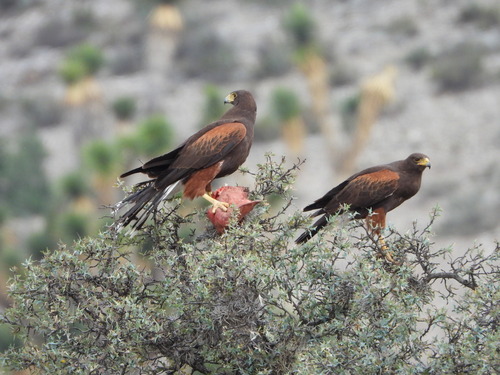
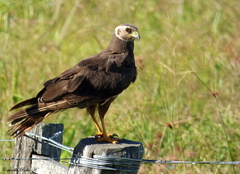
Long-winged Harrier

Long-winged Harrier

Circus buffoni

Silhouette: Shyamal · PhyloPic

LCLeast ConcernNTVUENCR
Daily sighting probability <5% · Rare
at Cochabamba

In 3 days ~10%

6 Verified sightings at Cochabamba
1,138 In all 6 parks From 2019 to 2026
November Best month
☀️ Diurnal When it's spotted

About the Long-winged Harrier

The long-winged harrier (Circus buffoni) is a common bird of prey species endemic to South America. They are members of the family Accipitridae, under the genus Circus which encompasses other harrier species. Its range encompasses most of South America, in grassland and wetland all across the continent. The long-winged harrier is a carnivorous bird, and will feed on many different animals found in its habitat.

Like owls and other harrier species, the long-winged harrier has a distinctive facial disc, which is used to triangulate the bird's hearing while it is hunting. The long-winged harrier is classified as a species of least concern by the IUCN Red List, however their population has been observed to decline due to habitat degradation by human activity.

The long-winged harrier was formally described in 1788 by the German naturalist Johann Friedrich Gmelin in his revised and expanded edition of Carl Linnaeus's Systema Naturae. He placed it with the falcons, eagles and their relatives in the genus Falco and coined the binomial name Falco buffoni. Gmelin based his description on the "Cayenne ringtail" that had been described in 1781 by the English ornithologist John Latham... Wikipedia →

Sounds

Flight call0:10

Brazil · 2023

© Douglas Meyer · XC779843 · CC BY-NC-SA 4.0

Song0:22

Brazil · 2022

© Miguel Angelo Biz · XC700093 · CC BY-NC-SA 4.0

Call0:29

Brazil · 2015

© Marcelo Villegas · XC288364 · CC BY-NC-SA 4.0

Global Distribution

Parks Where Found

# Park Country Daily sighting probability
1 Iberá National Park 🇦🇷 Argentina
~40%
2 Caroni Swamp 🇹🇹 Trinidad and Tobago
~30%
3 Emas National Park 🇧🇷 Brazil
~30%
4 Parque Estadual Encontro das Águas 🇧🇷 Brazil
~10%
5 Chapada Diamantina National Park 🇧🇷 Brazil
<5%
6 Iguaçu National Park 🇧🇷 Brazil
<5%

Cities Where Found

# City Country Daily sighting probability
1 Curitiba 🇧🇷 Brazil
~10%
2 Cochabamba 🇧🇴 Bolivia
<5%
3 Buenos Aires 🇦🇷 Argentina
<5%
4 Porto Alegre 🇧🇷 Brazil
<5%
5 Campo Grande 🇧🇷 Brazil
<5%
6 Asuncion 🇵🇾 Paraguay
<5%
7 São Paulo 🇧🇷 Brazil
<5%

Before you go

What are the chances of seeing a Long-winged Harrier in Cochabamba?

Rare

Under 5% of wildlife watchers report a Long-winged Harrier sighting in Cochabamba on a given day, based on 6 verified sightings from GBIF citizen-science data. It is the 101st most-seen of the 112 birds we can rate there. Over three days the chance rises to about 10%, if each day is a fresh chance.

When is the best time to see a Long-winged Harrier in Cochabamba?

November

In that month about 20% of wildlife watchers report a Long-winged Harrier in Cochabamba on a given day, against under 5% in December to October, the lowest months.

What time of day is best to see a Long-winged Harrier?

Between 8 and 11 am

Across all the parks we cover, that three-hour window holds the most Long-winged Harrier sightings with a recorded time, and about 9 in 10 of them come between 6 am and 6 pm: it is a daytime animal.

Is Cochabamba the best place to see a Long-winged Harrier?

2nd of 7

Of the 7 cities where we can rate Long-winged Harrier sightings, Cochabamba ranks 2nd at under 5%. The best odds are in Curitiba (Brazil, about 10%).

Which relatives of the Long-winged Harrier live in Cochabamba?

Same family: Accipitridae

The closest relatives of the Long-winged Harrier that you can see in Cochabamba (family Accipitridae, Hawks, Eagles, and Kites) are Roadside Hawk (about 40%) and Harris' Hawk (about 10%), with each one's daily chance of a sighting.

Where does the Long-winged Harrier sighting chance come from?

GBIF citizen-science records

It is estimated from how often the Long-winged Harrier is recorded against all the birds logged in Cochabamba (6 verified sightings), calibrated against known sighting rates. Figures are rounded to the nearest 10% because citizen-science data supports honest approximations, not decimals, and months with records from fewer than five people show "—". How it works.

← Back to Cochabamba