Tufted Tit-Tyrant

Tufted Tit-Tyrant

Anairetes parulus

Silhouette: Edwin Price · PhyloPic

LCLeast ConcernNTVUENCR
Daily sighting probability <5% · Rare
at Cochabamba

In 3 days ~10%

5 Verified sightings at Cochabamba
1,617 In all 6 parks From 2019 to 2026
January Best month
☀️ Diurnal When it's spotted

About the Tufted Tit-Tyrant

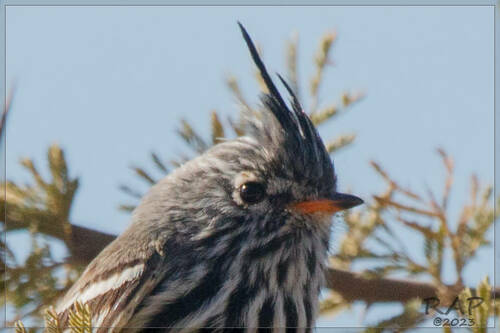
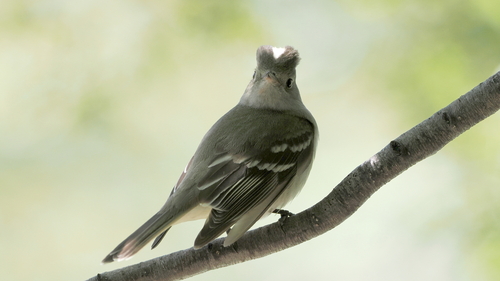
The tufted tit-tyrant (Anairetes parulus) is a species of bird in the tyrant flycatcher family Tyrannidae. This species is found in western South America; its range stretches from southern Colombia south along the Andes mountains to Tierra del Fuego. It prefers to live in upper montane forests and shrublands; however, it is a habitat generalist and can be found across a wide range of ecosystems. It is very small with a distinctive and conspicuous crest. The bird's head is black overall with white supraloral and postocular stripes. Its dull grayish-brown back contrasts with its white throat and breast that are covered with black streaks and pale, unmarked yellow underbelly. There are few noticeable differences in plumage between the subspecies. It is a vocal flycatcher with a broad repertoire of songs.

This tit-tyrant defends its territory only against other tit-tyrants and, except for the southernmost population, is non-migratory. The tufted tit-tyrant feeds mainly on a variety of insects that it hunts on or from small shrubs, typically by perch gleaning. It normally hunts in pairs. The breeding season varies for this bird depending on its geographical location. Two to three eggs are normally laid twice a year in a cup-shaped nest made of root fibers, grasses, and lichens and lined with small feathers. The tufted tit-tyrant is listed as a species of least concern due to its large range and population. Wikipedia →

Sounds

Call0:06

Ecuador · 2025

© Manuel Sánchez-Nivicela · XC1154429 · CC BY-NC-ND 4.0

Song1:15

Chile · 2025

© Marc Anderson · XC1075686 · CC BY-NC-ND 4.0

Duet1:25

Chile · 2020

© Dante Buzzetti · XC537790 · CC BY-NC-SA 4.0

Global Distribution

Parks Where Found

# Park Country Daily sighting probability
1 Vicente Pérez Rosales National Park 🇨🇱 Chile
~60%
2 Tierra del Fuego National Park 🇦🇷 Argentina
~50%
3 Nahuel Huapi National Park 🇦🇷 Argentina
~50%
4 Península Valdés 🇦🇷 Argentina
~10%
5 Torres del Paine National Park 🇨🇱 Chile
~10%
6 Lauca National Park 🇨🇱 Chile
<5%

Cities Where Found

# City Country Daily sighting probability
1 Santiago 🇨🇱 Chile
~50%
2 La Paz 🇧🇴 Bolivia
~50%
3 Quito 🇪🇨 Ecuador
~30%
4 Mendoza 🇦🇷 Argentina
<5%
5 Cochabamba 🇧🇴 Bolivia
<5%

Before you go

What are the chances of seeing a Tufted Tit-Tyrant in Cochabamba?

Rare

Under 5% of wildlife watchers report a Tufted Tit-Tyrant sighting in Cochabamba on a given day, based on 5 verified sightings from GBIF citizen-science data. It is the 108th most-seen of the 112 birds we can rate there. Over three days the chance rises to about 10%, if each day is a fresh chance.

When is the best time to see a Tufted Tit-Tyrant in Cochabamba?

January and August

In those months about 10% of wildlife watchers report a Tufted Tit-Tyrant in Cochabamba on a given day, against under 5% in February–July and September–December, the lowest months.

What time of day is best to see a Tufted Tit-Tyrant?

Between 2 and 5 pm

Across all the parks we cover, that three-hour window holds the most Tufted Tit-Tyrant sightings with a recorded time, and about 9 in 10 of them come between 6 am and 6 pm: it is a daytime animal.

Is Cochabamba the best place to see a Tufted Tit-Tyrant?

5th of 5

Of the 5 cities where we can rate Tufted Tit-Tyrant sightings, Cochabamba ranks 5th at under 5%. The best odds are in Santiago (Chile, about 50%), La Paz (Bolivia, about 50%) and Quito (Ecuador, about 30%).

Where does the Tufted Tit-Tyrant sighting chance come from?

GBIF citizen-science records

It is estimated from how often the Tufted Tit-Tyrant is recorded against all the birds logged in Cochabamba (5 verified sightings), calibrated against known sighting rates. Figures are rounded to the nearest 10% because citizen-science data supports honest approximations, not decimals, and months with records from fewer than five people show "—". How it works.

← Back to Cochabamba