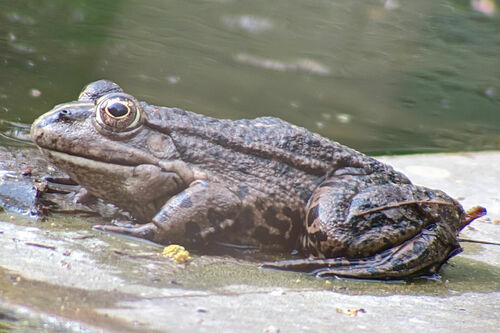
Pool Frog

Pool Frog

Pelophylax lessonae

Silhouette: Sharp Photography, sharpphotography.co.uk · PhyloPic

LCLeast ConcernNTVUENCR
Daily sighting probability ~20% · Possible
at Copenhagen

In 3 days ~40% in a week ~70%

62 Verified sightings at Copenhagen
11 In all 2 parks From 2019 to 2026
June Best month
☀️ Diurnal When it's spotted

About the Pool Frog

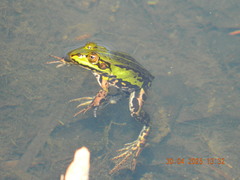
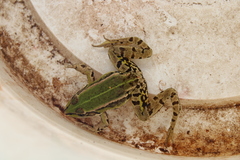
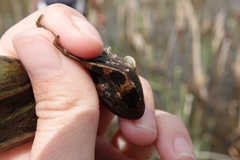
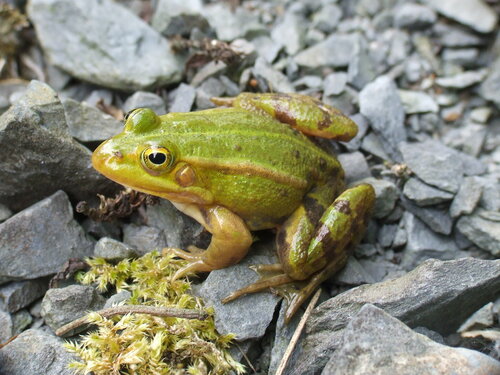
The pool frog (Pelophylax lessonae) is a species of frog in the family Ranidae. It is found in and around shallow, stagnant bodies of water across much of Europe, from France in the west to Russia in the east. Active in such areas from March to October, it disperses from the water to hibernate in woodland soil during the winter, and can tolerate being frozen overnight while hibernating. A close relative of the marsh frog, the two species can interbreed to produce a hybrid called the edible frog, which maintains its own population by breeding with one of its parental species. The pool frog is very similar in appearance to these related species, but can be distinguished based on vocal sac color, snout shape, leg length, the shape of a hardened lump on the foot, and skeletal features.

Active during both day and night, the adult pool frog is a predator that feeds mainly on invertebrates as an adult, but begins its life as a tadpole with a herbivorous diet. The breeding season is in early summer, when males use vocalisations to ward one another off and attract females. The frogs are sensitive to changes in temperature, which determines their reproductive behaviour and calls. Mating and egg-laying occur in water, where the tadpoles develop until they metamorphose and emerge onto land in late summer. At all life stages, pool frogs are hunted by a wide range of predators such as fish, birds, snakes and otters, and are parasitized by trematode and nematode worms. Tadpole development can vary based on temperature, pH, chemical exposure and the types of predators present.

Furthermore, P. l. lessonae can be split into two genetically distinct lineages that form a northern and southern clade respectively. While pool frogs as a whole are not considered to be endangered globally, populations in some countries have declined very severely. Northern clade populations are now considered critically endangered in Norway and were once wiped out from the UK, though they have since been reintroduced to the latter country. Wikipedia →
Sounds

Advertisement call0:07

France · 2026

© SWIFT Olivier · XC1156477 · CC BY-NC 4.0

Territorial call0:23

France · 2026

© Le Louaver Manuel · XC1152341 · CC BY-NC-SA 4.0

Uncertain1:01

France · 2017

© Olivier SWIFT · XC1095910 · CC BY-NC-SA 4.0

Global Distribution

Parks Where Found

# Park Country Daily sighting probability
1 Białowieża National Park 🇵🇱 Poland
~20%
2 Wadden Sea National Park 🇩🇪 Germany
<5%

Cities Where Found

# City Country Daily sighting probability
1 Copenhagen 🇩🇰 Denmark
~20%
2 Berlin 🇩🇪 Germany
~10%
3 Saint Petersburg 🇷🇺 Russia
<5%
4 Moscow 🇷🇺 Russia
<5%

Zoos & Centres Where Found

# Zoo / Centre Country
1 Parc Argonne Découverte 🇫🇷 France In captivity

Before you go

What are the chances of seeing a Pool Frog in Copenhagen?

Possible

About 20% of wildlife watchers report a Pool Frog sighting in Copenhagen on a given day, based on 62 verified sightings from GBIF citizen-science data. It is the 4th most-seen of the 9 amphibians we can rate there. Over three days the chance rises to about 40%, and over a week to about 70%, if each day is a fresh chance.

When is the best time to see a Pool Frog in Copenhagen?

June

In that month about 30% of wildlife watchers report a Pool Frog in Copenhagen on a given day, against under 5% in March and October–January, the lowest months.

What time of day is best to see a Pool Frog?

Between 1 and 4 pm

Across all the parks we cover, that three-hour window holds the most Pool Frog sightings with a recorded time, and about 8 in 10 of them come between 6 am and 6 pm: it is a daytime animal.

Is Copenhagen the best place to see a Pool Frog?

Yes

Of the 4 cities where we can rate Pool Frog sightings, Copenhagen has the highest daily chance: about 20%. Next come Berlin (Germany, about 10%) and Saint Petersburg (Russia, under 5%).

Where does the Pool Frog sighting chance come from?

GBIF citizen-science records

It is estimated from how often the Pool Frog is recorded against all the amphibians logged in Copenhagen (62 verified sightings), calibrated against known sighting rates. Figures are rounded to the nearest 10% because citizen-science data supports honest approximations, not decimals, and months with records from fewer than five people show "—". How it works.

← Back to Copenhagen