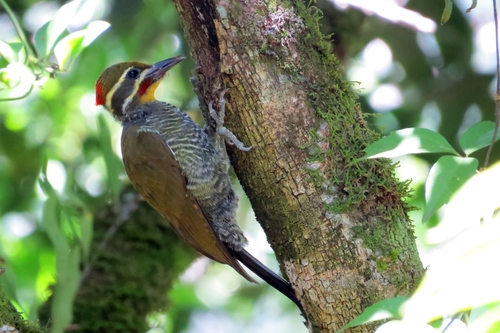
Ochre-collared Piculet

Ochre-collared Piculet

Picumnus temminckii

Silhouette: Pepe Reigada · PhyloPic

LCLeast ConcernNTVUENCR
Daily sighting probability ~10% · With luck
at Curitiba

In 3 days ~30% in a week ~60%

162 Verified sightings at Curitiba
3,774 In all 2 parks From 2019 to 2026
July Best month
☀️ Diurnal When it's spotted

About the Ochre-collared Piculet

The ochre-collared piculet (Picumnus temminckii) is a species of bird in subfamily Picumninae of the woodpecker family Picidae. It is found in Argentina, Brazil, and Paraguay. The ochre-collared piculet is monotypic. However, the species' taxonomy and that of genus Picnumnus in general are uncertain. The ochre-collared piculet is closely related to the white-barred piculet (P. cirratus) and the ocellated piculet (P. dorbignyanus) and at times these species have been treated as synonymous.

It frequently hybridizes with the white-barred piculet and occasionally with the white-wedged piculet (P. albosquamatus). The ochre-collared piculet is 9 to 10 cm (3.5 to 3.9 in) long and weighs 10 to 12.5 g (0.35 to 0.44 oz). Adult males have a black cap with red tips on the forehead feathers and small white spots on the rest of the cap. Their face is mostly rich buff-brown with a white stripe behind the eye. Their hindneck has the cinnamon-buff collar that provides its English name. Their upperparts are brown, sometimes with very faint paler bars. Their flight feathers are dark brown with narrow buff edges. Their tail is blackish; the innermost pair... Wikipedia →

Sounds

Song0:29

Brazil · 2025

© Joost van Bruggen · XC1050515 · CC BY-NC-ND 4.0

Drumming0:05

Argentina · 2022

© Marcos E. Sosa · XC1019095 · CC BY-NC-SA 4.0

Call0:17

Brazil · 2023

© JAYRSON ARAUJO DE OLIVEIRA · XC843459 · CC BY-NC-SA 4.0

Global Distribution

Parks Where Found

# Park Country Daily sighting probability
1 Iguazú National Park 🇦🇷 Argentina
~40%
2 Iguaçu National Park 🇧🇷 Brazil
~40%

Cities Where Found

# City Country Daily sighting probability
1 Curitiba 🇧🇷 Brazil
~10%
2 Santos 🇧🇷 Brazil
~10%
3 São Paulo 🇧🇷 Brazil
<5%

Before you go

What are the chances of seeing an Ochre-collared Piculet in Curitiba?

With luck

About 10% of wildlife watchers report an Ochre-collared Piculet sighting in Curitiba on a given day, based on 162 verified sightings from GBIF citizen-science data. It is the 68th most-seen of the 247 birds we can rate there. Over three days the chance rises to about 30%, and over a week to about 60%, if each day is a fresh chance.

When is the best time to see an Ochre-collared Piculet in Curitiba?

January–March and July

In those months about 20% of wildlife watchers report an Ochre-collared Piculet in Curitiba on a given day, against about 10% in April–June and August–December, the lowest months.

What time of day is best to see an Ochre-collared Piculet?

Between 8 and 11 am

Across all the parks we cover, that three-hour window holds the most Ochre-collared Piculet sightings with a recorded time, and nearly all of them come between 6 am and 6 pm: it is a daytime animal.

Is Curitiba the best place to see an Ochre-collared Piculet?

Yes

Of the 3 cities where we can rate Ochre-collared Piculet sightings, Curitiba has the highest daily chance: about 10%. Next come Santos (Brazil, about 10%) and São Paulo (Brazil, under 5%).

Which relatives of the Ochre-collared Piculet live in Curitiba?

Same family: Picidae

The closest relatives of the Ochre-collared Piculet that you can see in Curitiba (family Picidae, Woodpeckers) are Campo Flicker (about 30%), White Woodpecker (about 10%) and White-spotted Woodpecker (about 10%), with each one's daily chance of a sighting.

Where does the Ochre-collared Piculet sighting chance come from?

GBIF citizen-science records

It is estimated from how often the Ochre-collared Piculet is recorded against all the birds logged in Curitiba (162 verified sightings), calibrated against known sighting rates. Figures are rounded to the nearest 10% because citizen-science data supports honest approximations, not decimals, and months with records from fewer than five people show "—". How it works.

← Back to Curitiba