Bush Duiker

Bush Duiker

Sylvicapra grimmia

Silhouette: PhyloPic

LCLeast ConcernNTVUENCR
Daily sighting probability ~10% · With luck
at Durban

In 3 days ~20% in a week ~30%

9 Verified sightings at Durban
380 In all 10 parks From 2019 to 2026
November Best month
☀️ Diurnal When it's spotted

About the Bush Duiker

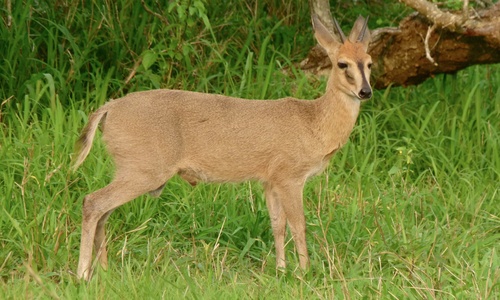
The common duiker (Sylvicapra grimmia), also known as the gray duiker or bush duiker, is a small antelope and the only member of the genus Sylvicapra. This species is found everywhere in Africa south of the Sahara, excluding the Horn of Africa and the rainforests of the central and western parts of the continent. Generally, they are found in habitats with sufficient vegetation cover to allow them to hide—savannah and hilly areas, including the fringes of human settlements.

Colouration of this species varies widely over its vast geographic range. There are 14 subspecies described, ranging from chestnut in forested areas of Angola to grizzled gray in northern savannas and light brown shades in arid regions. It grows to about 50 cm (20 in) in height and generally weighs 12 to 25 kg (26 to 55 lb); females are generally larger and heavier than the males. Only the male has horns and these can grow to 11 cm (4.3 in) long.

Breeding is year round and the female gives birth to one fawn after a gestation period of 6 to 7.5 months. The common duiker has a wide diet; beyond browsing for leaves, flowers, fruits and tubers, they will also eat insects, frogs, small... Wikipedia →
Global Distribution

Parks Where Found

# Park Country Daily sighting probability
1 Aberdare National Park 🇰🇪 Kenya
~70%
2 Bale Mountains National Park 🇪🇹 Ethiopia
~50%
3 uMkhuze Game Reserve 🇿🇦 South Africa
~30%
4 Kruger National Park 🇿🇦 South Africa
~20%
5 West Coast National Park 🇿🇦 South Africa
~20%
6 Addo Elephant National Park 🇿🇦 South Africa
~20%
7 Etosha National Park 🇳🇦 Namibia
~10%
8 iSimangaliso Wetland Park 🇿🇦 South Africa
~10%
9 Amboseli National Park 🇰🇪 Kenya
~10%
10 Hluhluwe-Imfolozi Park 🇿🇦 South Africa
~10%

Cities Where Found

# City Country Daily sighting probability
1 Lilongwe 🇲🇼 Malawi
~50%
2 Johannesburg 🇿🇦 South Africa
~10%
3 Pretoria 🇿🇦 South Africa
~10%
4 Durban 🇿🇦 South Africa
~10%
5 Cape Town 🇿🇦 South Africa
<5%

Zoos & Centres Where Found

# Zoo / Centre Country
1 San Diego Zoo 🇺🇸 United States In captivity
2 Drakenstein Lion Park 🇿🇦 South Africa In captivity
3 Bush Babies Monkey Sanctuary 🇿🇦 South Africa In captivity
4 African Dawn Bird and Wildlife Sanctuary 🇿🇦 South Africa In captivity
5 World of Birds Wildlife Sanctuary and Monkey Park 🇿🇦 South Africa In captivity
6 Animal Orphanage 🇰🇪 Kenya In captivity

Before you go

What are the chances of seeing a Bush Duiker in Durban?

With luck

About 10% of wildlife watchers report a Bush Duiker sighting in Durban on a given day, based on 9 verified sightings from GBIF citizen-science data. It is the 13th most-seen of the 15 mammals we can rate there. Over three days the chance rises to about 20%, and over a week to about 30%, if each day is a fresh chance.

When is the best time to see a Bush Duiker in Durban?

January, March and August–November

In those months about 10% of wildlife watchers report a Bush Duiker in Durban on a given day, against under 5% in February, April–July and December, the lowest months.

What time of day is best to see a Bush Duiker?

Between 6 and 9 am

Across all the parks we cover, that three-hour window holds the most Bush Duiker sightings with a recorded time, and about 7 in 10 of them come between 6 am and 6 pm: it is a daytime animal.

Is Durban the best place to see a Bush Duiker?

4th of 5

Of the 5 cities where we can rate Bush Duiker sightings, Durban ranks 4th at about 10%. The best odds are in Lilongwe (Malawi, about 50%), Johannesburg (South Africa, about 10%) and Pretoria (South Africa, about 10%).

Which relatives of the Bush Duiker live in Durban?

Same family: Bovidae

The closest relatives of the Bush Duiker that you can see in Durban (family Bovidae, Bovids) are Northern Bushbuck (about 20%), Natal Duiker (about 10%) and Impala (about 10%), with each one's daily chance of a sighting.

Where does the Bush Duiker sighting chance come from?

GBIF citizen-science records

It is estimated from how often the Bush Duiker is recorded against all the mammals logged in Durban (9 verified sightings), calibrated against known sighting rates. Figures are rounded to the nearest 10% because citizen-science data supports honest approximations, not decimals, and months with records from fewer than five people show "—". How it works.

← Back to Durban