
Yellow-Banded Amber

Yellow-Banded Amber

Acraea cabira

Daily sighting probability ~10% · With luck
at Durban

In 3 days ~30% in a week ~50%

41 Verified sightings at Durban
5 In 1 park From 2019 to 2026
May Best month
☀️ Diurnal When it's spotted

About the Yellow-Banded Amber

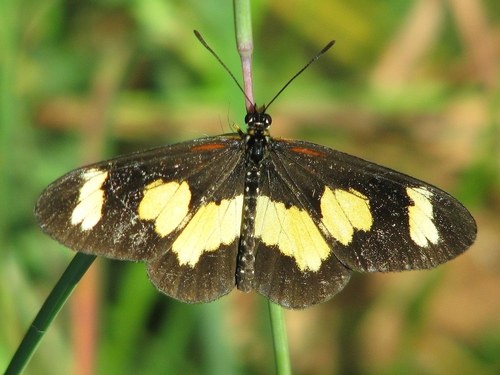
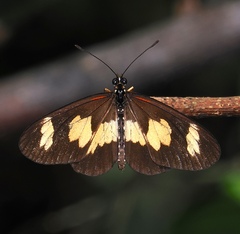
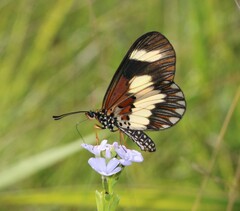
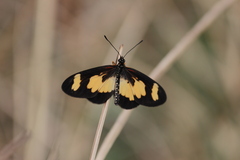
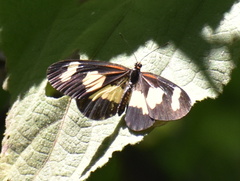
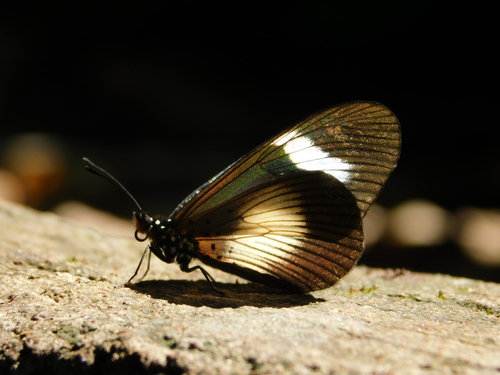
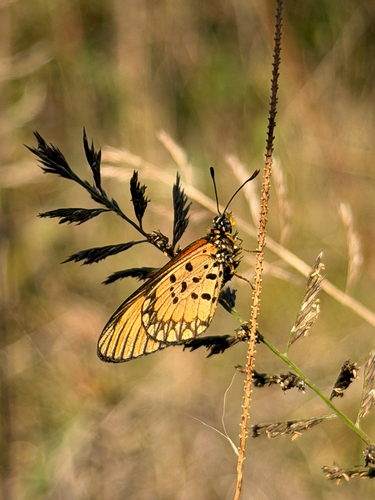
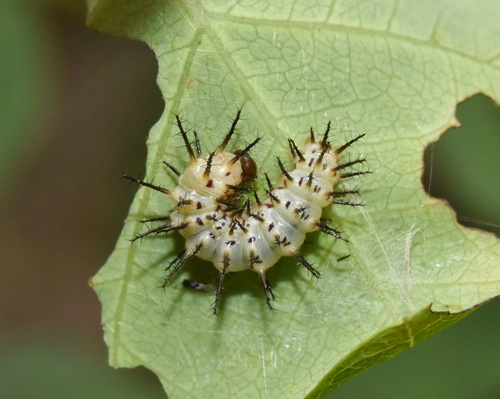
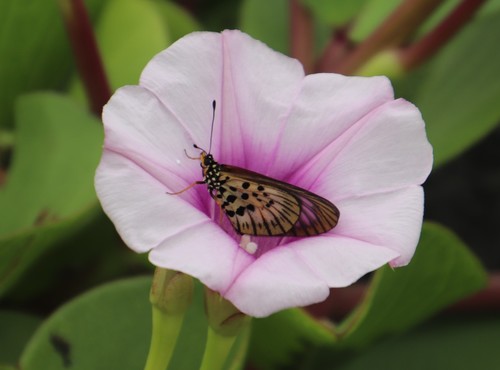
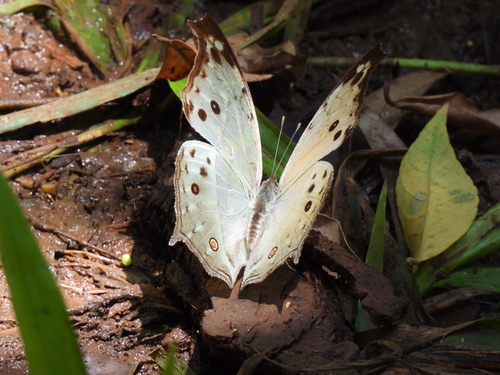
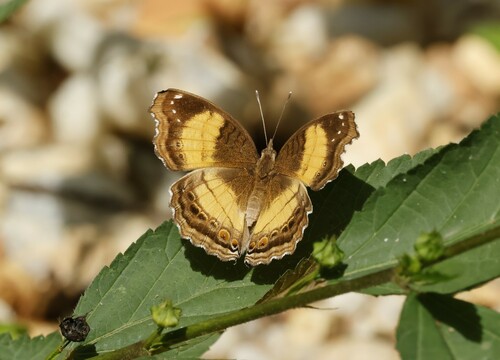
Acraea cabira, also known as the yellow-banded acraea, is a butterfly of the family Nymphalidae that is native to Africa. The wingspan is 38–44 mm (1.5–1.7 in) for males and 40–45 mm (1.6–1.8 in) for females. The male and female are very similar in colour. The upper surface of the wings is near black with large yellow patches on the forewing and hindwing. There is some reddish brown on the veins near the base of the forewings. The underside has patches of yellow corresponding to the upper side. The base of the undersurface of the wing has orange-brown markings with black spots. The margin of the wing on the undersurface has black lines on an orange-brown background.

A. cabira may be known by the hindmarginal spot on the upper side of the forewing completely covering the base of cellule 2 and reaching the cell in 1 b also; the light spot in 1 b is, however, proximally cut off obliquely and hence much narrower at vein 1 than at vein 2, so that the hindmarginal spot assumes a peculiar shape. The median band of the hind wing is widened in cellules 4 and 5 and on the under surface the hindwing has always broad red streaks in the cell and in... Wikipedia →

Global Distribution

Parks Where Found

# Park Country Daily sighting probability
1 Arusha National Park 🇹🇿 Tanzania
~20%

More parks will be added in future updates.

Cities Where Found

# City Country Daily sighting probability
1 Durban 🇿🇦 South Africa
~10%

Before you go

What are the chances of seeing a Yellow-Banded Amber in Durban?

With luck

About 10% of wildlife watchers report a Yellow-Banded Amber sighting in Durban on a given day, based on 41 verified sightings from GBIF citizen-science data. It is the 54th most-seen of the 401 insects we can rate there. Over three days the chance rises to about 30%, and over a week to about 50%, if each day is a fresh chance.

When is the best time to see a Yellow-Banded Amber in Durban?

May

In that month about 20% of wildlife watchers report a Yellow-Banded Amber in Durban on a given day, against under 5% in February, June–July and October–December, the lowest months. That is one of Durban's driest months, with about 40 mm of rain against 210 mm in January.

What time of day is best to see a Yellow-Banded Amber?

Between 11 am and 2 pm

Across all the parks we cover, that three-hour window holds the most Yellow-Banded Amber sightings with a recorded time, and about 8 in 10 of them come between 6 am and 6 pm: it is a daytime animal.

Where else can you see a Yellow-Banded Amber?

Only Durban, in our data

Durban is the only city on Wallace's Line with enough records to rate Yellow-Banded Amber sightings: about 10% of wildlife watchers there report one on a given day.

Which relatives of the Yellow-Banded Amber live in Durban?

Same genus: Acraea

The closest relatives of the Yellow-Banded Amber that you can see in Durban (genus Acraea, Acraeas) are Dusky Acraea (about 20%), Whitebar Acraea (about 20%) and Dancing Amber (about 10%), with each one's daily chance of a sighting.

Where does the Yellow-Banded Amber sighting chance come from?

GBIF citizen-science records

It is estimated from how often the Yellow-Banded Amber is recorded against all the insects logged in Durban (41 verified sightings), calibrated against known sighting rates. Figures are rounded to the nearest 10% because citizen-science data supports honest approximations, not decimals, and months with records from fewer than five people show "—". How it works.

← Back to Durban