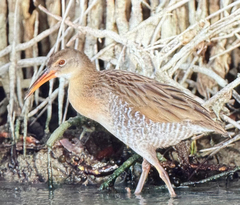
Mangrove Rail

Mangrove Rail

Rallus longirostris

Silhouette: Ferran Sayol · PhyloPic

LCLeast ConcernNTVUENCR
Daily sighting probability <5% · Rare
at Fortaleza

In 3 days ~10% in a week ~20%

10 Verified sightings at Fortaleza
46 In all 2 parks From 2019 to 2026
September Best month
☀️ Diurnal When it's spotted

About the Mangrove Rail

The mangrove rail (Rallus longirostris) is a species of bird in subfamily Rallinae of family Rallidae, the rails, gallinules, and coots. It is found in Central and South America. The mangrove rail was described by the French polymath Georges-Louis Leclerc, Comte de Buffon in 1781 in his Histoire Naturelle des Oiseaux from a specimen obtained in French Guiana. The bird was also illustrated in a hand-colored plate engraved by François-Nicolas Martinet in the Planches Enluminées D'Histoire Naturelle which was produced under the supervision of Edme-Louis Daubenton to accompany Buffon's text. Neither the plate caption nor Buffon's description included a scientific name but in 1783 the Dutch naturalist Pieter Boddaert coined the binomial name Rallus longirostris in his catalogue of the Planches Enluminées. The genus Rallus had been erected in 1758 by the Swedish naturalist Carl Linnaeus in the tenth edition of his Systema Naturae. The specific epithet longirostris combines the Latin longus meaning "long" and -rostris meaning "-billed".

The mangrove rail was formerly considered to be conspecific with what are now the Aztec rail (R. tenuirostris), Ridgway's rail... Wikipedia →

Sounds

Song0:40

Brazil · 2023

© Carlos Henrique Luz Nunes de Almeida · XC842597 · CC BY-NC-SA 4.0

Call0:09

Venezuela · 2023

Rosa Elena Albornoz · XC793741 · CC0

Duet0:21

Brazil · 2015

© Nykolas da Rocha Moreira · XC709219 · CC BY-NC-SA 4.0

Global Distribution

Parks Where Found

# Park Country Daily sighting probability
1 Caroni Swamp 🇹🇹 Trinidad and Tobago
<5%
2 Palo Verde National Park 🇨🇷 Costa Rica
<5%

Cities Where Found

# City Country Daily sighting probability
1 Fortaleza 🇧🇷 Brazil
<5%
2 Vitória 🇧🇷 Brazil
<5%
3 Rio de Janeiro 🇧🇷 Brazil
<5%

Before you go

What are the chances of seeing a Mangrove Rail in Fortaleza?

Rare

Under 5% of wildlife watchers report a Mangrove Rail sighting in Fortaleza on a given day, based on 10 verified sightings from GBIF citizen-science data. It is the 98th most-seen of the 129 birds we can rate there. Over three days the chance rises to about 10%, and over a week to about 20%, if each day is a fresh chance.

When is the best time to see a Mangrove Rail in Fortaleza?

September

In that month about 10% of wildlife watchers report a Mangrove Rail in Fortaleza on a given day, against under 5% in October to August, the lowest months. That is one of Fortaleza's driest months, with almost no rain against 240 mm in April.

What time of day is best to see a Mangrove Rail?

Between 9 am and noon

Across all the parks we cover, that three-hour window holds the most Mangrove Rail sightings with a recorded time, and about 9 in 10 of them come between 6 am and 6 pm: it is a daytime animal.

Is Fortaleza the best place to see a Mangrove Rail?

Yes

Of the 3 cities where we can rate Mangrove Rail sightings, Fortaleza has the highest daily chance: under 5%. Next come Vitória (Brazil, under 5%) and Rio de Janeiro (Brazil, under 5%).

Which relatives of the Mangrove Rail live in Fortaleza?

Same family: Rallidae

The closest relatives of the Mangrove Rail that you can see in Fortaleza (family Rallidae, Rails, Gallinules, and Coots) are Common Moorhen (about 30%), Gray-cowled Wood-Rail (about 20%) and American Purple Gallinule (about 20%), with each one's daily chance of a sighting.

Where does the Mangrove Rail sighting chance come from?

GBIF citizen-science records

It is estimated from how often the Mangrove Rail is recorded against all the birds logged in Fortaleza (10 verified sightings), calibrated against known sighting rates. Figures are rounded to the nearest 10% because citizen-science data supports honest approximations, not decimals, and months with records from fewer than five people show "—". How it works.

← Back to Fortaleza