Black Howler

Black Howler

Alouatta caraya

Silhouette: PhyloPic

LCNTNear ThreatenedVUENCR
Daily sighting probability ~20% · Possible
at Goiânia

In 3 days ~50% in a week ~80%

6 Verified sightings at Goiânia
259 In all 3 parks From 2019 to 2026
April Best month
☀️ Diurnal When it's spotted

About the Black Howler

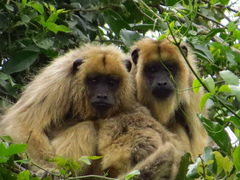
The black howler (Alouatta caraya) or black-and-gold howler, is among the largest New World monkeys and a member of the Alouatta genus. The black howler is distributed in areas of South America such as Paraguay, southern Brazil, eastern Bolivia, northern Argentina, and Uruguay. This species is sexually dimorphic, with adult males having entirely black fur and adult females and babies of both sexes having an overall golden colouring; which emphasizes black-and-gold in the name. The IUCN Red List has classed the black howler as Near Threatened as a result of a recent population reduction due to a variety of human-caused factors.

The black howler is one of nine species of the Alouatta genus that have been identified and is in the Atelidae family. Because of this species' sexual dimorphism, the taxon for the black howler has been distinguished. Alouatta caraya

Alouatta pigra Alouatta seniculus Alouatta arctoidea Alouatta sara Alouatta macconnelli Alouatta guariba Alouatta belzebul Alouatta palliata Black howlers are sexually dimorphic, the male and the female are distinguishable due to the difference in their fur coatings. As... Wikipedia →

Sounds

Recording0:42

Paraguay · 2024

© Guillermo Menéndez (gmmv80) · XC962291 · CC BY-NC-SA 4.0

Recording0:23

Brazil · 2024

© fabiana dos santos de oliveira rosin · iNaturalist · CC BY-NC 4.0

Recording0:43

Paraguay · 2024

© Guillermo Menéndez · iNaturalist · CC BY-NC 4.0

Global Distribution

Parks Where Found

# Park Country Daily sighting probability
1 Parque Estadual Encontro das Águas 🇧🇷 Brazil
~70%
2 El Impenetrable National Park 🇦🇷 Argentina
~40%
3 Iberá National Park 🇦🇷 Argentina
~40%

Cities Where Found

# City Country Daily sighting probability
1 Goiânia 🇧🇷 Brazil
~20%

Zoos & Centres Where Found

# Zoo / Centre Country
1 National Zoological Park 🇺🇸 United States In captivity
2 Cleveland Metroparks Zoo 🇺🇸 United States In captivity
3 Parque das Aves 🇧🇷 Brazil In captivity
4 Barcelona Zoo 🇪🇸 Spain In captivity
5 Greensboro Science Center 🇺🇸 United States In captivity
6 Zoo Miami 🇺🇸 United States In captivity
7 Centro de Reeducación de los Monos Carayá 🇦🇷 Argentina In captivity
8 Port Lympne Wild Animal Park 🇬🇧 United Kingdom In captivity
9 Yumka' 🇲🇽 Mexico In captivity
10 Parc zoologique de Montpellier 🇫🇷 France In captivity
11 Omaha’s Henry Doorly Zoo and Aquarium 🇺🇸 United States In captivity
12 Estación de Cría de Animales Silvestres (ECAS) 🇦🇷 Argentina In captivity
13 Banham Zoo 🇬🇧 United Kingdom In captivity
14 Los Angeles Zoo 🇺🇸 United States In captivity
15 Phoenix Zoo 🇺🇸 United States In captivity
16 Jacksonville Zoo and Gardens 🇺🇸 United States In captivity
17 Cape May County Park & Zoo 🇺🇸 United States In captivity
18 Silesian Zoological Garden 🇵🇱 Poland In captivity
19 Wildlife World Zoo 🇺🇸 United States In captivity
20 São Paulo Zoo 🇧🇷 Brazil In captivity
21 Birmingham Zoo 🇺🇸 United States In captivity
22 Audubon Zoo 🇺🇸 United States In captivity
23 Zoológico de Goiânia 🇧🇷 Brazil In captivity
24 Paignton Zoo 🇬🇧 United Kingdom In captivity
25 Temaikén 🇦🇷 Argentina In captivity
26 Gramado Zoo 🇧🇷 Brazil In captivity
27 Night Safari 🇸🇬 Singapore In captivity
28 Parque Zoobotânico Getúlio Vargas 🇧🇷 Brazil In captivity
29 Singapore Zoo 🇸🇬 Singapore In captivity
30 Wilhelma 🇩🇪 Germany In captivity
31 Houston Zoo 🇺🇸 United States In captivity
32 Zoo Opole 🇵🇱 Poland In captivity
33 Senda Verde (Wildlife Sanctuary) 🇧🇴 Bolivia In captivity
34 Mesker Park Zoo and Botanic Garden 🇺🇸 United States In captivity
35 Chapultepec Zoo 🇲🇽 Mexico In captivity
36 Hogle Zoo 🇺🇸 United States In captivity
37 Connecticut's Beardsley Zoo 🇺🇸 United States In captivity
38 Aquarama Barcelona 🇪🇸 Spain In captivity
39 Apenheul Primate Park 🇳🇱 Netherlands In captivity
40 Lincoln Park Zoo 🇺🇸 United States In captivity
41 Bauru Zoo 🇧🇷 Brazil In captivity
42 John Ball Zoo 🇺🇸 United States In captivity
43 Frankfurt Zoological Garden 🇩🇪 Germany In captivity
44 Monkeyland 🇿🇦 South Africa In captivity
45 River Wonders 🇸🇬 Singapore In captivity
46 Santa Ana Zoo 🇺🇸 United States In captivity
47 Zoológico de Fauna Sudamericana 🇧🇴 Bolivia In captivity
48 Parque Zoológico Bosque Guarani 🇧🇷 Brazil In captivity
49 Birds of Eden 🇿🇦 South Africa In captivity
50 GüiráOga 🇦🇷 Argentina In captivity

Before you go

What are the chances of seeing a Black Howler in Goiânia?

Possible

About 20% of wildlife watchers report a Black Howler sighting in Goiânia on a given day, based on 6 verified sightings from GBIF citizen-science data. Over three days the chance rises to about 50%, and over a week to about 80%, if each day is a fresh chance.

When is the best time to see a Black Howler in Goiânia?

April and December

In those months about 40% of wildlife watchers report a Black Howler in Goiânia on a given day, against under 5% in January–February and May–November, the lowest months. Those are among Goiânia's wettest months, with about 170 mm of rain a month against almost none in July.

What time of day is best to see a Black Howler?

Between 3 and 6 pm

Across all the parks we cover, that three-hour window holds the most Black Howler sightings with a recorded time, and about 9 in 10 of them come between 6 am and 6 pm: it is a daytime animal.

Where else can you see a Black Howler?

Only Goiânia, in our data

Goiânia is the only city on Wallace's Line with enough records to rate Black Howler sightings: about 20% of wildlife watchers there report one on a given day.

Which relatives of the Black Howler live in Goiânia?

Same order: Primates

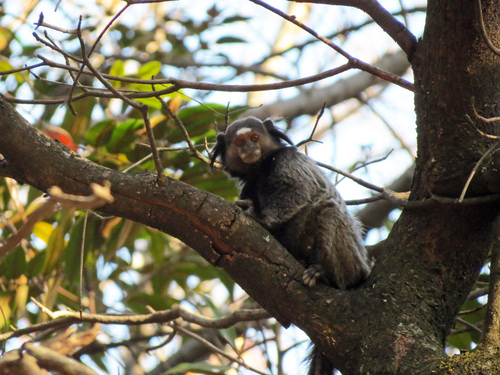
The closest relatives of the Black Howler that you can see in Goiânia (order Primates) are Black-pencilled Marmoset (about 40%) and Black-striped Capuchin (about 30%), with each one's daily chance of a sighting.

Where does the Black Howler sighting chance come from?

GBIF citizen-science records

It is estimated from how often the Black Howler is recorded against all the mammals logged in Goiânia (6 verified sightings), calibrated against known sighting rates. Figures are rounded to the nearest 10% because citizen-science data supports honest approximations, not decimals, and months with records from fewer than five people show "—". How it works.

← Back to Goiânia