Central American Indigo Snake

Central American Indigo Snake

Drymarchon melanurus

Silhouette: Alex Slavenko · PhyloPic

LCLeast ConcernNTVUENCR
Daily sighting probability ~10% · With luck
at Guayaquil

In 3 days ~30% in a week ~60%

8 Verified sightings at Guayaquil
21 In all 3 parks From 2019 to 2026
September Best month
☀️ Diurnal When it's spotted

About the Central American Indigo Snake

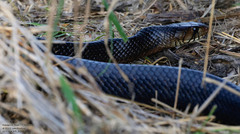
The Middle American indigo snake (Drymarchon melanurus), also known commonly as the blacktail cribo, is a species of large, nonvenomous, snake in the family Colubridae. The species is native to the southwestern United States, Mexico, Central America, and northern South America. In addition to the nominate subspecies, it has four other recognized subspecies, including D. m. erebennus, commonly known as the Texas indigo snake.

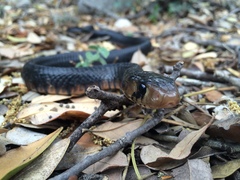
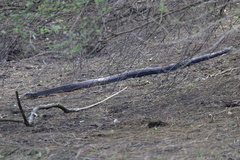
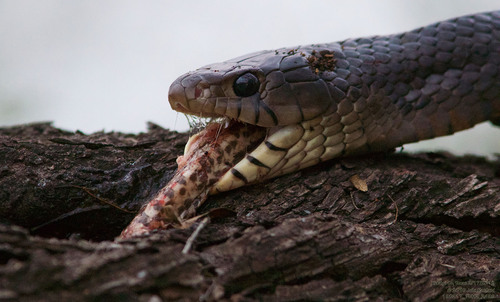
D. melanurus is a large species that can grow to a total length (including tail) of 1.80 m (6 ft) to over 2.40 m (8 ft). This species has predominantly olive-brown glossy dorsal scales evolving to black at the tail. The underside is a lighter olive-yellow, olive-tan color.

D. melanurus has distinctive dark markings round the eyes, a vertical dark slash just behind the jaw. and a heavy diagonal dark slash on both sides of the neck. The subspecies D. m. erebennus is predominantly solid black, though there can be lighter shaded variations.

The geographic range of D. melanurus extends from southern Texas southwards through the Gulf Coast of Mexico, the Yucatán Peninsula, Guatemala and Belize. On the Pacific coast... Wikipedia →
Sounds

Recording0:34

Ecuador · 2025

© bionatedu · iNaturalist · CC BY-NC 4.0

Global Distribution

Parks Where Found

# Park Country Daily sighting probability
1 Santa Rosa National Park 🇨🇷 Costa Rica
~20%
2 Calakmul Biosphere Reserve 🇲🇽 Mexico
~10%
3 Cumbres de Monterrey National Park 🇲🇽 Mexico
~10%

Cities Where Found

# City Country Daily sighting probability
1 Guayaquil 🇪🇨 Ecuador
~10%
2 Monterrey 🇲🇽 México
~10%

Zoos & Centres Where Found

# Zoo / Centre Country
1 San Diego Zoo 🇺🇸 United States In captivity
2 Zoo Miami 🇺🇸 United States In captivity
3 Omaha’s Henry Doorly Zoo and Aquarium 🇺🇸 United States In captivity
4 Central Florida Zoo and Botanical Gardens 🇺🇸 United States In captivity
5 Fort Worth Zoo 🇺🇸 United States In captivity
6 Virginia Zoological Park 🇺🇸 United States In captivity
7 Chattanooga Zoo at Warner Park 🇺🇸 United States In captivity
8 Croco Cun Zoo 🇲🇽 Mexico In captivity
9 Texas Sealife Center 🇺🇸 United States In captivity
10 Cali Zoo 🇨🇴 Colombia In captivity
11 Dubai Aquarium and Underwater Zoo 🇦🇪 United Arab Emirates In captivity
12 Snakeroom Serpentarium 🇪🇸 Spain In captivity
13 Zoológico Miguél Álvarez del Toro 🇲🇽 Mexico In captivity

Before you go

What are the chances of seeing a Central American Indigo Snake in Guayaquil?

With luck

About 10% of wildlife watchers report a Central American Indigo Snake sighting in Guayaquil on a given day, based on 8 verified sightings from GBIF citizen-science data. It is the 8th most-seen of the 8 reptiles we can rate there. Over three days the chance rises to about 30%, and over a week to about 60%, if each day is a fresh chance.

When is the best time to see a Central American Indigo Snake in Guayaquil?

September

In that month about 30% of wildlife watchers report a Central American Indigo Snake in Guayaquil on a given day, against under 5% in March, June–August and November–January, the lowest months. That is one of Guayaquil's driest months, with almost no rain against 220 mm in February.

What time of day is best to see a Central American Indigo Snake?

Between 9 am and noon

Across all the parks we cover, that three-hour window holds the most Central American Indigo Snake sightings with a recorded time, and about 9 in 10 of them come between 6 am and 6 pm: it is a daytime animal.

Is Guayaquil the best place to see a Central American Indigo Snake?

Yes

Of the 2 cities where we can rate Central American Indigo Snake sightings, Guayaquil has the highest daily chance: about 10%. Next come Monterrey (México, about 10%).

Where does the Central American Indigo Snake sighting chance come from?

GBIF citizen-science records

It is estimated from how often the Central American Indigo Snake is recorded against all the reptiles logged in Guayaquil (8 verified sightings), calibrated against known sighting rates. Figures are rounded to the nearest 10% because citizen-science data supports honest approximations, not decimals, and months with records from fewer than five people show "—". How it works.

← Back to Guayaquil