Croaking Ground-Dove

Croaking Ground-Dove

Columbina cruziana

Silhouette: Sheatherius · PhyloPic

LCLeast ConcernNTVUENCR
Daily sighting probability ~20% · Possible
at Guayaquil

In 3 days ~40% in a week ~70%

152 Verified sightings at Guayaquil
256 In 1 park From 2019 to 2026
February Best month
☀️ Diurnal When it's spotted

About the Croaking Ground-Dove

The croaking ground dove (Columbina cruziana) is a species of bird in the family Columbidae. It is found in Chile, Colombia, Ecuador, and Peru. The croaking ground dove and Picui ground dove (Columbina picui) are sometimes considered sister species. The croaking ground dove is monotypic.

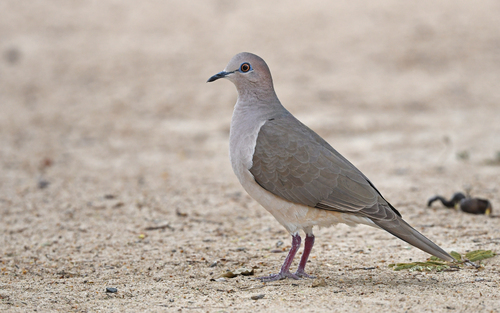
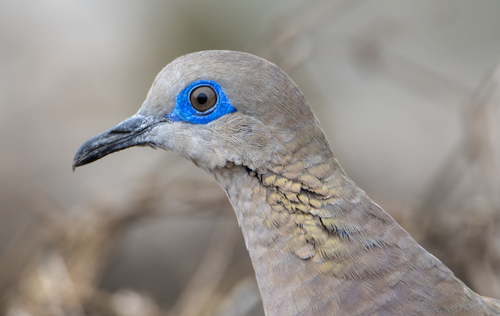
The croaking ground dove is 15 cm (5.9 in) long. Males weigh about 52 g (1.8 oz) and females 46 g (1.6 oz). The adult male's head is bluish gray, and its upperparts brownish gray. The central tail feathers are darker gray, and the outer ones black with white tips. The closed wing shows a dark bar and lines of dark spots. The breast and underparts are mauve pink. The eye is red with a white outer ring and is surrounded by bare yellow skin. Its fairly long bill is bright yellow near its base. The adult female's head is brown and the wing markings are less intense than the male's. Juveniles are similar to the female but their feathers have buffy tips.

The croaking ground dove is found near the Pacific coast from Nariño Department in extreme southwestern Colombia through Ecuador and Peru to Chile's Tarapacá Region. Its range... Wikipedia →

Sounds

Song0:09

Chile · 2019

© Cristian Pinto · XC498341 · CC BY-NC-SA 4.0

Call0:11

Ecuador · 2003

© John V. Moore · XC257617 · CC BY-NC-SA 4.0

Song0:07

Ecuador · 2018

© Leonardo Ordóñez-Delgado · XC461983 · CC BY-NC-SA 4.0

Global Distribution

Parks Where Found

# Park Country Daily sighting probability
1 Machalilla National Park 🇪🇨 Ecuador
~30%

More parks will be added in future updates.

Cities Where Found

# City Country Daily sighting probability
1 Arequipa 🇵🇪 Peru
~90%
2 Lima 🇵🇪 Peru
~60%
3 Guayaquil 🇪🇨 Ecuador
~20%

Zoos & Centres Where Found

# Zoo / Centre Country
1 Parc des oiseaux 🇫🇷 France In captivity
2 Nuremberg Zoo 🇩🇪 Germany In captivity
3 Tiergarten Am Tiergarten 28 in Nürnberg 🇩🇪 Germany In captivity
4 Budapest Zoo & Botanical Garden 🇭🇺 Hungary In captivity
5 Tiergarten Am Tiergarten 12 in Nürnberg 🇩🇪 Germany In captivity
6 Tiergarten Am Tiergarten 14 in Nürnberg 🇩🇪 Germany In captivity
7 Tiergarten Am Tiergarten 6 in Nürnberg 🇩🇪 Germany In captivity
8 Exotic Animal World 🇿🇦 South Africa In captivity

Before you go

What are the chances of seeing a Croaking Ground-Dove in Guayaquil?

Possible

About 20% of wildlife watchers report a Croaking Ground-Dove sighting in Guayaquil on a given day, based on 152 verified sightings from GBIF citizen-science data. It is the 47th most-seen of the 167 birds we can rate there. Over three days the chance rises to about 40%, and over a week to about 70%, if each day is a fresh chance.

When is the best time to see a Croaking Ground-Dove in Guayaquil?

February

In that month about 30% of wildlife watchers report a Croaking Ground-Dove in Guayaquil on a given day, against about 10% in March, June–July and September–November, the lowest months. That is one of Guayaquil's wettest months, with about 220 mm of rain against almost none in September.

What time of day is best to see a Croaking Ground-Dove?

Between 2 and 5 pm

Across all the parks we cover, that three-hour window holds the most Croaking Ground-Dove sightings with a recorded time, and about 9 in 10 of them come between 6 am and 6 pm: it is a daytime animal.

Is Guayaquil the best place to see a Croaking Ground-Dove?

3rd of 3

Of the 3 cities where we can rate Croaking Ground-Dove sightings, Guayaquil ranks 3rd at about 20%. The best odds are in Arequipa (Peru, about 90%) and Lima (Peru, about 60%).

Where does the Croaking Ground-Dove sighting chance come from?

GBIF citizen-science records

It is estimated from how often the Croaking Ground-Dove is recorded against all the birds logged in Guayaquil (152 verified sightings), calibrated against known sighting rates. Figures are rounded to the nearest 10% because citizen-science data supports honest approximations, not decimals, and months with records from fewer than five people show "—". How it works.

← Back to Guayaquil