Pacific Dove

Pacific Dove

Zenaida meloda

Silhouette: Danielle Alba · PhyloPic

LCLeast ConcernNTVUENCR
Daily sighting probability <5% · Rare
at Guayaquil

In 3 days <5% in a week ~10%

13 Verified sightings at Guayaquil
250 In all 2 parks From 2019 to 2026
February Best month
☀️ Diurnal When it's spotted

About the Pacific Dove

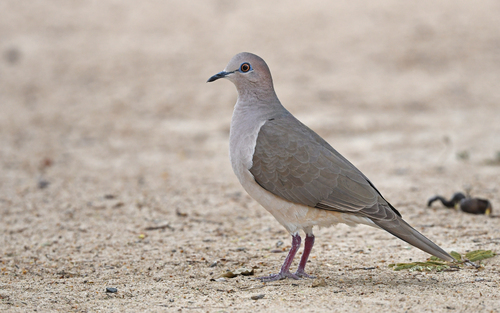
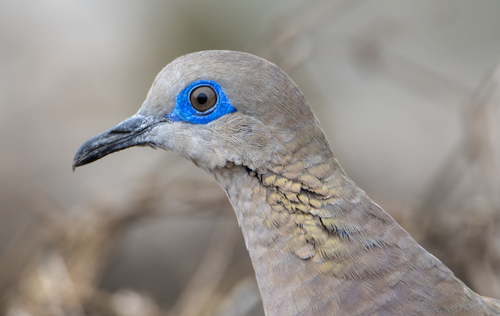
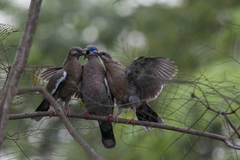
The West Peruvian dove or Pacific dove (Zenaida meloda), known locally as tórtola melódica or cuculí, is a species of dove in the genus Zenaida found on the South American Pacific coast. It was initially described by Swiss naturalist Johann Jakob von Tschudi in 1843 as Columba meloda, based upon a holotype specimen collected from a western slope of the Andes mountains in Peru. It has previously been considered conspecific with the white-winged dove (Zenaida asiatica), but has been retained as its own species based on genetic data and differences in plumage, soft part coloration, and vocalization and territorial song, which is not a learned behavior in doves.

Speciation between the white-winged dove and West Peruvian dove likely took place between 2 to 2.7 million years ago, beginning shortly after the formation of the Central American land bridge (around 3 million years ago), which enabled the dispersal of North American Zenaida doves into Central & South America and facilitated speciation.

The white-winged dove and the West Peruvian dove are each others' closest relatives, and they together form a clade which is a sister group to the rest of genus Zenaida. Wikipedia →
Sounds

Song0:17

Chile · 2021

© Ignacio Escobar · XC612342 · CC BY-NC-SA 4.0

Drumming0:43

Ecuador · 2017

© Leonardo Ordóñez-Delgado · XC513956 · CC BY-NC-SA 4.0

Wing noise0:11

Ecuador · 2003

© John V. Moore · XC257612 · CC BY-NC-SA 4.0

Global Distribution

Parks Where Found

# Park Country Daily sighting probability
1 Machalilla National Park 🇪🇨 Ecuador
~30%
2 Lauca National Park 🇨🇱 Chile
<5%

Cities Where Found

# City Country Daily sighting probability
1 Arequipa 🇵🇪 Peru
~90%
2 Lima 🇵🇪 Peru
~90%
3 Mendoza 🇦🇷 Argentina
<5%
4 Guayaquil 🇪🇨 Ecuador
<5%
5 Santiago 🇨🇱 Chile
<5%

Zoos & Centres Where Found

# Zoo / Centre Country
1 Burgers' Ocean 🇳🇱 Netherlands In captivity
2 Royal Burgers' Zoo 🇳🇱 Netherlands In captivity
3 Papiliorama 🇨🇭 Switzerland In captivity

Before you go

What are the chances of seeing a Pacific Dove in Guayaquil?

Rare

Under 5% of wildlife watchers report a Pacific Dove sighting in Guayaquil on a given day, based on 13 verified sightings from GBIF citizen-science data. It is the 125th most-seen of the 167 birds we can rate there. Over three days the chance rises to under 5%, and over a week to about 10%, if each day is a fresh chance.

When is the best time to see a Pacific Dove in Guayaquil?

February

In that month about 10% of wildlife watchers report a Pacific Dove in Guayaquil on a given day, against under 5% in March to January, the lowest months. That is one of Guayaquil's wettest months, with about 220 mm of rain against almost none in September.

What time of day is best to see a Pacific Dove?

Between 2 and 5 pm

Across all the parks we cover, that three-hour window holds the most Pacific Dove sightings with a recorded time, and nearly all of them come between 6 am and 6 pm: it is a daytime animal.

Is Guayaquil the best place to see a Pacific Dove?

4th of 5

Of the 5 cities where we can rate Pacific Dove sightings, Guayaquil ranks 4th at under 5%. The best odds are in Arequipa (Peru, about 90%), Lima (Peru, about 90%) and Mendoza (Argentina, under 5%).

Where does the Pacific Dove sighting chance come from?

GBIF citizen-science records

It is estimated from how often the Pacific Dove is recorded against all the birds logged in Guayaquil (13 verified sightings), calibrated against known sighting rates. Figures are rounded to the nearest 10% because citizen-science data supports honest approximations, not decimals, and months with records from fewer than five people show "—". How it works.

← Back to Guayaquil