Peruvian Pygmy-Owl

Peruvian Pygmy-Owl

Glaucidium peruanum

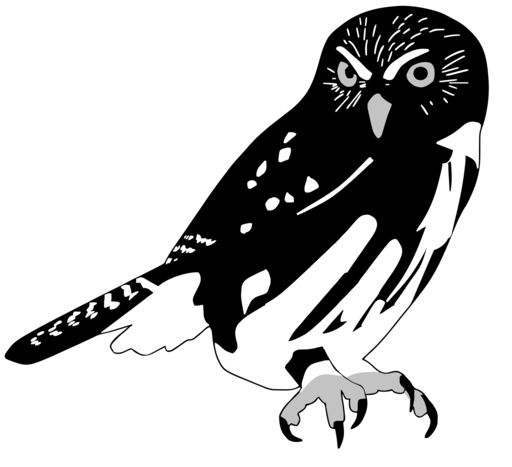
Silhouette: Edwin Price · PhyloPic

LCLeast ConcernNTVUENCR
Daily sighting probability ~20% · Possible
at Guayaquil

In 3 days ~40% in a week ~70%

145 Verified sightings at Guayaquil
238 In all 3 parks From 2019 to 2026
November Best month
☀️ Diurnal When it's spotted

About the Peruvian Pygmy-Owl

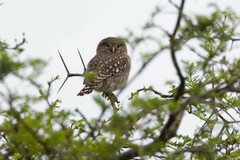
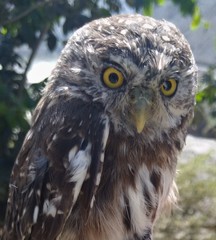
The Pacific pygmy owl (Glaucidium peruanum), or Peruvian pygmy owl, is a small "typical owl" in subfamily Surniinae. It is found in Chile, Ecuador, and Peru. The Peruvian pygmy owl was first described as a species by Claus König, a German ornithologist, in 1991. Until then it had been treated as a subspecies of the widespread ferruginous pygmy owl (G. brasilianum). König separated the two primarily by their vocal differences; their ranges do not overlap. The Pacific pygmy owl is monotypic.

The Pacific pygmy owl is 15 to 17 cm (5.9 to 6.7 in) long. Males weigh about 60 g (2.1 oz) and females about 65 g (2.3 oz). In addition to being heavier, females also have slightly longer wings and tails than males, but both sexes have the same plumage. The species has gray, brown, and rufous color morphs, with the first two predominating. The upperparts of gray morph adults are grayish brown with buff streaks on the forecrown and buff spots on the crown and nape. An incomplete white "collar" and oval black spots on the neck give the appearance of eyes. The shoulders and back have whitish spots. The tail is also grayish brown, with up to seven whitish... Wikipedia →

Sounds

Song0:27

Peru · 2024

© Pritam Baruah · XC922947 · CC BY-NC-SA 4.0

Call0:10

Peru · 2015

© Ross Gallardy · XC297078 · CC BY-NC-SA 4.0

Song1:22

Ecuador · 2020

© Leonardo Ordóñez-Delgado · XC607196 · CC BY-NC-ND 4.0

Global Distribution

Parks Where Found

# Park Country Daily sighting probability
1 Machalilla National Park 🇪🇨 Ecuador
~20%
2 Lauca National Park 🇨🇱 Chile
~10%
3 Podocarpus National Park 🇪🇨 Ecuador
<5%

Cities Where Found

# City Country Daily sighting probability
1 Guayaquil 🇪🇨 Ecuador
~20%
2 Arequipa 🇵🇪 Peru
~10%
3 Lima 🇵🇪 Peru
<5%

Zoos & Centres Where Found

# Zoo / Centre Country
1 Parque Cóndor 🇪🇨 Ecuador In captivity

Before you go

What are the chances of seeing a Peruvian Pygmy-Owl in Guayaquil?

Possible

About 20% of wildlife watchers report a Peruvian Pygmy-Owl sighting in Guayaquil on a given day, based on 145 verified sightings from GBIF citizen-science data. It is the 48th most-seen of the 167 birds we can rate there. Over three days the chance rises to about 40%, and over a week to about 70%, if each day is a fresh chance.

When is the best time to see a Peruvian Pygmy-Owl in Guayaquil?

November and December

In those months about 30% of wildlife watchers report a Peruvian Pygmy-Owl in Guayaquil on a given day, against about 10% in January and March–October, the lowest months. Those are among Guayaquil's driest months, with about 15 mm of rain a month against 220 mm in February.

What time of day is best to see a Peruvian Pygmy-Owl?

Between 7 and 10 am

Across all the parks we cover, that three-hour window holds the most Peruvian Pygmy-Owl sightings with a recorded time, and about 8 in 10 of them come between 6 am and 6 pm: it is a daytime animal.

Is Guayaquil the best place to see a Peruvian Pygmy-Owl?

Yes

Of the 3 cities where we can rate Peruvian Pygmy-Owl sightings, Guayaquil has the highest daily chance: about 20%. Next come Arequipa (Peru, about 10%) and Lima (Peru, under 5%).

Where does the Peruvian Pygmy-Owl sighting chance come from?

GBIF citizen-science records

It is estimated from how often the Peruvian Pygmy-Owl is recorded against all the birds logged in Guayaquil (145 verified sightings), calibrated against known sighting rates. Figures are rounded to the nearest 10% because citizen-science data supports honest approximations, not decimals, and months with records from fewer than five people show "—". How it works.

← Back to Guayaquil